Freedom251 › Ecommerce platforms

Spree Commerce
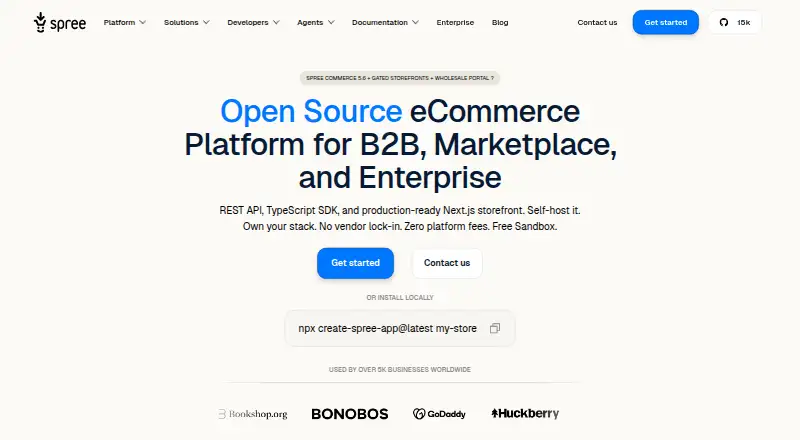
What Spree Commerce is
Spree Commerce is an open-source eCommerce platform for B2B businesses, marketplaces and enterprise commerce. It supports multi-vendor marketplaces, multi-tenant and multi-store setups, sales across regions and channels, digital products and subscriptions. Its catalog handles unlimited products and variants, product properties and rich media. Merchants can use price lists, volume tiers, customer-specific prices and time-based promotions. International commerce features include multiple currencies and languages, region-specific tax rules and EU Omnibus compliance. Developers have Store and Admin REST APIs, OpenAPI 3.0 documentation, typed TypeScript SDKs and a production-ready Next.js storefront. Payment Sessions can connect with Stripe, Adyen, PayPal or a merchant's own provider; 3D Secure and webhooks work across gateways. Community Edition can be self-hosted on cloud infrastructure or on-premises and is Docker-ready. Enterprise Edition adds features such as multi-tenant white-label commerce, approval workflows, seller synchronization with Shopify and WooCommerce, and dedicated SLA support. The site also offers free sandbox access to an instance with an admin dashboard and API, without requiring a credit card.
Who it suits
Spree Commerce suits businesses building B2B stores, multi-vendor marketplaces or multi-store commerce across regions and sales channels. It is also suited to developers who want APIs, typed TypeScript SDKs and a Next.js storefront, with a self-hosted Community Edition or enterprise support options.
What it does well
- Supports unlimited products and variants.
- Includes price lists, volume tiers and customer-specific pricing.
- Provides multi-currency and multi-language support.
- Payment Sessions connect to several named gateways or a merchant's provider.
- Community Edition can be self-hosted on cloud infrastructure or on-premises.
- Free sandbox access needs no credit card.
What to know first
- Community Edition is self-hosted.
- Dedicated SLA support is an Enterprise Edition addition.
- White-label multi-tenant commerce, approval workflows and seller sync are Enterprise additions.
Limits
Community Edition is self-hosted. Multi-tenant white-label commerce, approval workflows, Shopify and WooCommerce seller synchronization, and dedicated SLA support are listed as Enterprise Edition additions.
Plans
| Plan | Billed and limits | Price |
|---|---|---|
| Community Edition | self-hosted · open source · DTC, B2B and marketplace · Store/Admin/Seller APIs · TypeScript SDKs · CLI · webhooks | Free |
| Enterprise Edition | self-hosted or private cloud · multi-tenant · approval workflows · Shopify/WooCommerce seller sync · SLA support · enterprise license | On request |
As spreecommerce.org lists them, read 15 Oct 2026. The maker's own page has the final word.
Getting started
- Visit the Spree Commerce website.
- Use the free sandbox to access an instance with an admin dashboard and API; no credit card is required.
- Choose Community Edition or Enterprise Edition based on the listed capabilities.
- For Community Edition, self-host on cloud infrastructure or on-premises; it is Docker-ready.
- Connect a payment provider through Payment Sessions.
Spree Commerce is an open-source platform for building online commerce across business models and regions. It is best for teams that want control of their commerce stack and can support a self-hosted system. Its flexible APIs and storefront options are a strength, but the breadth brings operational work and some capabilities require Enterprise Edition.
Overview
Spree can support B2B sales, multi-vendor marketplaces, multi-store and multi-tenant commerce, multiple regions, omnichannel sales, digital products and subscriptions. That makes it a plausible base for businesses with more than one sales model or market. A straightforward store that needs a managed, ready-to-run service may find the self-hosted approach unnecessary.
The catalog handles unlimited products and variants, with product properties and rich media. Price lists, volume tiers, customer-specific pricing and time-based promotions give sellers room to tailor offers, particularly for B2B accounts. There is no transaction fee, though that does not remove the work of hosting and operating the platform.
Key features
APIs, storefront and payments
Store and Admin REST APIs, OpenAPI 3.0 documentation and typed TypeScript SDKs give development teams defined ways to integrate and extend commerce operations. A production-ready Next.js storefront offers a starting point for a custom storefront rather than requiring a team to build every layer from scratch. This developer-oriented approach suits organizations with technical capacity better than merchants seeking a no-code setup.
Payment Sessions connect to Stripe, Adyen, PayPal or a merchant’s own provider, with 3D Secure and webhooks across gateways. The integrations directory also includes Google Pay, Razorpay, Braintree and Apple Pay for payments, and Mailchimp and Klaviyo for marketing. The range helps accommodate different payment choices, but integration options still require implementation and configuration.
International commerce and security
Multi-currency and multi-language support, regional tax rules and EU Omnibus compliance address important needs for cross-border selling. Enterprise security features include encryption at rest and in transit, SSO, role-based access controls and audit logging. Spree says its architecture supports SOC 2 Type 2, ISO/IEC 27001, GDPR, CCPA, HIPAA and PCI DSS requirements; organizations should assess their own implementation against the requirements that apply to them.
Pricing
Spree uses a freemium model, with a free plan and free sandbox access to an instance with an admin dashboard and API. The sandbox requires no credit card, making it useful for evaluation before committing engineering effort. No transaction fee is charged.
- Community Edition: Price not listed. This self-hosted, open-source edition is positioned for DTC, B2B and marketplace commerce. It is the route for teams that want an open-source foundation and can manage deployment and operations themselves.
- Enterprise Edition: Custom pricing. It can be self-hosted or run in a private cloud, and is source-available with enterprise support. It adds multi-tenant white-label commerce, approval workflows, Shopify and WooCommerce seller sync, and dedicated SLA support. Support includes a success manager, SLA-backed response times, direct engineer access, long-term support releases and priority fixes.
The published plan descriptions do not give seat quotas, usage caps or a trial length. Community Edition is the clearer fit when open-source self-hosting is the priority; Enterprise is aimed at organizations that need its additional workflows, seller sync or support commitments.
Platforms
Spree is available for web and through APIs, with Android and iOS also listed as platforms. Community Edition can be self-hosted on cloud infrastructure or on-premises, and is Docker-ready. Enterprise Edition adds private-cloud hosting as an option. This deployment control is valuable to teams with hosting requirements, but it also means they take responsibility for operating their environment.
Who it's for
Spree is a strong candidate for technically capable teams building B2B commerce, marketplaces or multi-region operations, especially when they need tailored pricing, multiple stores or control over hosting and integrations. It is less suitable for merchants who prioritize a managed service, minimal setup or a store that can be served by a simpler hosted builder.
Pros and cons
- Pro: Unlimited products and variants, plus customer-specific and volume pricing, support varied catalogs and B2B selling without a stated catalog cap.
- Pro: REST APIs, typed SDKs and a production-ready Next.js storefront give developers useful building blocks for a tailored commerce experience.
- Pro: Self-hosting on cloud or on-premises gives teams deployment control, while Enterprise adds private-cloud hosting and dedicated support.
- Con: Self-hosting makes deployment and ongoing operations part of the decision; teams seeking a managed, low-effort store should look elsewhere.
- Con: Multi-tenant white-label commerce, approval workflows, seller sync and dedicated SLA support require Enterprise Edition, whose price is custom.
Alternatives
For a different open-source commerce option, consider nopCommerce, which is free and self-hosted. Choose it when those characteristics are the priority over Spree’s stated focus on B2B, marketplaces and multi-region commerce.
Wix eCommerce offers a free plan with web hosting, a drag-and-drop editor and templates, making it a better fit for merchants who want no-code design tools. Lightspeed eCom has a free-forever account and may suit readers seeking that starting point instead.
Shoptet caps its free plan at 10 products, so it is an option for a small catalog. Shopware offers a free Community Edition for readers looking for another open-source core. OroCommerce has a free-to-use customizable Community Edition designed for developers and technical teams, making it another candidate for that audience.
Spwig is another freemium platform with a free Community plan; consider it if its included storefront, admin, page builder and POS UI match your needs. Liferay Commerce has a free tier for exploration, development and pre-production, which is a distinct fit for evaluation or non-production use.
Browse Ecommerce platforms or Headless Ecommerce Platforms for more options.
Verdict
Choose Spree when you need a self-hosted foundation for complex B2B, marketplace or multi-region commerce and have the technical capacity to shape and operate it. Its APIs, pricing controls and broad commerce scope are the central reasons to choose it. Look elsewhere if you need a managed, simpler store, or if Enterprise-only workflows and support are essential but custom pricing does not fit.
Verdict
Choose Spree Commerce if you need a self-hosted platform for B2B, marketplaces or multi-region commerce and can work with its APIs and storefront options. Community Edition provides the open-source route, while teams needing dedicated SLA support, seller sync or approval workflows should consider Enterprise Edition.
Questions
Is Spree Commerce free?
A free plan and free sandbox access are listed. The sandbox provides an instance with an admin dashboard and API without requiring a credit card.
Is Spree Commerce open source?
Community Edition is open source. Enterprise Edition is described as source-available with enterprise support.
How can it be hosted?
Community Edition can be self-hosted on cloud infrastructure or on-premises, and is Docker-ready. Enterprise Edition is listed as self-hosted or private cloud.
Which payment options does it support?
Payment Sessions can connect to Stripe, Adyen, PayPal or a merchant's own provider. The integrations directory also lists Google Pay, Razorpay, Braintree and Apple Pay.
What does Enterprise Edition add?
Listed additions include multi-tenant white-label commerce, approval workflows, Shopify and WooCommerce seller sync, and dedicated SLA support.
Does Spree charge a transaction fee?
The listed transaction fee is none.
Facts from Spree Commerce's own pages
- APIs and storefront
- Spree provides Store and Admin REST APIs, OpenAPI 3.0 documentation, typed TypeScript SDKs, and a production-ready Next.js storefront. · spreecommerce.org, 7 Oct 2026
- B2B
- B2B functions include account-specific price lists, buyer organizations, approval workflows, net terms and gated catalogs. · spreecommerce.org, 15 Oct 2026
- Company headquarters
- Crunchbase lists headquarters in Bethesda, Maryland, United States. · crunchbase.com, 15 Oct 2026
- Company history
- Crunchbase says the open-source platform began in 2008 and names Brian Quinn and Sean Schofield as founders. · crunchbase.com, 15 Oct 2026
- Company legal name
- Crunchbase lists the legal entity as Spree Commerce Inc. · crunchbase.com, 15 Oct 2026
- Company size
- Crunchbase reports a company headcount range of 11 to 50 employees. · crunchbase.com, 15 Oct 2026
- Compliance
- Spree says its architecture supports SOC 2 Type 2, ISO/IEC 27001, GDPR, CCPA, HIPAA, and PCI DSS requirements. · spreecommerce.org, 7 Oct 2026
- Customer segmentation
- Customer groups can use segments, order history and custom attributes for personalized pricing and experiences. · spreecommerce.org, 15 Oct 2026
- Databases
- The documentation states that Spree works with PostgreSQL, MySQL and SQLite. · spreecommerce.org, 15 Oct 2026
- Digital products
- Yes · spreecommerce.org, 20 Sept 2026
- Documentation
- Documentation covers installation, platform concepts, catalog, checkout, fulfillment, events, webhooks, SDKs, CLI and API references. · spreecommerce.org, 15 Oct 2026
- Extensibility
- Events, webhooks, dependency injection and extension points allow components to be replaced without changing core code. · spreecommerce.org, 15 Oct 2026
- Free plan
- Yes · spreecommerce.org, 20 Sept 2026
- Free sandbox
- The site offers free sandbox access to an instance with an admin dashboard and API, with no credit card required. · spreecommerce.org, 7 Oct 2026
- Hosting
- Community Edition can be self-hosted on cloud infrastructure or on-premises, and the platform is Docker-ready. · spreecommerce.org, 7 Oct 2026
- Hosting model
- self-hosted · spreecommerce.org, 20 Sept 2026
- Installation requirements
- The create-spree-app route requires Node.js 20 or newer and Docker; manual setup uses Ruby on Rails and libvips. · spreecommerce.org, 15 Oct 2026
- Integrations
- Official integration listings include Google Pay, Razorpay, PayPal, Braintree, Stripe, Apple Pay, Shippo, USPS, Elasticsearch, Mailchimp, Klaviyo and Yotpo. · spreecommerce.org, 15 Oct 2026
- International commerce
- The platform includes multiple currencies, languages, regional tax rules, translations and EU Omnibus support. · spreecommerce.org, 15 Oct 2026
- License
- The backend uses BSD-3-Clause and frontend code uses MIT; Enterprise-only code is under a commercial license. · spreecommerce.org, 15 Oct 2026
- Limit: customization effort
- A G2 reviewer says substantial rewriting of pages and stylesheets may be needed for store personalization and that database schemas are difficult to understand. · g2.com, 15 Oct 2026
- Limit: developer cost
- A TrustRadius reviewer says supporting Spree can be expensive from a developer perspective. · trustradius.com, 15 Oct 2026
- Limit: out-of-box scope
- TrustRadius reviewers report that the platform lacks enough ready-made options and that its CMS can feel clumsy. · trustradius.com, 15 Oct 2026
- Limit: search performance
- G2 reviewers report slow searches when order or email datasets become very large. · g2.com, 15 Oct 2026
Where Spree Commerce stands on Freedom251
- Ecommerce platforms#3 of 280
- Cross Border E-Commerce Software#1 of 20
- B2C eCommerce Software#2 of 30
- Headless Ecommerce Platforms#3 of 28