Freedom251 › Speech Recognition Software
CMU Sphinx
What CMU Sphinx is
CMU Sphinx is an open-source toolkit for developers building speech applications, with PocketSphinx and SphinxTrain as its currently maintained components. PocketSphinx is a lightweight C speech recognizer library, while SphinxTrain provides acoustic model training tools. The toolkit is designed for efficient recognition on low-resource platforms and supports keyword spotting, grammar and language-model searches, and word-level segmentation. Recognition requires acoustic and language models; the project lists prebuilt models for languages including English, Chinese, French, Spanish, German, and Russian. SphinxTrain can support adding a language through data collection, cleaning, model training, and testing. Noise handling uses MFCC features, noise tracking, and spectral subtraction. The license is described as BSD-like and allows commercial distribution. Potential applications listed include voice control, language learning, transcription, closed captioning, speech translation, and voice search. The project documents offline and on-device use, including an Android library and demo, but cautions that its Android tutorial may no longer work with current tools. Input audio must be converted to PCM before processing.
Who it suits
It suits developers adding speech recognition to applications, particularly where efficient operation on low-resource platforms matters. Its documented use cases include transcription, voice control, language learning, and voice search.
What it does well
- Open-source BSD-like license permits commercial distribution.
- Supports keyword spotting and word-level segmentation.
- Designed for efficient recognition on low-resource platforms.
- Offline and on-device use are documented.
What to know first
- Recognition requires acoustic and language models.
- Audio must be converted to PCM before processing.
- The Android tutorial may not work with current tools.
- Large-vocabulary recognition is too demanding for small devices.
Limits
The toolkit is free under a BSD-like license. On phones and other small embedded devices, large-vocabulary recognition is too computationally demanding, so limited vocabularies are commonly used.
Plans
| Plan | Billed and limits | Price |
|---|---|---|
| CMU Sphinx toolkit | BSD-like license · commercial distribution allowed | Free |
As cmusphinx.github.io lists them, read 5 Oct 2026. The maker's own page has the final word.
Getting started
- Visit the CMU Sphinx website
- Choose a platform: Android, Linux, macOS, self-hosted, or Windows
- Use PocketSphinx for recognition or SphinxTrain for acoustic model training
- Select or prepare acoustic and language models for the intended language
- Convert audio to PCM before processing
Overview
CMU Sphinx is an open-source toolkit for developers building speech-recognition applications. It suits teams that want to work with recognition components and train acoustic models, especially for low-resource or on-device use. Its flexibility comes with setup work: users must supply suitable models and convert audio to PCM before decoding.
Key features
The maintained core is PocketSphinx, a lightweight C recognizer library, alongside SphinxTrain, which provides acoustic-model training tools. That combination gives developers both a recognition component and a path to train models for additional languages. The toolkit describes a workflow of collecting and cleaning data, training a model, then testing it; this is meaningful control, but not a turnkey way to add a language.
Recognition interfaces support keyword spotting, grammar and language-model searches, and word-level segmentation. MFCC features, noise tracking, and spectral subtraction address noisy audio, while real-time and offline recognition, API access, command control, speaker labeling, and on-device deployment are supported. These capabilities make Sphinx suitable for application-specific speech tasks, but recognition depends on acoustic and language models rather than language support alone. Prebuilt models are listed for languages including English, Chinese, French, Spanish, German, and Russian.
The tools are designed for efficient use on low-resource platforms. That does not make every task practical on a phone: the FAQ cautions that large-vocabulary recognition is too computationally demanding for phones and small embedded devices, where limited vocabularies are common. Decoders also do not convert encoded audio, so applications must provide PCM input.
Pricing
The CMU Sphinx toolkit costs free and is open source under a BSD-like license that allows commercial distribution. There is no paid tier to unlock the documented toolkit, and commercial distribution is permitted. Commercial support is also described. The trade-off is that developers take on model preparation, audio conversion, and integration rather than buying a managed transcription service.
Platforms
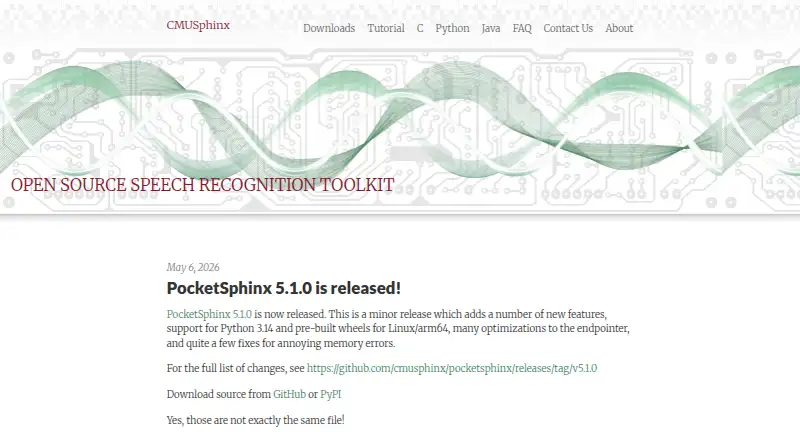
CMU Sphinx lists Android, Linux, macOS, Windows, and self-hosted deployment. PocketSphinx has a documented Android library and demo, but the tutorial warns that it has not been tested for quite some time and may no longer work with current Android tools. Linux users may also note the homepage's PocketSphinx 5.1.0 release announcement, dated May 6, 2026, which includes Python 3.14 support and prebuilt Linux/arm64 wheels.
Who it's for
This is a developer toolkit, not a finished dictation product. It fits builders of voice control, language-learning, transcription, captioning, speech-translation, or voice-search applications who need to integrate recognition and can work with models and PCM audio. Its low-resource design and on-device option are useful where local deployment matters. It is a weaker fit for teams seeking ready-to-use, large-vocabulary mobile transcription or an end-user interface.
Pros and cons
- Pros: The free, BSD-like license permits commercial distribution, making it viable for commercial applications without a toolkit license fee.
- Pros: PocketSphinx and SphinxTrain cover both recognition and acoustic-model training, with documented interfaces for several recognition modes.
- Pros: Offline and on-device options, plus a low-resource design, suit applications that need local speech processing.
- Cons: Developers must source or train models, and adding a language involves collecting, cleaning, training, and testing data.
- Cons: PCM conversion is required before decoding; encoded audio is not converted by the decoders.
- Cons: Large-vocabulary recognition is a poor match for phones and small embedded devices, and the Android tutorial may be out of date.
Alternatives
Choose SpeechRecognition instead if a free, open-source Python library with support for speech recognition through engines and APIs better matches your integration approach. Notta is a freemium option with Android, iOS, desktop, web, and extension platforms; its Free plan includes one seat and 120 transcription minutes per month, making it a better fit for users who want a transcription service rather than a model-building toolkit.
Speechmatics offers a freemium option across API, desktop, web, and self-hosted platforms, with a Free plan based on credits and limits on concurrent real-time sessions and pre-recorded files. Superwhisper has a free tier for voice-to-text in apps and meeting transcription across mobile and desktop platforms, a closer fit for ready-to-use personal dictation.
MacWhisper is a freemium choice for Apple platforms, with free transcription and subtitle export and a one-time Pro plan; choose it if that platform scope and packaged transcription better suit the job. Voice In is a browser-extension-oriented dictation alternative with a free plan offering 60 minutes per day and punctuation commands.
Amazon Transcribe is a paid API and web option with a limited free tier, worth considering when a managed transcription service fits better than integrating an open-source toolkit. AssemblyAI is another API, self-hosted, and web option, with free credits and a paid usage model. For a broader comparison, see Speech Recognition Software.
Verdict
CMU Sphinx is a strong choice for developers who want a free, commercially distributable speech-recognition toolkit with offline, on-device, and model-training options. Its main reason to choose it is the control those components provide; its main reason to look elsewhere is the work required to prepare models and PCM audio, especially if the goal is large-vocabulary mobile recognition or finished transcription software.
Verdict
CMU Sphinx offers speech-recognition components and model-training tools for developers, with documented offline and on-device options. Users need to prepare models and PCM audio, and Android users should note the tutorial's age-related warning.
Questions
Is CMU Sphinx free?
Yes. The toolkit is listed as free, and its license is described as BSD-like.
Can it be used commercially?
Yes. The license description says commercial distribution is allowed.
Which platforms does it support?
The listed platforms are Android, Linux, macOS, self-hosted, and Windows.
Does it work offline?
Yes. Offline and on-device recognition are listed capabilities.
Which languages can it recognize?
Recognition requires acoustic and language models. Prebuilt models are listed for English, Chinese, French, Spanish, German, and Russian.
Who maintains the toolkit components?
The currently maintained components are PocketSphinx, a lightweight C recognizer library, and SphinxTrain, acoustic model training tools.
Facts from CMU Sphinx's own pages
- Android support
- The site documents a PocketSphinx Android library and demo, while cautioning that the tutorial has not been tested for quite some time and may no longer work with current Android tools. · cmusphinx.github.io, 5 Oct 2026
- Commercial use
- The site describes its license as BSD-like and says it allows commercial distribution. · cmusphinx.github.io, 5 Oct 2026
- Current release
- The homepage announces PocketSphinx 5.1.0, released May 6, 2026, with Python 3.14 support and prebuilt Linux/arm64 wheels. · cmusphinx.github.io, 5 Oct 2026
- Developer audience
- The developer tutorial is intended for developers applying speech technology in applications, rather than speech-recognition researchers. · cmusphinx.github.io, 5 Oct 2026
- Input audio requirement
- The decoders do not convert encoded audio formats, so audio must be converted to PCM before processing. · cmusphinx.github.io, 5 Oct 2026
- Languages
- CMU Sphinx is language-independent, but recognition requires acoustic and language models; the site lists prebuilt models for languages including English, Chinese, French, Spanish, German, and Russian. · cmusphinx.github.io, 5 Oct 2026
- Low-resource design
- The tools are designed for efficient speech recognition on low-resource platforms. · cmusphinx.github.io, 5 Oct 2026
- Maintained components
- The currently maintained components are PocketSphinx, a lightweight C recognizer library, and SphinxTrain, acoustic model training tools. · cmusphinx.github.io, 5 Oct 2026
- Model training
- SphinxTrain provides acoustic model training tools, and the toolkit describes collecting data, cleaning it, training a model, and testing it to add a language. · cmusphinx.github.io, 5 Oct 2026
- Noise handling
- CMU Sphinx uses mel-cepstrum MFCC features with noise tracking and spectral subtraction for noise reduction. · cmusphinx.github.io, 5 Oct 2026
- Platform constraints
- The FAQ says large-vocabulary speech recognition is too computationally demanding for phones and other small embedded devices, where limited vocabularies are commonly used. · cmusphinx.github.io, 5 Oct 2026
- Purpose
- CMU Sphinx is an open-source speech recognition toolkit for building speech applications. · cmusphinx.github.io, 5 Oct 2026
- Recognition features
- The toolkit supports keyword spotting, grammar searches, language-model searches, and word-level segmentation through its documented interfaces. · pocketsphinx.readthedocs.io, 5 Oct 2026
- Support
- The site describes commercial support and directs users to GitHub project and issue trackers for help. · cmusphinx.github.io, 5 Oct 2026
- Use cases
- The tutorial lists voice control, language learning, transcription, closed captioning, speech translation, and voice search as possible applications. · cmusphinx.github.io, 5 Oct 2026
Where CMU Sphinx stands on Freedom251
- Speech Recognition Software#3 of 32