Freedom251 › Speech Recognition Software
SpeechRecognition
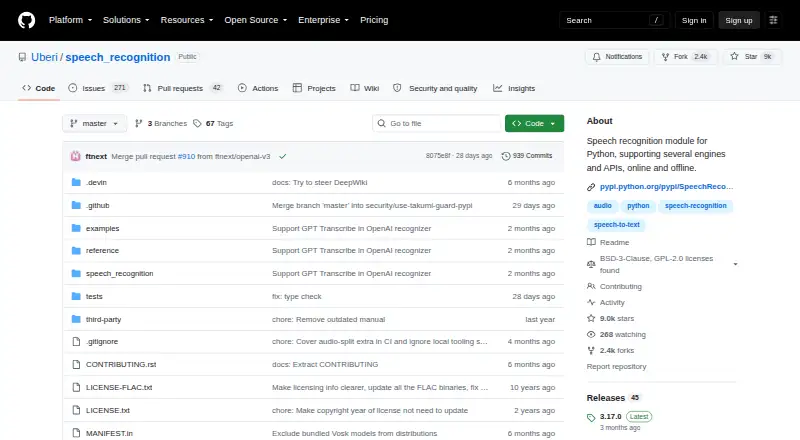
What SpeechRecognition is
SpeechRecognition is a free Python library that connects speech-recognition projects to a range of engines and APIs, with online and offline options. Supported services include CMU Sphinx, Google Speech Recognition, Google Cloud Speech API, Wit.ai, Microsoft Azure Speech, Houndify, IBM Speech to Text, Vosk, Whisper, Groq Whisper, and Cohere Transcribe. CMU Sphinx, Snowboy Hotword Detection, Vosk, and Whisper are identified as working offline. Examples cover microphone input, audio-file transcription, saving audio, extended results, ambient-noise calibration, and background microphone listening. The easiest installation method listed is `pip install SpeechRecognition`; installation from the PyPI source distribution is also described. Python 3.10 or later is required. PyAudio 0.2.11 or later is needed only for microphone input; other library features work without it. Google Cloud Speech use requires local Google credentials, while OpenAI and Groq recognizers require environment API keys. The OpenAI transcription recognizer supports compatible self-hosted endpoints such as vLLM and Ollama. The library is under the 3-clause BSD license; included FLAC binaries use GPLv2.
Who it suits
It suits Python developers building speech recognition with a choice of online, offline, or self-hosted options. Users should account for the Python requirement and any credentials or optional microphone dependency needed for their chosen recognizer.
What it does well
- Supports multiple speech engines and APIs
- Includes options identified as working offline
- Microphone input and audio-file transcription examples
- Microphone input does not require PyAudio for other features
- Supports compatible self-hosted OpenAI endpoints
What to know first
- Requires Python 3.10 or later
- Microphone input requires PyAudio 0.2.11 or later
- Google Cloud Speech API V2 is not supported
- OpenAI and Groq recognizers require environment API keys
Limits
Python 3.10 or later is required. PyAudio 0.2.11 or later is required for microphone input, and Google Cloud Speech API V2 is unsupported.
Plans
| Plan | Billed and limits | Price |
|---|---|---|
| Free/open-source library | Python library · Speech recognition through supported engines and APIs · Optional dependencies vary by feature | Free |
As github.com lists them, read 5 Oct 2026. The maker's own page has the final word.
Getting started
- Open the SpeechRecognition project website.
- Install Python 3.10 or later.
- Install the library with `pip install SpeechRecognition`, or use the PyPI source distribution.
- Install PyAudio 0.2.11 or later if you will use microphone input.
- Add local Google credentials for Google Cloud Speech, or environment API keys for OpenAI or Groq, when using those recognizers.
Verdict
SpeechRecognition offers a broad interface for speech recognition in Python, including offline and self-hosted choices. Requirements vary by feature and engine, so check the relevant dependency and credentials before choosing an option.
Questions
How much does SpeechRecognition cost?
The library is free; its listed plan is free.
Which platforms does it support?
The listed platforms are API, Linux, macOS, self-hosted, and Windows.
Can it work offline?
Yes. CMU Sphinx, Snowboy Hotword Detection, Vosk, and Whisper are identified as working offline.
Is SpeechRecognition open source?
It is available under the 3-clause BSD license. Included FLAC binaries use GPLv2.
What does microphone input require?
Microphone input requires PyAudio 0.2.11 or later. The rest of the library works without it.
Which Google Cloud Speech API versions does it support?
It supports Google Cloud Speech API V1 and does not support V2.
Facts from SpeechRecognition's own pages
- Cloud credentials
- The README requires local Google credentials for Google Cloud Speech use and environment API keys for OpenAI and Groq recognizers. · github.com, 5 Oct 2026
- Founded
- 2014 · github.com, 28 Sept 2026
- Google API limit
- The README says the library supports Google Cloud Speech API V1 and does not support V2. · github.com, 5 Oct 2026
- Input and output
- Examples cover recognizing microphone input, transcribing audio files, saving audio data, extended results, ambient-noise calibration, and background microphone listening. · github.com, 5 Oct 2026
- Installation
- The README gives `pip install SpeechRecognition` as the easiest installation method and also describes installing from the PyPI source distribution. · github.com, 5 Oct 2026
- License
- The library is available under the 3-clause BSD license; included FLAC binaries are GPLv2-licensed. · github.com, 5 Oct 2026
- Microphone requirement
- PyAudio 0.2.11 or later is required only for microphone input; the rest of the library works without it. · github.com, 5 Oct 2026
- Offline operation
- The README identifies CMU Sphinx, Snowboy Hotword Detection, Vosk, and Whisper as working offline. · github.com, 5 Oct 2026
- Purpose
- SpeechRecognition is a Python library for speech recognition with support for several engines and APIs, online and offline. · github.com, 5 Oct 2026
- Python requirement
- Python 3.10 or later is required to use the library. · github.com, 5 Oct 2026
- Recognition engines
- Supported options include CMU Sphinx, Google Speech Recognition, Google Cloud Speech API, Wit.ai, Microsoft Azure Speech, Houndify, IBM Speech to Text, Vosk, Whisper, Groq Whisper, and Cohere Transcribe. · github.com, 5 Oct 2026
- Self-hosted endpoints
- The OpenAI transcription recognizer supports OpenAI-compatible self-hosted endpoints such as vLLM and Ollama. · github.com, 5 Oct 2026
- Support
- The project asks users to report bugs and suggestions through its GitHub issue tracker. · github.com, 5 Oct 2026
Where SpeechRecognition stands on Freedom251
- Speech Recognition Software#16 of 32