Freedom251 › Speech-to-Text Software

AssemblyAI
What AssemblyAI is
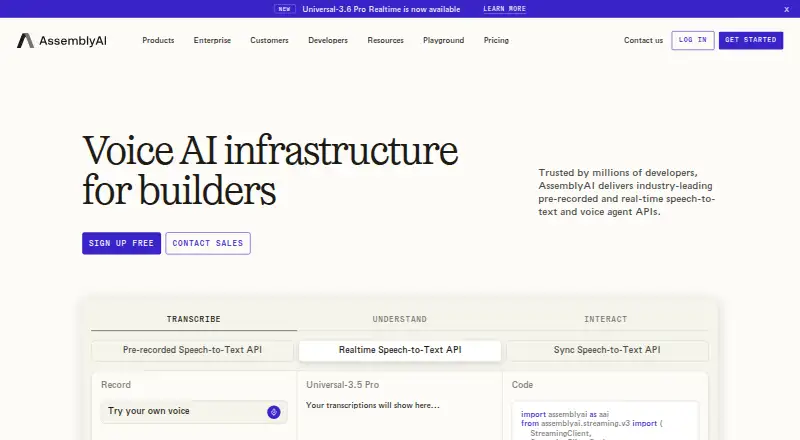
AssemblyAI provides Voice AI models and APIs for speech-to-text, speech understanding, and voice applications. Its Speech Understanding API includes speaker diarization and identification, summaries, action items, sentiment analysis, key phrases, entity and topic detection, formatting, language detection, translation, PII redaction, and content moderation. AssemblyAI states that it covers 99 languages and translates into 86. Customers can use its managed cloud or self-host models inside their own environment. Integrations include Twilio, Zoom RTMS, Zapier, LangChain, and Vercel AI SDK, while its documentation includes Python and JavaScript SDK guidance. Listed protections include TLS 1.2+ encryption in transit, AES-256 encryption at rest, zero data retention, and an option to opt out of model training. AssemblyAI states that streaming and voice-agent latency is below 300ms. A free tier includes audio credits subject to connection and transcription limits. Usage-based plans are billed monthly; listed rates include $0.15 per hour for Universal-2 and $0.45 per hour for Universal-3.6 Pro Realtime.
Who it suits
AssemblyAI may suit developers building speech-to-text, speech-understanding, or voice applications through APIs. It also offers self-hosting for customers who want to run models in their own environment.
What it does well
- Speech features include diarization, summaries, and sentiment analysis.
- States support for 99 languages.
- Offers managed-cloud and self-hosted deployment.
- Free tier includes audio credits.
- Monthly billing is based on actual usage.
What to know first
- Free tier has streaming and transcription limits.
- Universal-3.5 Pro Realtime is listed for 18 languages.
- Pay-as-you-go charges vary with usage.
Limits
Free credits include $50 in audio credits, up to five new streaming connections per minute, and five concurrent pre-recorded transcriptions. The listed free tier also specifies up to 185 hours of pre-recorded transcription and up to 333 hours of streaming transcription. Paid usage is billed monthly based on actual usage; listed model rates range from $0.15 per hour for Universal-2 to $0.45 per hour for Universal-3.6 Pro Realtime.
Plans
| Plan | Billed and limits | Price |
|---|---|---|
| Free credits | $50 in audio credits · 5 new streaming connections per minute · 5 concurrent pre-recorded transcriptions | Free |
| Pay as you go — Universal-2 | Billed monthly based on actual usage; audio is prorated to the second · 99 languages · 200+ concurrent pre-recorded transcriptions | $0.15 a month |
| Pay as you go — Universal-3.5 Pro | Billed monthly based on actual usage; audio is prorated to the second · 18 languages · 200+ concurrent pre-recorded transcriptions | $0.21 a month |
| Pay as you go — Universal-Streaming | Billed monthly based on actual usage · 5 new streams per minute on free accounts · 100+ starting sessions per minute on paid accounts | $0.15 a month |
| Pay as you go — Universal-3.5 Pro Realtime | Billed monthly based on actual usage · 18 languages · 100+ starting sessions per minute on paid accounts | $0.45 a month |
| Free tier | Up to 185 hours pre-recorded transcription · up to 333 hours streaming transcription · 5 new streaming connections per minute | Free |
| Universal-Streaming | per hour of audio · English-only realtime transcription | $0.15 a month |
| Universal-2 | per hour of audio · 99 languages · lower-price speech-to-text model | $0.15 a month |
The first 8 of 13 plans, as assemblyai.com lists them, read 20 Sept 2026. The maker's own page has the final word. Every plan
Getting started
- Visit the AssemblyAI website.
- Choose managed cloud use or self-hosted deployment.
- Use the API access and documentation, including Python or JavaScript SDK guidance.
- Start with the free credits or select a pay-as-you-go model.
- Connect through an official integration if it fits your workflow.
AssemblyAI is a developer-focused platform for adding transcription, speech analysis, and voice interactions to products through APIs or self-hosted models. It is strongest for teams that need more than a raw transcript, while model-specific language coverage and usage limits demand careful selection.
Overview
AssemblyAI combines speech-to-text, speech understanding, and voice-application tooling in one platform. Its APIs can be consumed from managed cloud deployments, while customers can also run models in their own environment. Official guidance covers Python and JavaScript SDKs, API references, cookbooks, support resources, a changelog, and a service-status page.
The service states that it handles more than 800 million API calls per month and targets sub-300ms latency for streaming and voice agents. Those figures suit production applications with realtime requirements, but they are platform claims rather than a substitute for checking your own workload and model choice.
Key features
The Speech Understanding API adds analysis around a transcript: speaker diarization and identification, summaries, action items, sentiment, key phrases, entities, topics, formatting, language detection, translation, PII redaction, and content moderation. This is a strong fit for applications that need searchable or structured conversation data; a basic transcription pipeline may not need this breadth.
AssemblyAI supports 99 transcription languages and translation into 86. Coverage varies sharply by model: Universal-2 supports 99 languages, Universal-3.5 Pro 18, and Universal-3.6 Pro Realtime 32. Realtime options are narrower: Universal-Streaming is English-only, while Universal-Streaming Multilingual covers English, Spanish, German, French, Portuguese, and Italian. Verify the selected model before committing to a multilingual product.
Speaker labels and timestamps support captioning and dialogue workflows, with SRT and VTT exports. Integrations include LiveKit, Pipecat, OpenRouter, Zapier, Make, n8n, Postman, Recall.ai, Zoom RTMS, Telnyx, Twilio, Amazon Connect, Genesys Cloud, LangChain, Vercel AI SDK, Power Automate, Semantic Kernel, Cloudflare, Bubble, Pipedream, and Drupal. Security controls include TLS 1.2+ in transit, AES-256 at rest, zero data retention, and an option to opt out of model training. AssemblyAI also maintains an annually audited SOC 2 Type 2 report and conducts annual third-party penetration tests.
Pricing
Pay-as-you-go billing has no minimum commitment, upfront fee, contract, or monthly subscription requirement; invoices are generated monthly for prior usage and audio is prorated to the second where stated. The free tier provides up to 185 hours of pre-recorded transcription, up to 333 hours of streaming transcription, $50 in audio credits, five new streaming connections per minute, and five concurrent pre-recorded transcriptions. These caps make it useful for prototypes, but sustained or concurrent production use requires a paid account.
- Universal-2 — $0.15 per month, billed monthly on actual usage: 99 languages and 200+ concurrent pre-recorded transcriptions. It is the lower-price broad-language choice.
- Universal-3.5 Pro — $0.21 per month, billed monthly on actual usage: 18 languages and 200+ concurrent pre-recorded transcriptions, with custom rate limits available. Choose it when that model's language set and higher rate fit your quality or throughput needs.
- Universal-Streaming — $0.15 per month, billed per hour of audio: English-only realtime transcription. Paid accounts start at 100+ sessions per minute; free accounts get five new streams per minute.
- Universal-Streaming Multilingual — $0.15 per month, billed per hour: English, Spanish, German, French, Portuguese, and Italian.
- Universal-3.6 Pro Realtime — $0.45 per month, billed per hour: 32 languages, context carryover, and conversation memory.
- Voice Agent API — $4.50 per month, billed per hour of connected conversation time: managed orchestration and hosting without per-layer add-ons or concurrency fees.
The published rates are usage charges despite the plan labels showing “per month”; budget from audio or conversation hours rather than treating them as fixed subscriptions.
Platforms
AssemblyAI is offered through API, web, and self-hosted deployment. That range accommodates cloud-first teams and organizations that need models inside their own environment.
Who it's for
Choose AssemblyAI for a product team building transcription, captions, call analysis, searchable recordings, or realtime voice agents and wanting one API surface for recognition and post-transcription intelligence. It is particularly suitable when speaker labeling, timestamps, security controls, integrations, or self-hosting matter. Look elsewhere if you need a narrowly focused end-user transcription app or if your required language is absent from the chosen model.
Pros and cons
- Pro: Speech understanding includes diarization, summaries, action items, sentiment, entities, redaction, and moderation, reducing the need to assemble separate analysis services.
- Pro: Self-hosting, zero data retention, encryption, SOC 2 Type 2 auditing, and penetration testing support stricter deployment and privacy requirements.
- Pro: Usage billing without commitments lets a prototype scale without a subscription obligation.
- Con: Language counts differ substantially between models, and realtime choices are especially limited compared with the headline 99-language coverage.
- Con: Free-account concurrency and streaming-connection caps can restrict demonstrations or bursty workloads.
- Con: The number of capabilities and model rates makes architecture and cost planning more involved than with a single-purpose transcription tool.
Alternatives
For a broader directory comparison, see Podcast Transcription Software, Transcription Software, Speech-to-Text Software, Audio Transcription Software, and Speech Recognition Software.
- Simon Says is a freemium option with extension, iOS, macOS, self-hosted, web, and Windows apps, plus pay-as-you-go billing at $15 per month ($15 per hour).
- Happy Scribe suits users wanting freemium access across Android, API, iOS, and macOS, with a free plan that includes unlimited meeting recordings capped at 45 minutes per recording and a 10-minute AI trial.
- OpenWhispr is a free cross-platform option with 2,000 words per week, five hours of meeting recordings monthly, and unlimited local AI models.
- Speechmatics offers a free $100 credit allowance, two concurrent realtime sessions, and ten pre-recorded files per second for API, desktop, web, and self-hosted use.
- mercuryScribe is free and open-source under the MIT license for personal, academic, or commercial use.
- Rev provides English-only free transcription with 45 AI minutes per month and five files at once, aimed at a simpler transcription workflow.
- AudioPod AI combines transcription with audio-generation credits through API, iOS, and web apps.
- Whipscribe offers a free first transcript, with 99+ languages auto-detected and later files starting at $2.
Verdict
AssemblyAI is a strong choice for developers who need speech recognition plus structured understanding, realtime options, and deployment flexibility under usage-based billing. Choose another service when a simpler end-user workflow, open-source distribution, or a model with wider realtime language coverage better matches your application.
Verdict
AssemblyAI offers a broad set of speech capabilities and usage-based plans, with a free tier subject to stated limits. Compare the language coverage and rates for each model to the needs of your application.
Questions
Is AssemblyAI free?
Yes. Its free credits plan is priced at $0 and includes $50 in audio credits, with connection and transcription limits.
How is paid usage priced?
Pay-as-you-go plans are billed monthly based on actual usage, with audio prorated to the second for listed plans. Listed rates include $0.15 per hour for Universal-2 and $0.45 per hour for Universal-3.6 Pro Realtime.
Which languages does it support?
AssemblyAI states that transcription covers 99 languages and translation is available into 86. Individual model language coverage varies; for example, Universal-3.5 Pro lists 18 languages.
Can AssemblyAI be self-hosted?
Yes. Customers can use its managed cloud or self-host models inside their own environment.
What integrations are available?
Official integrations include LiveKit, Zapier, Twilio, LangChain, Vercel AI SDK, and many others, including Zoom RTMS, Make, n8n, and Drupal.
What security provisions are listed?
AssemblyAI lists TLS 1.2+ encryption in transit, AES-256 encryption at rest, zero data retention, and an option to opt out of model training.
Facts from AssemblyAI's own pages
- API access
- Yes · assemblyai.com, 20 Sept 2026
- Billing
- Pay-as-you-go billing has no minimum commitments, upfront fees, contracts, or monthly subscription requirement, and invoices are generated monthly for prior usage. · assemblyai.com, 1 Oct 2026
- Compliance
- AssemblyAI maintains an annually audited SOC 2 Type 2 report and conducts annual third-party penetration tests. · assemblyai.com, 1 Oct 2026
- Deployment
- Customers can run AssemblyAI in its managed cloud or self-host the models inside their own environment. · assemblyai.com, 1 Oct 2026
- Developer support
- AssemblyAI provides documentation, an API reference, cookbooks, support resources, a changelog, and a service-status page. · assemblyai.com, 1 Oct 2026
- Export formats
- SRT,VTT · assemblyai.com, 20 Sept 2026
- Free plan
- No · assemblyai.com, 20 Sept 2026
- Integrations
- Official integrations include LiveKit, Pipecat, OpenRouter, Zapier, Make, n8n, Postman, Recall.ai, Zoom RTMS, Telnyx, Twilio, Amazon Connect, Genesys Cloud, LangChain, Vercel AI SDK, Power Automate, Semantic Kernel, Cloudflare, Bubble, Pipedream, and Drupal. · assemblyai.com, 1 Oct 2026
- Languages supported
- 99 · assemblyai.com, 20 Sept 2026
- Language coverage
- The platform states coverage across 99 languages and translation into 86 languages. · assemblyai.com, 1 Oct 2026
- Latency
- AssemblyAI states sub-300ms latency for streaming and voice agents. · assemblyai.com, 1 Oct 2026
- Scale
- AssemblyAI states that its platform processes more than 800 million API calls per month. · assemblyai.com, 1 Oct 2026
- SDKs
- Official documentation provides Python and JavaScript SDK guidance. · assemblyai.com, 1 Oct 2026
- Security
- AssemblyAI offers TLS 1.2+ encryption in transit, AES-256 encryption at rest, zero data retention, and an opt-out from model training. · assemblyai.com, 1 Oct 2026
- Speaker identification
- Yes · assemblyai.com, 20 Sept 2026
- Speech features
- Its Speech Understanding API supports speaker diarization, speaker identification, summarization, action items, sentiment analysis, key phrases, entity detection, topic detection, formatting, language detection, translation, PII redaction, and content moderation. · assemblyai.com, 1 Oct 2026
- Timestamp support
- Yes · assemblyai.com, 20 Sept 2026
- What it does
- AssemblyAI provides Voice AI models and APIs for speech-to-text, speech understanding, and voice applications. · assemblyai.com, 1 Oct 2026
Where AssemblyAI stands on Freedom251
- Speech-to-Text Software#2 of 35
- Transcription Software#3 of 46
- Podcast Transcription Software#2 of 25
- Audio Transcription Software#4 of 35
- Speech Recognition Software#4 of 32
- Transcription tools#5 of 28
- AI transcription tools#9 of 46