Freedom251 › Cloud Security Posture Management Software
CloudSploit
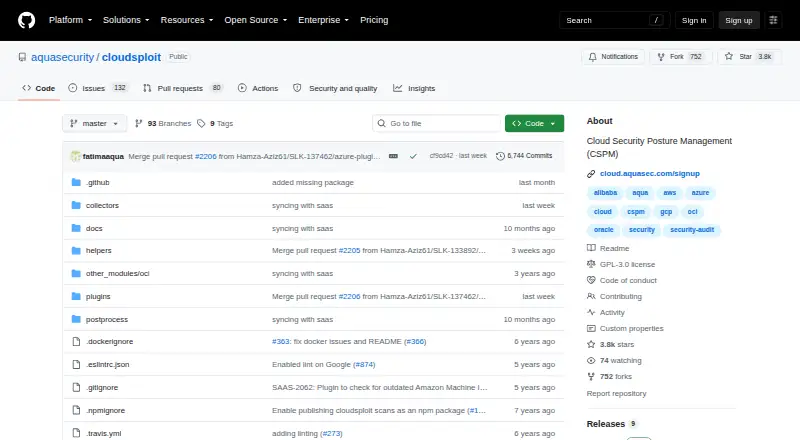
What CloudSploit is
CloudSploit is an open-source project that scans cloud accounts for potential misconfigurations, risks, and other security issues. It uses read-only access to collect account metadata through infrastructure APIs, then checks that data. Supported accounts include AWS, Microsoft Azure, Google Cloud Platform, Oracle Cloud Infrastructure, and GitHub. The project offers a free, self-hosted version, while a commercial version is hosted at Aqua Wave. Its setup instructions cover installing NodeJS and running npm install; Docker build and run commands are also provided. The command-line interface can map findings to HIPAA, PCI, and CIS Level 1 and Level 2 requirements. Results can be printed in the console or written as CSV, JSON, or JUnit XML. For CI/CD use, the CLI can return a non-zero status when it finds results that do not pass. AWS GovCloud and AWS China are among its region options. CloudSploit runs on Linux and is also listed for web use. Its repository uses the GPL-3.0 license. Listed capabilities include multi-cloud support, cloud asset inventory, automated remediation, and Kubernetes security.
Who it suits
CloudSploit suits teams that want to scan several cloud providers using a self-hosted, open-source project. Its compliance mappings, output formats, and non-zero status option can also suit teams incorporating cloud checks into CI/CD workflows.
What it does well
- Scans AWS, Azure, Google Cloud, Oracle Cloud, and GitHub accounts.
- Requires read-only access to scanned cloud accounts.
- Supports HIPAA, PCI, and CIS Level 1 and Level 2 mappings.
- Exports results as CSV, JSON, or JUnit XML.
- Can return a non-zero status for non-passing results.
- Free self-hosted version is licensed under GPL-3.0.
What to know first
- The commercial Aqua Wave version has no listed price.
- The project requires NodeJS or Docker setup for self-hosting.
- Image scanning, runtime protection, and identity security are not included.
Limits
The free plan is the self-hosted open-source version. Image scanning, posture management, runtime protection, admission control, and identity security are listed as unavailable; managed Kubernetes is listed as none.
Plans
| Plan | Billed and limits | Price |
|---|---|---|
| Open-source CloudSploit | Self-hosted open-source version | Free |
| Hosted at Aqua Wave | Commercial hosted version; pricing not stated | On request |
As github.com lists them, read 7 Oct 2026. The maker's own page has the final word.
Getting started
- Open the CloudSploit GitHub website.
- Choose the self-hosted open-source version or the commercial version hosted at Aqua Wave.
- For the self-hosted version, install NodeJS and run npm install as instructed in the README.
- Alternatively, use the Docker build and run commands provided in the README.
- Grant read-only permission to the cloud account to be scanned.
Overview
CloudSploit scans cloud accounts for configuration risks by collecting metadata through provider APIs. It is a strong fit for teams able to run and maintain an open-source command-line scanner, especially those checking several cloud providers. Its appeal is broad account coverage at no software cost; teams needing runtime defense or identity security should choose a broader tool.
Key features
CloudSploit supports AWS, Microsoft Azure, Google Cloud Platform, Oracle Cloud Infrastructure, and GitHub accounts. It uses read-only permissions to collect account metadata and identify potential misconfigurations and other security issues. That keeps the scanner from needing write access, while teams remain responsible for deciding how to address findings.
Checks map to HIPAA, PCI, and CIS Level 1 and Level 2 requirements. Results can be printed to the console or saved as CSV, JSON, or JUnit XML. The CLI can return a non-zero status when results do not pass, giving CI/CD pipelines a way to flag findings. AWS GovCloud and China region options also make it relevant to teams operating in those environments.
The project includes cloud asset inventory, Kubernetes security, and automated remediation. Setup uses NodeJS and npm install; Docker build and run commands offer another deployment route. Those options suit teams comfortable managing their own installation. The project is licensed under GPL-3.0.
Pricing
Open-source CloudSploit: free. The self-hosted version gives teams the scanner without a software charge. It is best suited to organizations that can handle deployment and ongoing operation themselves.
Hosted at Aqua Wave: custom pricing. The commercial hosted version is an option for teams that prefer a hosted deployment. Its price is custom, so buyers should compare a quote against the effort of running the open-source version.
Platforms
CloudSploit is available for Linux, web, and self-hosted deployment. Its documented NodeJS installation and Docker commands provide workable setup paths for teams that already manage command-line tools or containers.
Who it's for
Choose CloudSploit if you need to inspect accounts across multiple cloud providers, map checks to compliance frameworks, or feed findings into CI/CD, and have the capacity to run a self-hosted tool. Its read-only scanning and machine-readable output make it practical for recurring configuration checks. It is a weaker fit for teams seeking image scanning, runtime protection, admission control, or identity security.
Pros and cons
- Pros: Supports five account types across major cloud providers and GitHub, so one scanner can cover a varied cloud estate.
- Pros: Compliance mappings and CSV, JSON, and JUnit XML output support audits and automated workflows.
- Pros: Free self-hosted use and read-only scan permissions keep software cost and required account access low.
- Cons: Self-hosting requires teams to install and operate the tool.
- Cons: No image scanning, runtime protection, admission control, or identity security; teams needing those controls will need other products.
Alternatives
For Kubernetes-focused policy checks, Fairwinds Polaris offers a free open-source policy engine aimed at small teams. Kubescape is another free self-hosted option, with a CLI and Kubernetes operator under the Apache 2.0 license. Kyverno is a free open-source project under Apache License 2.0.
Monokle is a free desktop option with an open-source MIT license. Falco is a free, open-source Linux and self-hosted option. KSPM Pro has a free tier for one Kubernetes cluster with real-time scans and CIS coverage. KubeArmor is a free open-source runtime security project. KubeLinter is a free Apache-licensed option with no paid tiers listed.
Explore Kubernetes Security Software, Cloud Security Posture Management Software, Security Configuration Management Software, Container Security Software, or Infrastructure Testing Tools for more options. LLM Evaluation Tools is another directory category.
Verdict
CloudSploit is a sensible choice for technically equipped teams that want free, self-hosted, multi-cloud configuration scanning with compliance mappings and CI/CD-friendly output. Its account coverage and flexible output are useful strengths, but its missing runtime, image, admission-control, and identity capabilities set a clear boundary: choose another product if you need protection beyond configuration checks.
Verdict
Choose CloudSploit if you want a free, self-hosted way to scan accounts across multiple cloud providers, with compliance mappings and CI/CD-friendly output. Teams looking for image scanning, runtime protection, or identity security should look elsewhere based on its listed capabilities.
Questions
Is CloudSploit free?
The self-hosted open-source plan is free. A commercial version is hosted at Aqua Wave, with no price listed.
Which cloud accounts can it scan?
It lists AWS, Microsoft Azure, Google Cloud Platform, Oracle Cloud Infrastructure, and GitHub as supported accounts.
What platforms does CloudSploit support?
It is listed for Linux, web, and self-hosted deployment.
Is CloudSploit open source?
Yes. The repository lists the project under the GPL-3.0 license.
Which compliance mappings are available?
The CLI supports HIPAA, PCI, and CIS Level 1 and Level 2 mappings.
How can I install it?
The README instructs users to install NodeJS and run npm install. It also provides Docker build and run commands.
Facts from CloudSploit's own pages
- Access required
- CloudSploit requires read-only permission to the cloud account it scans. · github.com, 7 Oct 2026
- AWS regions
- The CLI includes AWS GovCloud and AWS China options. · github.com, 7 Oct 2026
- CI/CD use
- The CLI can exit with a non-zero status when it finds non-passing results, which the README identifies as useful for CI/CD systems. · github.com, 7 Oct 2026
- Cloud providers
- The project lists AWS, Microsoft Azure, Google Cloud Platform, Oracle Cloud Infrastructure, and GitHub as supported accounts. · github.com, 7 Oct 2026
- Compliance mappings
- The CLI supports HIPAA, PCI, and CIS Level 1 and Level 2 compliance mappings. · github.com, 7 Oct 2026
- Deployment
- The project documents a self-hosted open-source version and a commercial version hosted at Aqua Wave. · github.com, 7 Oct 2026
- Docker
- The README provides Docker build and run commands for CloudSploit. · github.com, 7 Oct 2026
- Founded
- 2015 · github.com, 28 Sept 2026
- Headquarters
- Boston, Massachusetts, United States and Ramat Gan, Israel · github.com, 28 Sept 2026
- Installation
- The README instructs users to install NodeJS and run npm install for setup. · github.com, 7 Oct 2026
- License
- The GitHub repository lists the project under the GPL-3.0 license. · github.com, 7 Oct 2026
- Output formats
- Results can be written as CSV, JSON, or JUnit XML, or printed to the console. · github.com, 7 Oct 2026
- Purpose
- CloudSploit is an open-source project for detecting potential misconfigurations and security risks in cloud infrastructure accounts. · github.com, 7 Oct 2026
- Scanning process
- It collects account metadata through cloud infrastructure APIs, then scans the collected data for potential misconfigurations, risks, and other security issues. · github.com, 7 Oct 2026