Freedom251 › Cloud Workload Protection Platforms

Falco
What Falco is
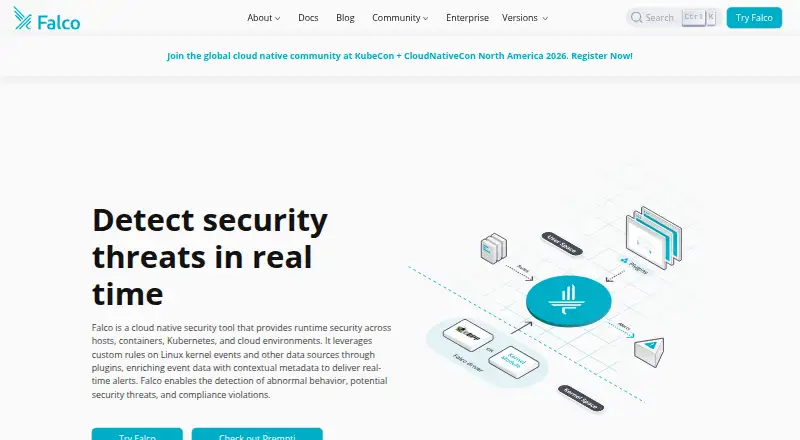
Falco is a free, open source runtime security project for Linux and self-hosted environments. It monitors hosts, containers, Kubernetes, and cloud environments for abnormal activity, potential threats, and compliance violations in real time. It checks events against built-in rules, and users can write custom rules for their environments. Its event sources include Linux kernel system calls, Kubernetes audit logs, AWS CloudTrail, and events from services such as GitHub and Okta. For kernel monitoring, Falco uses an eBPF driver by default and also offers a kernel module for wider compatibility. Installation options include Linux hosts, Docker containers, and Kubernetes, with official Helm charts; supported architectures are x86_64 and ARM64. Falcosidekick can forward events to more than 50 systems, including email, chat, message queues, serverless functions, and databases. Falco is hosted by the CNCF and is described as a graduated project. Detection depends on having appropriate rules in place, and resource use varies with server load and workload, so the project recommends checking performance in the target environment.
Who it suits
Falco suits teams running Linux hosts, containers, Kubernetes, or cloud environments that want runtime event monitoring. It is a fit for users prepared to maintain appropriate detection rules and assess resource use in their own workloads.
What it does well
- Free and open source.
- Monitors hosts, containers, Kubernetes, and cloud environments.
- Supports built-in and custom detection rules.
- Falcosidekick forwards events to more than 50 systems.
- Offers Linux, Docker, and Kubernetes deployment options.
What to know first
- Detection depends on appropriate rules being in place.
- Resource use varies with server load and workload.
- Enterprise support and detection rules are partner offerings with no listed prices.
Plans
| Plan | Billed and limits | Price |
|---|---|---|
| Falco | Zero cost to start · open source | Free |
As falco.org lists them, read 4 Oct 2026. The maker's own page has the final word.
Falco is a free, open-source runtime security project for Linux hosts, containers, Kubernetes and cloud environments. It best suits teams able to run and tune self-hosted security tooling. Its varied event sources are a strong foundation, but useful detection depends on suitable rules and workload-specific performance checks.
Overview
Falco compares events with built-in rules and rules teams create, looking for abnormal behavior, potential threats and compliance violations in real time. That makes it adaptable to different environments, but it is not an automatic catch-all: teams must ensure their rules cover the activity they care about.
Hosted by the CNCF and described as a graduated project, Falco is open source. The core project costs nothing to start; partner offerings for enterprise support and detection rules use custom pricing.
Key features
Broad event inputs
Falco can monitor Linux kernel system calls and ingest Kubernetes audit logs, AWS CloudTrail events, and events from GitHub and Okta. Plugins also cover Docker, AWS EKS audit events and Nomad. This breadth can help teams bring signals from hosts, orchestration and connected services into one detection workflow. The trade-off is that more event sources do not by themselves ensure meaningful coverage; rules must match the events and risks in each environment.
Rule-based detection and response routing
Built-in rules offer a starting point, while custom rules let teams adapt detection to their setup. Falcosidekick can forward events to more than 50 systems, including email, chat, message queues, serverless functions and databases. That flexibility can fit existing response workflows, but teams need to configure both relevant detections and useful destinations.
Kernel monitoring and deployment
Falco uses a modern eBPF driver by default for kernel event monitoring and offers a kernel module for wider compatibility. Installation options cover Linux hosts, Docker containers and Kubernetes, with official Helm charts. This gives infrastructure teams several deployment paths, while keeping operational responsibility with the team running the software.
Falco supports x86_64 and ARM64 architectures; Linux packages are listed for x86_64 and aarch64. Resource use varies with server load and workload, so teams should evaluate performance in the environment where they intend to deploy it.
Pricing
Falco: free. The open-source project has no cost to start, making it suitable for teams that can operate and configure their own runtime monitoring. The free offering does not remove the work of writing appropriate rules or assessing resource use.
Community support is available through Kubernetes Slack and the project's mailing list. Partner-provided enterprise support and detection-rule offerings use custom pricing, which may suit organizations seeking commercial help rather than relying on community channels.
Platforms
Falco runs on Linux and is self-hosted, with deployment options for hosts, Docker containers and Kubernetes. Support for x86_64 and ARM64 widens the range of compatible infrastructure, though the Linux packages are specified for x86_64 and aarch64.
Who it's for
Falco is a strong fit for infrastructure and security teams that want a no-cost, self-hosted way to monitor runtime events across Linux, containers, Kubernetes and selected cloud or service integrations. It is less suitable for teams expecting comprehensive out-of-the-box detection or unwilling to maintain rules and assess workload impact.
Pros and cons
Pros
- Free, open-source core: teams can start without a software charge and adapt rules to their environments.
- Many event sources: kernel syscalls, Kubernetes and cloud audit events, and service integrations can feed detections.
- Flexible deployment and routing: host, Docker and Kubernetes installation options pair with forwarding to more than 50 systems.
Cons
- Coverage requires rule work: Falco does not automatically detect every possible threat.
- Performance needs evaluation: resource use varies with workload and server load.
- Self-hosted operations: teams are responsible for deployment, configuration and ongoing rule suitability.
Alternatives
- Calico Cloud is worth considering for teams seeking a freemium option with web and Windows platforms as well as Linux and self-hosting; its free plan is limited to one user and one cluster, retains logs for 24 hours, and makes the Policy Editor view-only.
- Amazon GuardDuty may suit teams that prefer a paid, pay-as-you-go service with a free trial; charges vary with analyzed volume, data source and AWS Region.
- Qualys TotalCloud offers a free license with limited API calls for control evaluation, alongside a paid cloud platform subscription with custom pricing.
- Tetragon is another free, open-source choice for Linux, Kubernetes and container installations.
- Tracee is a free, Linux-only open-source option that requires a compatible kernel and elevated capabilities.
- Bitdefender Total Security is a paid alternative for Android, iOS, macOS and Windows rather than Falco's Linux and self-hosted platform scope.
- Sysdig Secure is a paid alternative whose licensing is based on the number of hosts in a customer's environment, with compute instances used for CSPM.
- FortiCNAPP is another paid alternative, with Standard tiers offered for one- or three-year terms and entitlement per vCPU.
Explore Cloud Workload Protection Platforms, Kubernetes Security Software and Container Security Software for related categories.
Verdict
Choose Falco if you want a free, flexible runtime monitoring foundation and have the capacity to deploy it, tune rules and check performance against your workloads. Its broad event inputs and forwarding options are compelling for self-hosted infrastructure teams. Look elsewhere if you need detection coverage without ongoing rule work or prefer a commercial service with a different operating model.
Verdict
Falco brings runtime monitoring and flexible event sources to Linux and self-hosted deployments. Its detection coverage depends on the rules users configure, and resource needs should be evaluated for the intended workload.
Facts from Falco's own pages
- Architectures
- Falco supports x86_64 and ARM64 architectures, with Linux packages listed for x86_64 and aarch64. · falco.org, 4 Oct 2026
- Commercial offering
- The project site links to partner commercial offerings for enterprise support and detection rules, but does not list their prices. · falco.org, 4 Oct 2026
- Deployment
- The project provides installation options for Linux hosts, Docker containers, and Kubernetes, including official Helm charts. · falco.org, 4 Oct 2026
- Detection rules
- Falco compares events against built-in rules and lets users create custom rules for their environment. · falco.org, 4 Oct 2026
- Event sources
- Falco can ingest Linux kernel syscalls, Kubernetes audit logs, cloud events such as AWS CloudTrail, and events from systems such as GitHub and Okta. · falco.org, 4 Oct 2026
- Founded
- 2016 · falco.org, 28 Sept 2026
- Integrations
- Falco's plugins include sources for GitHub webhooks, Kubernetes audit events, AWS EKS audit events, CloudTrail logs, Docker events, Okta audit logs, and Nomad events. · falco.org, 4 Oct 2026
- Notable detection limit
- Falco does not automatically cover every possible threat; detection depends on having appropriate rules in place. · falco.org, 4 Oct 2026
- Performance considerations
- Falco's resource use varies with server load and workload, and the project recommends testing performance in the target environment. · falco.org, 4 Oct 2026
- Project status
- Falco is an open source project hosted by the CNCF and is described on its site as a CNCF graduated project. · falco.org, 4 Oct 2026
- Purpose
- Falco provides runtime security across hosts, containers, Kubernetes, and cloud environments, detecting abnormal behavior, potential threats, and compliance violations in real time. · falco.org, 4 Oct 2026
- Security mechanism
- For kernel event monitoring, Falco uses a modern eBPF driver by default and offers a kernel module for wider compatibility. · falco.org, 4 Oct 2026
- Support
- Community support is available through Kubernetes Slack and the project's mailing list; the project also lists partner-provided enterprise offerings. · falco.org, 4 Oct 2026
- Threat response
- Falcosidekick can forward Falco events to more than 50 systems, including email, chat, message queues, serverless functions, and databases. · falco.org, 4 Oct 2026
Where Falco stands on Freedom251
- Cloud Workload Protection Platforms#5 of 23
- Kubernetes Security Software#9 of 27
- Container Security Software#9 of 26