Freedom251 › Kubernetes Security Software
KubeLinter
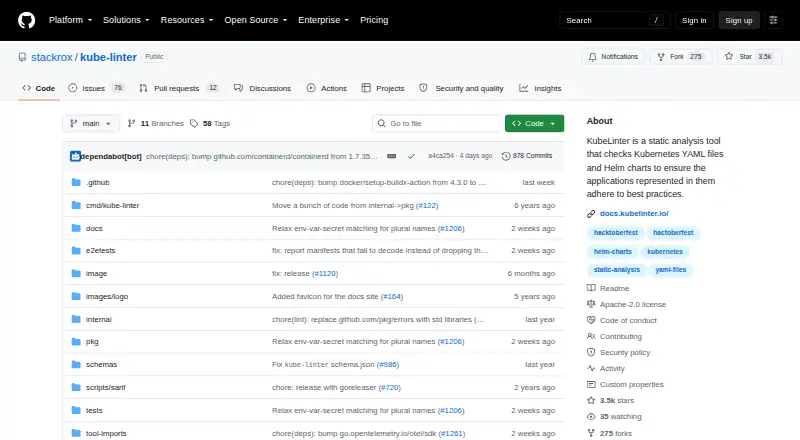
What KubeLinter is
KubeLinter is a free, open-source static analyzer for Kubernetes YAML files, Helm charts and Kustomize manifests. Its checks assess production-readiness and security practices, including whether containers run as non-root, privileges are limited, and sensitive information is stored in secrets. Users can enable or disable checks and define custom checks for organizational policies. When a check fails, KubeLinter provides remediation suggestions and returns a non-zero exit code. It can generate multiple output formats in one run, including SARIF and JSON. Documented installation routes include Go, release binaries, Homebrew or LinuxBrew, nix-shell and Docker. The project's container images are signed with cosign, and a public key is provided for verification; the README cautions that keyless cosign signatures are not production ready. The project was created by StackRox and is now powered by Red Hat. KubeLinter uses the Apache License 2.0, with no paid tiers listed. Its README also warns that commands, flags and configuration file formats may change. Users can join the project's Slack workspace to engage with maintainers and others.
Who it suits
KubeLinter suits teams checking Kubernetes configuration files and manifests against security and production-readiness practices. Custom checks can help align linting with an organization's policies.
What it does well
- Analyzes Kubernetes YAML, Helm and Kustomize files
- Custom checks can reflect organizational policies
- Failure output includes remediation suggestions
- Supports SARIF and JSON output
- Apache License 2.0; no paid tiers listed
What to know first
- Command usage, flags and configuration formats may change
- Keyless cosign signatures are not production ready
Limits
The free plan is the Apache License 2.0 release, and no paid tiers are listed. The README warns that command usage, flags, and configuration file formats may change; keyless cosign signatures are not production ready.
Plans
| Plan | Billed and limits | Price |
|---|---|---|
| KubeLinter | Apache License 2.0 · no paid tiers listed | Free |
As github.com lists them, read 4 Oct 2026. The maker's own page has the final word.
Getting started
- Choose an installation route: Go, release binary, Homebrew or LinuxBrew, nix-shell, or Docker.
- Install on Linux or macOS, or use a self-hosted setup.
- Run KubeLinter against Kubernetes YAML, Helm charts, or Kustomize manifests.
- Review any failed checks, remediation recommendations, and the selected output format.
Verdict
KubeLinter offers configurable static checks for Kubernetes manifests, with output that can be used in automated workflows. Readers should account for the project's warning that its commands and configuration formats may change.
Questions
How much does KubeLinter cost?
The KubeLinter plan is free under the Apache License 2.0. No paid tiers are listed.
Which platforms does it support?
KubeLinter supports Linux, macOS, and self-hosted use.
What does KubeLinter analyze?
It analyzes Kubernetes YAML files, Helm charts, and Kustomize manifests. Terraform and CloudFormation analysis are not supported.
Can teams define their own checks?
Yes. Users can enable or disable checks and create custom checks to match organizational policies.
Who makes KubeLinter?
The project was created by StackRox and is now powered by Red Hat.
Is KubeLinter open source?
Yes. It is licensed under the Apache License 2.0.
Facts from KubeLinter's own pages
- Community support
- The project invites users to join its Slack workspace to engage with maintainers and other users. · github.com, 4 Oct 2026
- Compatibility caveat
- The README warns that command usage, flags, and configuration file formats may change in the future. · github.com, 4 Oct 2026
- Custom checks
- Users can enable or disable checks and create custom checks to match organizational policies. · github.com, 4 Oct 2026
- Default checks
- Default checks cover practices such as running containers as non-root, enforcing least privilege, and storing sensitive information only in secrets. · github.com, 4 Oct 2026
- Install options
- The project documents installation through Go, release binaries, Homebrew or LinuxBrew, nix-shell, and Docker. · github.com, 4 Oct 2026
- Keyless verification
- The README says keyless cosign signatures are not production ready. · github.com, 4 Oct 2026
- Latest release
- The latest release page opened for this research identifies version v0.8.3. · github.com, 4 Oct 2026
- License
- KubeLinter is licensed under the Apache License 2.0. · github.com, 4 Oct 2026
- Lint feedback
- When a check fails, KubeLinter reports remediation recommendations and returns a non-zero exit code. · github.com, 4 Oct 2026
- Maker
- The README says KubeLinter was created by StackRox and is now powered by Red Hat. · github.com, 4 Oct 2026
- Output formats
- KubeLinter can generate multiple output formats in one run, including SARIF and JSON. · github.com, 4 Oct 2026
- Purpose
- KubeLinter statically analyzes Kubernetes YAML files, Helm charts, and Kustomize manifests against best practices for production readiness and security. · github.com, 4 Oct 2026
- Signing
- KubeLinter container images are signed with cosign, and the project provides a public key for verification. · github.com, 4 Oct 2026
- Vulnerability reporting
- The security policy directs confidential vulnerability reports to Red Hat's Product Security team. · github.com, 4 Oct 2026
Where KubeLinter stands on Freedom251
- Kubernetes Security Software#10 of 27
- IaC Security Scanners#7 of 16
- Infrastructure Testing Tools#15 of 28
- Infrastructure as Code Security Software#14 of 22