Freedom251 › Rollback Management

CircleCI
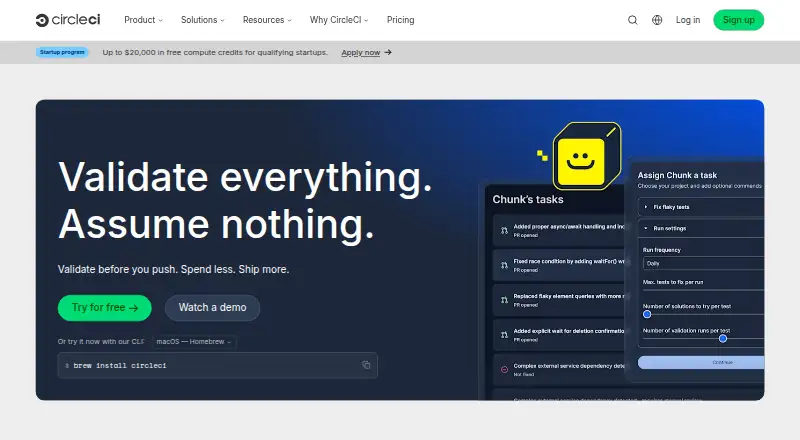
What CircleCI is
CircleCI provides CI/CD tooling for engineering teams to ship code and validate changes. Smarter Testing includes test impact analysis, dynamic test splitting, and automatic reruns of failed tests. Execution options include Docker, Linux, Arm, Windows, macOS, and self-hosted runners. CircleCI Cloud supports repositories hosted on GitHub, GitLab, GitLab self-managed, Bitbucket Cloud, and Cursor Origin, which is in beta. Teams can use Orbs, shareable configuration packages, including private orbs on all listed plans. CircleCI Deploys provides visibility into incremental releases and can roll them back automatically. Security controls include encrypted source-code communication, restricted contexts, audit logging, isolated build sandboxes, and OpenID Connect support. The company states that it is SOC 2 Type II compliant and has a FedRAMP Tailored designation. Its API enables programmatic interaction with pipelines, projects, and organizations. A free plan is available, while Performance starts at $15 a month. Free-plan credits expire after a month without rollover; paid credits roll over and expire after a year.
Who it suits
CircleCI is aimed at developers, developer experience teams, and businesses managing software delivery. Its supported runners and repository integrations may suit teams with varied build environments or version-control platforms.
What it does well
- Supports Linux, macOS, Windows, and self-hosted runners
- Can split tests dynamically and rerun failures automatically
- Private Orbs are available across listed plans
- API supports pipeline, project, and organization interactions
What to know first
- Free-plan credits expire after a month without rollover
- Cursor Origin integration is in beta
- Performance starts at $15 a month
Limits
The Free plan includes up to 6,000 build minutes using small Docker, up to five active users per month, 30x concurrency, 1 GB of network, and 2 GB of storage. Its credits expire after one month without rollover. Performance includes 30,000 credits and five active users, with 80x concurrency, 5 GB of network, and 2 GB of storage; paid credits roll over and expire after a year.
Plans
| Plan | Billed and limits | Price |
|---|---|---|
| Performance | Starting at $15 /month · 30,000 credits included free · 5 active users included free · 80x concurrency · 5 GB network · 2 GB storage · Larger resources | $15 a month |
| Free | $0 /month · Up to 6,000 build minutes using small Docker · Up to 5 active users/month · 30x concurrency · 1 GB network · 2 GB storage | On request |
| Scale | Billed annually; Get in touch · Customizable plans · Enterprise controls · Unlimited concurrency · 50 GB network · 200 GB storage · All environments, including GPU | On request |
As circleci.com lists them, read 30 Sept 2026. The maker's own page has the final word.
Getting started
- Open https://circleci.com/ and choose a plan.
- Connect a repository hosted on a supported service.
- Configure the pipeline using YAML.
- Select a supported execution environment and set up build jobs.
- Use the API to interact with pipelines, projects, or organizations programmatically if needed.
CircleCI is a CI/CD service for building, testing, and delivering software changes. It is best suited to engineering teams that need flexible execution environments and ways to manage test performance. Its broad runner support is compelling, though free usage is tightly capped and Scale requires a custom quote.
Overview
Teams can configure pipelines in YAML, connect supported code hosts, run pull request checks, and use the API to interact programmatically with pipelines, projects, and organizations. Artifact and dependency caching support recurring build workflows. The combination suits teams that want build and test controls in one service, but may be more than a small project needs if its free allowance is sufficient.
Key features
Test optimization and configuration
Smarter Testing brings together test impact analysis, dynamic test splitting, and automatic reruns of failed tests. These tools address slow or unreliable suites by helping focus and distribute validation and retrying failures. Orbs package reusable configuration for teams to share between projects; private orbs are available on all plans.
Execution and deployment
CircleCI supports Docker, Linux, Arm, Windows, macOS, and self-hosted runners. That range helps teams accommodate varied build requirements, including jobs that need their own infrastructure. CircleCI Deploys provides visibility into incremental releases and can roll them back automatically, which is useful for teams managing releases in stages.
Security and support
Security controls include encrypted source-code communication, restricted contexts, audit logging, isolated build sandboxes, and OpenID Connect support. CircleCI states that it is SOC 2 Type II compliant and has a FedRAMP Tailored designation. Community support is included on every plan; Performance and Scale add ticket-based global support and 8x5 SLAs, while Scale offers 24x7 SLAs. Those higher-tier options matter to organizations with support coverage requirements, but they are not part of the free offer.
Pricing
CircleCI uses a freemium model, with paid plans starting at $15/mo. The Free plan is billed at $0 per month and includes up to 6,000 build minutes using small Docker, up to 5 active users per month, 30x concurrency, 1 GB of network transfer, and 2 GB of storage. It is a reasonable place for small projects to start, but the modest user, resource, and transfer allowances can constrain busier teams. Credits expire after a month and do not roll over.
Performance starts at $15 a month, billed starting at $15 /month. It includes 30,000 credits, 5 active users, 80x concurrency, 5 GB of network transfer, 2 GB of storage, and larger resources. The included credits and concurrency make it the more practical choice for teams whose builds outgrow Free, though five active users and the included quotas still set boundaries. Paid credits roll over and expire after a year. Ticket-based global support and 8x5 support SLAs are available on this plan.
Scale is billed annually with custom pricing and customizable plans. It includes enterprise controls, unlimited concurrency, 50 GB of network transfer, 200 GB of storage, and all environments, including GPU. It suits organizations that need those higher limits or enterprise controls; annual billing and custom pricing make it less straightforward to budget than Performance. Scale also offers 24x7 support SLAs.
Platforms
CircleCI is available via web and API, with Linux, macOS, Windows, and self-hosted execution options. CircleCI Cloud supports GitHub, GitLab, GitLab self-managed, Bitbucket Cloud, and Cursor Origin repositories; Cursor Origin is in beta. This mix gives teams options across common code hosts and operating environments, while the beta integration warrants caution for teams that depend on it.
Who it's for
CircleCI is a strong fit for developers and developer experience teams that need test optimization, multiple execution environments, or visibility into incremental releases. It also fits businesses seeking controls such as restricted contexts, audit logs, and enterprise options. A small team with low build volume may be better served by Free, while teams needing 24x7 SLAs, unlimited concurrency, or GPU execution should assess Scale's custom-priced annual plan.
Pros and cons
- Pros: Smarter Testing combines impact analysis, test splitting, and automatic retries, addressing several common sources of test delay and disruption.
- Pros: Docker, Linux, Arm, Windows, macOS, and self-hosted runners support varied build environments.
- Pros: Private orbs are available across plans, and deployment rollback, security controls, and an API extend the product beyond basic build execution.
- Cons: Free credits expire monthly without rollover, and the plan caps active users, concurrency, network transfer, storage, and build minutes.
- Cons: Performance includes only 5 active users, while Scale is custom-priced and billed annually, complicating planning for larger needs.
- Cons: Cursor Origin support is in beta, so teams relying on it may prefer a stable integration path.
Alternatives
Choose HyperExecute if its free allowance of 300 testing minutes, up to 2 concurrent sessions, and Windows or Linux VMs better fits a bounded testing workload. Bitbucket Pipelines is worth considering for teams prioritizing a free-forever plan for up to 5 users with unlimited public and private repositories. Buildkite may suit teams whose free plan limits of up to 5 users and 10 concurrent jobs match their needs.
For teams focused specifically on managing flaky tests, Captain offers an OSS plan with flaky-test tracking, quarantine, retries, and parallel suite partitioning. Cypress has a free Starter plan with 10 users and 500 test results per month, making it an option for teams evaluating that allowance. Qualflare offers a free Starter plan limited to one project, one active user, 200 test cases, and 100 test reports.
TeamCity is an alternative with a free on-premises Professional plan that includes unlimited users, 3 build agents, and 100 build configurations. Testery may fit teams seeking a free entry point for test execution, with 10 test execution hours, 10 parallel runners, reporting, and analytics.
Compare more options in Test Flakiness Management Software, Continuous Integration Software, Mobile CI/CD Software, and Game Build Automation Software.
Verdict
Choose CircleCI if your engineering team needs flexible runners, test optimization, and release visibility together, especially when Performance's included credits and concurrency fit your build load. Look elsewhere if monthly free-credit expiration or Performance's five-user allowance is restrictive, or if you need Scale's capabilities without custom annual pricing.
Verdict
CircleCI brings build execution, test optimization, deployment visibility, and security controls into a CI/CD offering. Review its credit expiration rules and plan support options when estimating fit for your team.
Questions
Is CircleCI free?
Yes. Its Free plan is billed at $0 per month and includes up to 6,000 build minutes using small Docker.
How much does CircleCI cost?
Performance starts at $15 a month. Scale is billed annually with customizable plans, and requires contacting CircleCI.
Which platforms and execution environments does CircleCI support?
Listed platforms include API, Linux, macOS, self-hosted, web, and Windows. Execution options include Docker, Linux, Arm, Windows, macOS, and self-hosted runners.
Which repository services can CircleCI Cloud connect to?
It supports GitHub, GitLab, GitLab self-managed, Bitbucket Cloud, and Cursor Origin. Cursor Origin is in beta.
Does CircleCI offer an API?
Yes. The API supports programmatic interaction with pipelines, projects, and organizations.
What support and security provisions are listed?
Community support is included across plans. Performance and Scale offer ticket-based global support and 8x5 support SLAs; Scale also offers 24x7 SLAs. Security controls include encrypted source-code communication, restricted contexts, audit logging, isolated build sandboxes, and OpenID Connect support.
Facts from CircleCI's own pages
- API
- CircleCI's API enables programmatic interaction with pipelines, projects, and organizations. · circleci.com, 30 Sept 2026
- Compliance
- CircleCI states that it is SOC 2 Type II compliant and has a FedRAMP Tailored designation. · circleci.com, 30 Sept 2026
- Deployment visibility
- The product page says CircleCI Deploys lets teams monitor incremental releases and roll back automatically. · circleci.com, 30 Sept 2026
- Execution environments
- CircleCI pricing lists Docker, Linux, Arm, Windows, macOS, and self-hosted runners as supported execution options. · circleci.com, 30 Sept 2026
- Founded
- 2011 · circleci.com, 28 Sept 2026
- Headquarters
- San Francisco, California, United States · circleci.com, 28 Sept 2026
- Product
- CircleCI provides CI/CD tooling to help engineering teams ship code and validate changes. · circleci.com, 30 Sept 2026
- Reusable configuration
- Orbs are shareable configuration packages, and private orbs are available across all listed plans. · circleci.com, 30 Sept 2026
- Security controls
- CircleCI describes encrypted source-code communication, restricted contexts, audit logging, isolated build sandboxes, and OpenID Connect support. · circleci.com, 30 Sept 2026
- Support
- Community support is included across plans; ticket-based global support and 8x5 support SLAs are available on Performance and Scale, with 24x7 SLAs available on Scale. · circleci.com, 30 Sept 2026
- Test optimization
- Smarter Testing includes test impact analysis, dynamic test splitting, and automatic reruns of failed tests. · circleci.com, 30 Sept 2026
- Usage limits
- Free-plan credits expire after a month without rollover, while paid credits roll over and expire after a year. · circleci.com, 30 Sept 2026
- Version control integrations
- CircleCI Cloud supports repositories hosted on GitHub, GitLab, GitLab self-managed, Bitbucket Cloud, and Cursor Origin; Cursor Origin is in beta. · circleci.com, 30 Sept 2026
- Who it serves
- CircleCI describes its tooling as serving developers, developer experience teams, and businesses seeking speed, focus, and control in software delivery. · circleci.com, 30 Sept 2026
Where CircleCI stands on Freedom251
- Rollback Management#4 of 25
- Continuous Integration Software#10 of 58
- Test Flakiness Management Software#6 of 31
- Developer Tools#8 of 33
- Game Build Automation Software#11 of 43
- Ci Cd Platforms#8 of 28
- Mobile CI/CD Software#8 of 22