Freedom251 › Eye Tracking Software

Chiasm
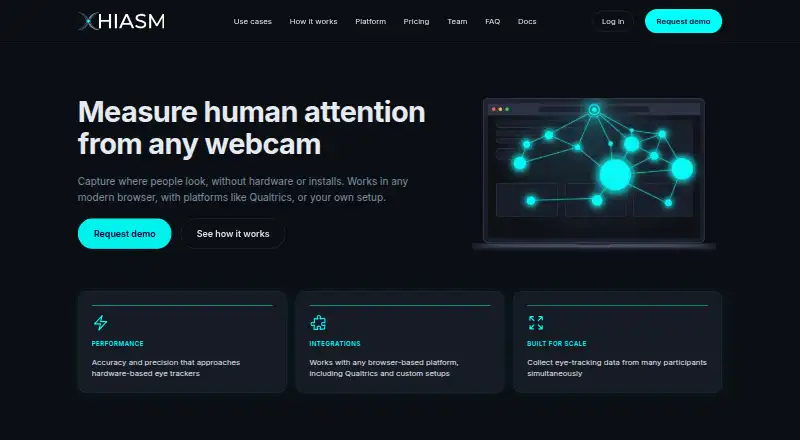
What Chiasm is
Chiasm captures gaze data from participants’ webcams for remote online studies and research. It processes webcam frames in real time and returns timestamped gaze coordinates linked to study events, along with session metadata. Researchers can connect it to Qualtrics, jsPsych, or custom web studies through a JavaScript library; Chiasm says studies can run with hundreds of participants at once. Participants use Google Chrome on a laptop or desktop with a webcam.
Researchers can download gaze data from Chiasm or stream it to their own server. For integrations such as Qualtrics, data is held on Chiasm’s servers for later export. Webcam video is not stored by default, though limited calibration or validation recordings may be stored with explicit opt-in consent. Chiasm describes encryption, role-based access, segregated environments, and logging and monitoring. It says personal data are primarily processed and stored in the European Economic Area on Google Cloud Platform servers in Europe, and that it follows GDPR requirements and provides a Data Processing Agreement when acting as processor. Flex costs €0.25 per minute with no monthly minimum; Starter is €199 per month and Pro is €499 per month.
Who it suits
Chiasm is intended for business, professional, academic, institutional, or organizational researchers running remote gaze studies. It is not intended for consumers using it personally.
What it does well
- Returns timestamped gaze coordinates and session metadata
- Integrates with Qualtrics, jsPsych, and custom web studies
- Data can be downloaded or streamed to a researcher’s server
- Webcam video is not stored by default
What to know first
- Requires Google Chrome on a laptop or webcam-equipped desktop
- Standard support excludes study-design advice and data analysis
- No free plan; Flex costs €0.25 per minute
Limits
Flex is billed at €0.25 per minute and has no monthly minimum. Starter includes 900 participant-minutes per month for €199 per month, while Pro includes 3,000 participant-minutes per month for €499 per month.
Plans
| Plan | Billed and limits | Price |
|---|---|---|
| Flex | €0.25/min pay per use · No monthly minimum · pay per use | Free |
| Starter | €199/month · 900 participant-minutes/mo included | €199 a month |
| Pro | €499/month · 3,000 participant-minutes/mo included | €499 a month |
| Custom | Custom pricing · Volume-based pricing | On request |
As chiasm.eu lists them, read 9 Oct 2026. The maker's own page has the final word.
Getting started
- Open https://chiasm.eu/.
- Use Google Chrome on a laptop or desktop with a webcam.
- Connect Chiasm through its JavaScript library to Qualtrics, jsPsych or a custom web study.
- Choose Flex pay-per-use, Starter, Pro or Custom pricing.
- Download gaze data from Chiasm or configure streaming to your own server.
Chiasm converts participants’ webcam images into gaze measurements for browser-based studies. It is aimed at professional and academic teams integrating eye tracking with online experiments or surveys. The service is most compelling when event-linked data and remote scale matter more than a fully managed research service.
Overview
Chiasm is a remote eye-tracking platform for studies delivered through the web. It captures gaze from a participant’s webcam and associates the resulting measurements with events in the study, making it possible to relate where someone looked to a question, stimulus or task step. The product is intended for business, professional, academic, institutional and organisational use rather than personal consumer use.
Its browser and API orientation suits teams already building online studies. Qualtrics and jsPsych users can add gaze capture through Chiasm’s JavaScript library, while custom web applications can integrate directly. The seven-day trial gives prospective customers a short period to check whether their participant workflow and device setup are suitable before paying.
Key features
Chiasm processes webcam frames in real time and supplies timestamped gaze coordinates tied to study events, together with session metadata. That combination is more useful for task-based research than an unlabelled stream of coordinates, because analysis can be aligned to what participants were doing at each moment.
Studies can run with hundreds of participants simultaneously, which makes Chiasm a plausible option for sizeable remote cohorts. Participants use a laptop or desktop with a webcam, and Chrome is the supported browser. This requirement excludes phone-only participation and means researchers must account for webcam-equipped computer access when recruiting.
The JavaScript integration covers Qualtrics, jsPsych and custom web studies. Data can be downloaded from Chiasm or streamed to a researcher’s own server. In integrations such as Qualtrics, gaze data is held on Chiasm’s servers for later export; teams that need direct control of their own data pipeline should favour streaming where their implementation supports it.
Chiasm says webcam video is not stored by default. Limited calibration or validation recordings can be retained when participants explicitly opt in. Its privacy statement describes encryption in transit and at rest, role-based access control, segregated environments, and logging and monitoring. Personal data is primarily processed and stored in the European Economic Area on Google Cloud Platform servers in Europe. Chiasm says it follows GDPR requirements and offers a Data Processing Agreement when it acts as a processor.
Standard technical support is provided on a best-effort basis. It covers bug fixes, platform-use assistance, documentation and general guidance, but excludes study-design advice and data analysis. Research teams should therefore plan to handle methodological and analytical questions internally or through separate expertise.
Pricing
Chiasm is paid software with no free plan, but a seven-day trial is available. The Flex plan charges €0.25 per participant-minute with no monthly minimum. It is the sensible entry point for occasional pilots or irregular studies, since there is no recurring commitment; costs rise directly with every minute collected.
Starter costs €199 per month and includes 900 participant-minutes each month. It fits a team running predictable, modest-volume studies. Pro costs €499 per month and includes 3,000 participant-minutes, making it better suited to recurring programmes or larger cohorts. The included allowance is the main distinction from Flex: teams with consistently high usage can budget around a monthly plan, while light users may pay less by staying pay-as-you-go.
Custom uses volume-based custom pricing for requirements beyond the published tiers. The plans do not advertise a free allowance, and the listed terms do not describe rollover or overage treatment, so purchasers should confirm how usage outside included minutes is billed before committing.
Platforms
Chiasm is offered through web and API access. Studies run remotely in Google Chrome on laptops or desktops equipped with webcams. Export is available as a download from Chiasm or as a stream to a customer-owned server.
Who it's for
Choose Chiasm if your research team needs webcam-based gaze measures inside Qualtrics, jsPsych or a custom browser study, especially when event timestamps and concurrent participation are important. Flex is appropriate for occasional work; Starter and Pro are aimed at teams with repeatable monthly volume. It is less suitable for phone-first recruitment, consumer self-use, or teams expecting the vendor to provide study-design and analysis support.
Pros and cons
Pros
- Event-linked gaze output: Timestamped coordinates and session metadata connect eye behaviour to study events.
- Flexible data handling: Download or stream results to fit different analysis and infrastructure practices.
- Remote scale: Chiasm says hundreds of participants can run simultaneously.
- Privacy controls: Video is not stored by default, with opt-in recordings limited to calibration or validation use.
- Usage choices: Pay-per-minute Flex avoids a monthly minimum, while higher tiers include defined monthly allowances.
Cons
- Computer-and-Chrome dependency: Participants need a webcam-equipped laptop or desktop and supported browser, ruling out phone-only sessions.
- No free plan: Even small studies move to paid usage after the seven-day trial.
- Support boundary: Standard support does not include study-design advice or data analysis.
- Hosted storage in some integrations: Qualtrics workflows store data on Chiasm’s servers until export.
Alternatives
Browse the Eye Tracking Software directory for more options.
- GazePlotter is a free, GNU GPL v3 open-source tool spanning Android, iOS, Linux, macOS, web and Windows; choose it when zero licence cost and broad platform coverage matter more than Chiasm’s paid integration model.
- GazeRecorder offers free non-commercial use across Android, iOS, web and Windows; it is a better fit for non-commercial projects seeking no-cost access.
- Labvanced has a free tier with 300 MB storage, 10 recordings and one active recruiting link, plus paid options; consider it when those study limits and a freemium model fit your work.
- Hawkeye provides a free plan capped at one project and five sessions, with a $39.99-per-month Starter Plan; it suits small projects needing iOS and web access.
- iTrace is free, MIT-licensed and self-hosted for Linux; pick it when open-source deployment is the priority.
- PyGaze is a free open-source Python toolbox for Linux, macOS and Windows; it is aimed at teams wanting a code-based toolkit.
- OGAMA is free, open-source Windows software; choose it for a Windows-focused freeware option.
- OpenGazer is a free open-source Linux gaze tracker requiring a webcam and Linux build dependencies; it fits technically capable Linux users.
Verdict
Chiasm is a strong choice for research organisations running remote browser studies that need gaze coordinates tied to task events, JavaScript integration and the option to stream data into their own systems. Flex keeps occasional work accessible, while Starter and Pro provide clearer budgeting for recurring volume.
Verdict
Chiasm is aimed at research teams that need webcam-based gaze data integrated with online studies. Review its participant device requirements, data handling, and support scope before selecting a plan.
Questions
Is Chiasm free?
There is no free plan. Flex is pay-per-use at €0.25 per minute with no monthly minimum.
Which plans are available?
Flex costs €0.25 per minute. Starter is €199 per month with 900 participant-minutes, and Pro is €499 per month with 3,000 participant-minutes. Custom pricing is volume-based.
Which platforms and browsers does it support?
Chiasm lists web and API platforms. Participants use Google Chrome on laptops or desktops with a webcam.
Can researchers export study data?
Researchers can download gaze data from Chiasm or stream it to their own server. With platforms such as Qualtrics, data is stored on Chiasm’s servers for later export.
Does Chiasm keep webcam video?
It does not store webcam video by default. Limited calibration or validation recordings may be stored with explicit opt-in consent.
Who is Chiasm intended for?
It is intended for business, professional, academic, institutional or organizational use, not personal consumer use.
Facts from Chiasm's own pages
- Compliance
- Chiasm says it follows GDPR requirements and provides a Data Processing Agreement for customer studies where it acts as processor. · chiasm.eu, 9 Oct 2026
- Data export
- Researchers can export gaze data or stream it to their own server; with platforms such as Qualtrics, data is stored on Chiasm’s servers for later export. · chiasm.eu, 9 Oct 2026
- Data location
- The privacy statement says personal data are primarily processed and stored in the European Economic Area on Google Cloud Platform servers in Europe. · chiasm.eu, 9 Oct 2026
- Features
- The platform processes webcam frames in real time and provides timestamped gaze coordinates linked to study events, plus session metadata. · chiasm.eu, 9 Oct 2026
- Headquarters
- Amsterdam, The Netherlands · chiasm.eu, 28 Sept 2026
- Integrations
- Chiasm integrates through a JavaScript library with Qualtrics, jsPsych and custom web studies. · docs.chiasm.eu, 9 Oct 2026
- Intended users
- The service is for business, professional, academic, institutional or organisational use and is not intended for consumers using it personally. · chiasm.eu, 9 Oct 2026
- Platforms
- Participants use a modern browser and standard webcam without installing software; Chiasm currently works best in Google Chrome on laptops and desktops. · chiasm.eu, 9 Oct 2026
- Purpose
- Chiasm captures gaze data from participants’ webcams for online studies and research. · chiasm.eu, 9 Oct 2026
- Scale
- Chiasm says studies can run with hundreds of participants simultaneously. · chiasm.eu, 9 Oct 2026
- Security
- Chiasm’s privacy statement lists encryption in transit and at rest, role-based access control, segregated environments, and logging and monitoring. · chiasm.eu, 9 Oct 2026
- Support
- Standard technical support is best effort and includes bug fixes, platform-use assistance, documentation and general guidance; study-design advice and data analysis are excluded. · chiasm.eu, 9 Oct 2026
- Video handling
- Chiasm says it does not store webcam video by default, but may store limited calibration or validation recordings with explicit opt-in consent. · chiasm.eu, 9 Oct 2026
Where Chiasm stands on Freedom251
- Eye Tracking Software#10 of 27