Freedom251 › Employee Wellbeing Software
ChallengeRunner
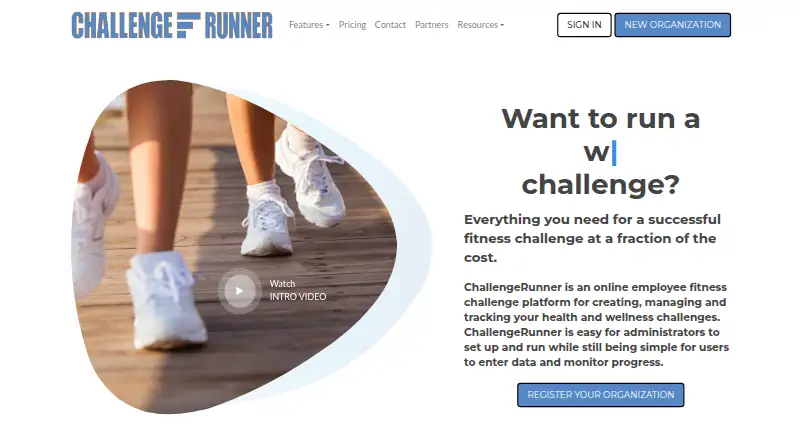
What ChallengeRunner is
ChallengeRunner is an online platform for organizing employee health and wellness challenges. Administrators can create weight-loss, walking, activity-based, nutrition, multi-activity and image-based challenges, then manage participation and results. Participants can submit data through a browser, smartphone apps, fitness trackers or text message. The listed trackers include Apple Health, Samsung Health, Fitbit, Garmin, COROS, Withings, Wahoo, Oura, Polar, Strava, Suunto and MapMyFitness.
Administrators can assign participants to teams or let participants and, optionally, team leaders create teams. Team leaderboard scores can be averaged or cumulative. Live leaderboards can appear as a bar chart, race map or tournament bracket, depending on the challenge. Slack, Microsoft Teams and Cisco Webex integrations let participants join challenges, view standings and submit or update data within those apps. For data review, administrators can set upper and lower bounds for entries and inspect submissions in a scatter chart. The privacy policy describes TLS 1.2 for data transmission and field-level and database-level encryption at rest. ChallengeRunner has Android, iOS and web access. Its free Sandbox plan covers up to 10 participants for up to 7 days; paid plans include Core from $15 a month and Core Annual at $259 a year.
Who it suits
ChallengeRunner suits organizations that want to run employee fitness or wellness challenges with team competition and live standings. It can also suit groups whose participants use different data-entry methods or fitness trackers.
What it does well
- Supports six types of health and activity challenges.
- Participants can submit data by app, browser, tracker or text.
- Lists integrations with 12 fitness trackers.
- Live leaderboards can use three display formats.
- Integrates with Slack, Microsoft Teams and Cisco Webex.
What to know first
- Sandbox is limited to 10 participants and 7 days.
- Core pricing depends on participant count and active challenge duration.
Limits
Sandbox allows up to 10 participants for up to 7 days. Core pricing varies by participant count and covers the active challenge duration; Core Annual includes unlimited challenges during its annual term.
Plans
| Plan | Billed and limits | Price |
|---|---|---|
| Sandbox | Up to 10 participants · Up to 7 days · Tracker syncing · Website and smartphone apps · Real-time leaderboard · Self-service setup | Free |
| Core | Pay only for the actual challenge duration; pricing based on participant count · Unlimited duration and participants based on pricing tier · Multiple admins · Multiple activities · Teams · Branding · Downloadable reports | $15 a month |
| Core Annual | Annual term; unlimited challenges during annual term · All Core features · Microsoft Teams, Slack, and Webex integration · Effectiveness report · White label available | $259 a year |
As challengerunner.com lists them, read 7 Oct 2026. The maker's own page has the final word.
Getting started
- Visit the ChallengeRunner website.
- Choose the free Sandbox or a paid plan.
- Set up a challenge and select its activity type.
- Invite participants to enter data through a browser, app, tracker or text message.
- Create or assign teams and choose a leaderboard format.
Overview
ChallengeRunner gives employers a way to organize employee fitness campaigns, from walking contests to multi-activity challenges. It fits organizations that want configurable competition and several routes for recording activity, rather than a broader wellbeing program. Live standings and tracker support are useful strengths, but the free option is brief and small, and the paid plans are the route to larger or longer events.
Key features
Organizers can build weight-loss, walking, activity-based, nutrition, multi-activity, or image-based challenges. This range works for campaigns that need more than a step count, though organizations looking for assessments, coaching, or mental health resources will need another service.
Participants can enter data through a browser, smartphone apps, or text message, or sync a tracker. Supported devices and services include Apple Health, Samsung Health, Fitbit, Garmin, COROS, Withings, Wahoo, Oura, Polar, Strava, Suunto, and MapMyFitness. Multiple submission routes can accommodate a workforce with varied devices, while also leaving administrators to account for different ways of reporting activity.
Administrators can assign teams or let participants—and optionally team leaders—form them. Scores can be cumulative or averaged, which lets organizers choose between rewarding total output and balancing results across teams. Real-time leaderboards take the form of a bar chart, race map, or tournament bracket, depending on the challenge. Slack, Microsoft Teams, and Cisco Webex integrations let participants join challenges, check standings, and submit or update data without leaving those apps.
For data quality, administrators can set upper and lower limits on entries and inspect a scatter chart for unusual values. The privacy policy says data is encrypted in transit with TLS 1.2 and at field and database levels at rest. It also says Google Health data is not used for advertising, credit decisions, diagnosis, or treatment, and is not sold or transferred to ad platforms or data brokers. Organizations that are HIPAA Covered Entities are instructed to sign a Business Associate Agreement. Technical support is provided through an FAQ, with further questions directed to a contact page.
Pricing
The Sandbox plan costs nothing and allows up to 10 participants for up to seven days. It includes tracker syncing, the website and smartphone apps, a real-time leaderboard, and self-service setup. That is enough for a short pilot or small-group event, but its caps make it unsuitable for a larger workforce or an extended campaign.
Core costs $15 a month, billed only for the actual challenge duration, with pricing based on participant count. It supports unlimited duration and participants according to the pricing tier, and adds multiple administrators, multiple activities, teams, branding, and downloadable reports. This is the more suitable choice for organizations that need a longer or larger challenge; the participant tier determines the cost.
Core Annual costs $259 a year and includes unlimited challenges during the annual term, all Core features, Microsoft Teams, Slack, and Webex integration, and an effectiveness report. White label is available. It suits organizations expecting to run multiple campaigns across the year, while the annual commitment is less fitting for a one-off event. There are no setup fees or add-ons; registration before a challenge and report access afterward are free.
Platforms
ChallengeRunner is available on Android, iOS, and the web. Single sign-on is supported, giving organizations another option for managing access alongside multiple administrator accounts on the paid Core plan.
Who it's for
ChallengeRunner is a strong fit for employers who want employees to compete in structured activity campaigns, especially when teams, live standings, tracker syncing, or workplace chat integrations matter. It is less appropriate for organizations seeking a full wellbeing offering: assessments, coaching, and mental health resources are not included.
Pros and cons
- Flexible challenge formats and data entry: Activity, nutrition, image, and other challenge types pair with browser, app, text, and tracker submissions.
- Useful team scoring choices: Averaged and cumulative standings support different ways of comparing teams, with real-time visual leaderboards.
- Entry review controls: Value bounds and scatter-chart review give administrators tools to flag unusual submissions.
- Strict free-plan limits: Sandbox stops at 10 participants and seven days, so it cannot serve a larger or longer challenge.
- Narrow wellbeing scope: There are no assessments, coaching, or mental health resources for employers seeking support beyond challenges.
- Annual plan trade-off: Core Annual enables unlimited campaigns and adds integrations, but requires an annual term.
Alternatives
Employee Wellbeing Software is a broader category to explore when an employee challenge platform alone is not enough.
Choose MindFi instead if a freemium option with access to licensed psychologists and counsellors better matches the need; its Basic plan is free for teams under 20, with therapy billed per session starting at $35/session.
Stridekick is another freemium option for short challenges: its free plan supports public challenges of up to seven days and 10 participants, while Pro 10 costs $12.99 a month and supports 10 participants and private challenges.
Consider Wellhub instead when a wellness-app offering is the priority: its free Digital plan starts at $ 0.00 /mo and includes 10 wellness apps, while Starter starts at $ 11.99 /mo and includes 46.
GoJoe is an alternative for organizations considering a rewards marketplace, benefits navigator, expert health programmes, or a Les Mills subscription; its Reward Annual plan has no published price.
GOQii Corporate Wellness is an alternative for organizations considering a fitness tracker, personalised health subscription, diagnostics booking, health and fitness sessions, and custom rewards; its plan has no published price.
Healthify Corporate offers a custom corporate wellness plan tailored to an organization's needs, with no published price.
Peppy may suit employers seeking a benefit offered through an employer or health insurer, with service scope and duration depending on that agreement.
Personify Health is another personalized health platform; pricing is not published, and a demo or contact is required.
Verdict
Choose ChallengeRunner for employee fitness campaigns where configurable activities, team scoring, and live leaderboards are the main requirements. Its range of input methods and administrator controls support organized competition, but organizations needing wellbeing assessments, coaching, or mental health services should choose a broader solution instead.
Verdict
Choose ChallengeRunner if your organization wants configurable employee challenges, team scoring and live leaderboards. The Sandbox plan offers a short, small-group option, while larger or longer challenges require a paid plan. Organizations seeking coaching or mental health resources should look elsewhere, as those are not included.
Questions
Is there a free plan?
Yes. Sandbox costs nothing and supports up to 10 participants for up to 7 days.
How much do the paid plans cost?
Core starts at $15 a month and bills for the active challenge duration, with pricing based on participant count. Core Annual costs $259 a year.
Which platforms does ChallengeRunner support?
It supports Android, iOS and web access.
Which fitness trackers are listed?
Apple Health, Samsung Health, Fitbit, Garmin, COROS, Withings, Wahoo, Oura, Polar, Strava, Suunto and MapMyFitness.
Does it integrate with workplace communication apps?
Yes. Slack, Microsoft Teams and Cisco Webex integrations let participants join challenges, view leaderboards, and submit or update data within those apps.
What are the billing terms for challenges?
There are no setup fees or add-ons. Billing covers the active challenge duration, while registration before and report access after the challenge are free.
Facts from ChallengeRunner's own pages
- Challenge types
- It supports weight-loss, walking, activity-based, nutrition, multi-activity, and image-based challenges. · challengerunner.com, 7 Oct 2026
- Data entry
- Participants can enter challenge data through a browser, smartphone apps, fitness trackers, or text message. · challengerunner.com, 7 Oct 2026
- Data validation
- Administrators can set upper and lower bounds for entered values and review participant data in a scatter chart to spot abnormal entries. · hpa.challengerunner.com, 7 Oct 2026
- Headquarters
- Las Vegas, Nevada, United States · challengerunner.com, 28 Sept 2026
- HIPAA
- Organizations identified as HIPAA Covered Entities are instructed to sign a Business Associate Agreement with ChallengeRunner LLC. · challengerunner.com, 7 Oct 2026
- Integrations
- ChallengeRunner integrates with Slack, Microsoft Teams, and Cisco Webex so participants can join challenges, view leaderboards, and submit or update data within those apps. · challengerunner.com, 7 Oct 2026
- Leaderboards
- Leaderboards update in real time and may appear as a bar chart, race map, or tournament bracket depending on the challenge. · challengerunner.com, 7 Oct 2026
- Limits and billing
- The pricing page says there are no setup fees or add-ons, billing covers the active challenge duration, and registration before and report access after the challenge are free. · challengerunner.com, 7 Oct 2026
- Privacy
- The privacy policy says Google Health data is not used for advertising, creditworthiness decisions, diagnosis, or treatment, and is not sold or transferred to advertising platforms or data brokers. · challengerunner.com, 7 Oct 2026
- Purpose
- ChallengeRunner is an online employee fitness challenge platform for creating, managing, and tracking health and wellness challenges. · challengerunner.com, 7 Oct 2026
- Security
- The privacy policy says data transmission uses TLS 1.2 and data at rest uses field-level and database-level encryption. · challengerunner.com, 7 Oct 2026
- Support
- ChallengeRunner provides a technical-support FAQ and directs users with more questions to its contact page. · challengerunner.com, 7 Oct 2026
- Team competition
- Administrators can assign participants to teams or let participants and optionally team leaders create teams, with averaged or cumulative team leaderboard scores. · challengerunner.com, 7 Oct 2026
- Trackers
- The FAQ lists Apple Health, Samsung Health, Fitbit, Garmin, COROS, Withings, Wahoo, Oura, Polar, Strava, Suunto, and MapMyFitness as supported trackers. · challengerunner.com, 7 Oct 2026
Where ChallengeRunner stands on Freedom251
- Employee Wellbeing Software#1 of 26