Freedom251 › AI Literature Review Software

Catchii
What Catchii is
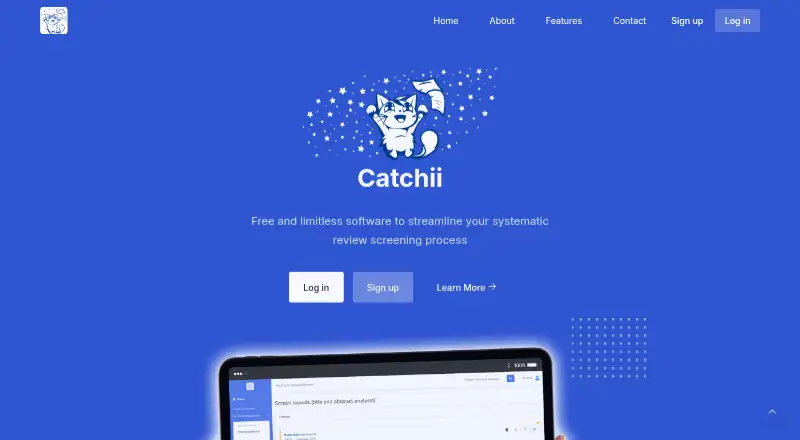
Catchii is a web-based tool for screening large scientific-literature datasets in systematic reviews. It supports review stages from duplicate detection through PRISMA flowchart generation. References can be imported from PubMed, Scopus, Web of Science, OVID databases, CSV files, and reference management software. Its duplicate detector identifies records with highly similar titles or abstracts for review and removal. Reviewers can screen titles and abstracts, move to full-text analysis, and resolve disagreements; data extraction from included articles is available at the final stage. Multiple reviewers can be assigned roles such as reviewer, conflict-resolution reviewer, and manager. Screening can be performed offline on a computer, tablet, or smartphone. Grouped, color-coded keywords can highlight inclusion, exclusion, or topic terms. The Auto Reviewer uses AI to assist with first-phase screening and provide inclusion or exclusion decisions with justifications; uploaded records are sent to OpenAI, an external service, for processing. Selected records can be exported in formats compatible with EndNote, Zotero, or Mendeley, with PDF attachments and a PRISMA flowchart. Catchii is free, with no subscription fees, trial periods, paid upgrades, or advertisements.
Who it suits
Catchii suits systematic review teams screening large bodies of scientific literature. Its multiple reviewer roles, offline screening, and export options may help teams working across review stages.
What it does well
- Free with no subscription fees or paid upgrades.
- Supports offline screening on computers and mobile devices.
- Includes duplicate detection and disagreement resolution.
- Exports records with PDF attachments and a PRISMA flowchart.
What to know first
- Auto Reviewer sends uploaded records to OpenAI.
- Focused on systematic review screening.
Plans
| Plan | Billed and limits | Price |
|---|---|---|
| Free | No subscription fees · No trial periods · No paid upgrades · No advertisements · Multiple users supported | Free |
| Free to use | limitless · no subscription fees · no trial periods · no paid upgrades · no advertisements | Free |
As catchii.org lists them, read 20 Sept 2026. The maker's own page has the final word.
Getting started
- Visit the Catchii website.
- Open the web-based tool on a computer, tablet, or smartphone.
- Import references from a supported database, CSV file, or reference management software.
- Add reviewers and assign roles for screening and conflict resolution.
- Screen records and proceed to full-text analysis, data extraction, or export.
Catchii is a web workspace for systematic-review teams managing substantial scientific-literature collections. It is best suited to researchers who need shared screening, extraction and reporting across several devices, without a subscription budget. The main reason to hesitate is its AI reviewer’s external processing of uploaded records.
Overview
Catchii follows a review from imported citations to a finished report. References can come from PubMed, Scopus, Web of Science, OVID databases, CSV files and reference-management software. The workflow then covers duplicate checking, title-and-abstract screening, full-text analysis, data extraction from included papers and PRISMA flowchart generation. That breadth is useful when a team wants one workspace instead of stitching together separate screening and reporting tools.
Screening runs in a browser on a computer, tablet or smartphone, and it can continue offline. Multiple reviewers can be assigned distinct reviewer, conflict-resolution reviewer or manager roles. Double-blinded screening and disagreement-resolution tools support independent decisions before conflicts are settled, making Catchii a stronger fit for collaborative evidence reviews than for a lone reader doing an informal literature survey.
Key features
Importing and duplicate control
The broad import support accommodates major scholarly indexes as well as files exported from reference managers. Its duplicate detector flags records with highly similar titles or abstracts for review and removal. This is a practical safeguard against counting the same study twice, although flagged matches still require human judgment.
Screening and review controls
Catchii separates title-and-abstract screening from full-text analysis and provides tools for resolving disagreements. Customisable, grouped, colour-coded keywords can mark inclusion, exclusion or topic terms, helping teams apply a visible vocabulary consistently. Offline access is valuable for travel or unreliable connections, while multi-device access lets reviewers work from whichever screen is convenient.
AI assistance and outputs
The Auto Reviewer can assist first-phase screening by issuing inclusion or exclusion decisions with justifications. That can reduce the initial reading burden, but it should be treated as an aid rather than an unquestioned arbiter. Uploaded records are sent to OpenAI for processing, so organisations with strict data-governance requirements may prefer to keep AI disabled or choose another product. At the end, selected records can be exported for EndNote, Zotero or Mendeley, with PDF attachments and a PRISMA flowchart. Data extraction is performed at the final stage, keeping the tool relevant beyond initial triage.
Pricing
Catchii is free to use. The Free plan costs nothing and has no subscription fees, trial period, paid upgrade or advertisements; multiple users are supported. A second Free to use plan is also priced at $0 and is described as limitless, with no subscription fees, trial periods, paid upgrades or advertisements. In practice, this removes the seat and quota trade-offs common in team screening products, making Catchii suitable for student groups, research teams and independent reviewers alike. There is no paid tier to unlock more capacity, so teams needing contractual enterprise terms or a different hosting model should assess alternatives rather than expecting a premium upgrade path.
Platforms
Catchii is web-based. Screening is available on computers, tablets and smartphones, including offline work, so reviewers are not tied to a single device or constant connection.
Who it's for
Choose Catchii for systematic reviews that need double-blind screening, several reviewer roles, duplicate checking, full-text handling and PRISMA reporting in one free service. It is particularly compelling for teams importing from multiple databases and sharing work across locations. It is less suitable when sending records to an external AI processor is unacceptable, or when you need review types beyond systematic review.
Pros and cons
- Pro: The workflow spans imports, deduplication, two-stage screening, extraction and PRISMA output, reducing tool switching.
- Pro: Multiple roles, double-blinded screening and conflict resolution support disciplined team decisions.
- Pro: Unlimited, ad-free free access with multiple users removes subscription and quota barriers.
- Pro: Offline, mobile and desktop screening accommodates varied working conditions.
- Con: Auto Reviewer processing sends uploaded records to OpenAI, which may conflict with institutional privacy rules.
- Con: AI decisions and similarity-based duplicate flags still need reviewer oversight.
- Con: The product is focused on systematic reviews, so it is not a general-purpose literature-management environment.
Alternatives
For a wider comparison, see Systematic Review Software and AI Literature Review Software.
- ReviewAid is a free, open-source Apache 2.0 option with web, desktop and self-hosted platforms; choose it when licensing and hosting control matter most.
- ASReview is free and open source across web, desktop, API and self-hosted deployments; pick it when running the software on your own hardware is preferable.
- RevMan offers a freemium model with a free trial on web and desktop platforms; consider it when you want that commercial option.
- Universal SLR Assistant is free and open source on web and desktop, with possible cloud-AI API fees; choose it when an MIT-licensed tool fits your workflow.
- Bango is free for researchers without subscriptions, paywalls or limits and runs on Linux, macOS and Windows; choose it when desktop-only work is sufficient.
- Rayyan has a free plan limited to three active reviews and two reviewers, plus paid seats; pick it when its mobile apps and tiered collaboration model suit your scale.
- Covexe is a freemium web service with an AI co-pilot; consider it when that model better matches your needs.
- HAWC is a free web platform for public assessments; choose it for that assessment-focused use case.
Verdict
Catchii is a strong choice for research teams wanting a genuinely free, end-to-end systematic-review workspace with multiple reviewers, offline screening and PRISMA exports. Look elsewhere if external AI processing of records is a deal-breaker or if your work falls outside systematic review screening.
Verdict
Catchii covers systematic review screening from duplicate checks through exports and PRISMA flowchart generation, with support for multiple reviewers and offline work. Note that its AI Auto Reviewer sends uploaded records to an external service for processing.
Questions
Is Catchii free?
Yes. Catchii lists a free plan at no cost, with no subscription fees, trial periods, paid upgrades, or advertisements.
Which platforms can I use?
Catchii is listed for the web. Screening can be performed on a computer, tablet, or smartphone, and is available offline.
Which review stages does Catchii support?
It supports duplicate detection, title-and-abstract screening, full-text analysis, disagreement resolution, data extraction from included articles, and PRISMA flowchart generation.
Does Catchii use AI?
Its Auto Reviewer uses AI to assist first-phase screening with inclusion or exclusion decisions and justifications. Uploaded records are sent to OpenAI for processing.
Can I export review records?
Selected records can be exported in formats compatible with EndNote, Zotero, or Mendeley, with PDF attachments and a PRISMA flowchart.
Facts from Catchii's own pages
- AI data processing
- The Auto Reviewer sends uploaded records to OpenAI, an external service, for processing. · app.catchii.org, 30 Sept 2026
- AI screening
- The Auto Reviewer uses AI to assist first-phase screening and provides inclusion or exclusion decisions with justifications. · catchii.org, 30 Sept 2026
- Data extraction
- Data extraction from included articles can be performed at the final stage. · catchii.org, 30 Sept 2026
- Device access
- Screening can be performed on a computer, tablet or smartphone. · catchii.org, 30 Sept 2026
- Duplicate detection
- The built-in duplicate detector identifies records with highly similar titles or abstracts for review and removal. · catchii.org, 30 Sept 2026
- Exports
- Selected records can be exported in formats compatible with EndNote, Zotero or Mendeley, with PDF attachments and a PRISMA flowchart. · catchii.org, 30 Sept 2026
- Keyword highlighting
- Customisable, grouped and colour-coded keywords can highlight inclusion, exclusion or topic terms. · catchii.org, 30 Sept 2026
- Offline screening
- Screening is available offline. · catchii.org, 30 Sept 2026
- Purpose
- Catchii is a systematic review screening tool for working with large datasets of scientific literature. · catchii.org, 30 Sept 2026
- Reference imports
- References can be imported from PubMed, Scopus, Web of Science, OVID databases, CSV files and reference management software. · catchii.org, 30 Sept 2026
- Screening phases
- Catchii supports title-and-abstract screening followed by full-text analysis, with disagreement resolution tools. · catchii.org, 30 Sept 2026
- Support
- Catchii lists [email protected] for general contact and [email protected] for help. · catchii.org, 30 Sept 2026
- User roles
- Users can add multiple reviewers with roles including reviewer, conflict-resolution reviewer and manager. · catchii.org, 30 Sept 2026
- Workflow coverage
- It supports key systematic review stages from duplicate detection through PRISMA flowchart generation. · catchii.org, 30 Sept 2026
Where Catchii stands on Freedom251
- AI Literature Review Software#6 of 38
- Systematic Review Software#8 of 30