Freedom251 › AI Literature Review Software

Axelium
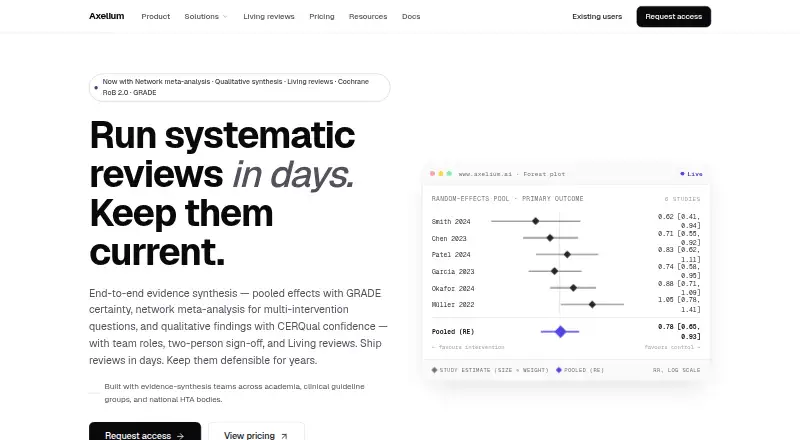
What Axelium is
Axelium is a platform for systematic reviews and meta-analyses, taking work from evidence search through reporting and living reviews. Its 11-stage workflow includes protocol planning, screening, full-text review, data extraction, RoB 2.0, GRADE, statistics and network meta-analysis. The maker says AI extracts structured values, while deterministic analysis code calculates statistics; extracted data points link to snippets in original PDFs. Listed methods include pairwise and network synthesis, GRADE certainty ratings, CERQual and PRISMA-style reporting. Users can import references from tools such as EndNote, Zotero and Mendeley, and from sources including PubMed, ClinicalTrials.gov and Web of Science. Exports include Word, Excel, RIS, BibTeX and RevMan. Team controls include reviewer roles, comments, dual-person sign-off and audit snapshots. Axelium is available as a web product and browser extension. The Free plan provides one lifetime review and one seat; Researcher costs $29/mo. Human validation is needed for screening suggestions, extracted values, risk-of-bias assessments and generated reports. Recurring statistical refresh for living-review network meta-analysis is paused.
Who it suits
Axelium suits individual researchers, pharma and HEOR teams, CROs, consultancies, HTA bodies and clinical guideline committees. Teams needing shared review roles and sign-offs may use its collaboration controls.
What it does well
- 11 stages span search through reporting.
- Data points link to source PDF snippets.
- Supports pairwise and network synthesis.
- Free plan includes one lifetime review.
- Imports references from named tools and databases.
What to know first
- Screening suggestions need reviewer validation.
- Extracted values and risk assessments need checking.
- Generated reports are drafts requiring review.
- Recurring living-review NMA refresh is paused.
Limits
The Free plan includes one review for the lifetime of the account and one seat. Researcher includes three reviews per month and one seat; recurring statistical refresh for living-review network meta-analysis is paused.
Plans
| Plan | Billed and limits | Price |
|---|---|---|
| Free | Free · 1 review (lifetime) · 1 seat · All core features · Community support | Free |
| Team | $266/ mo · 7 pooled reviews / seat / month · 3-seat minimum · Shared extraction and stats artifacts · Per-seat attribution dashboard · Priority support | $266 a month |
| Researcher | $29/ mo · 3 reviews / month · 1 seat · All core features · Email support · Review packs from $49 | $29 a month |
| Professional | $79/ mo · 12 reviews / month · 1 seat · Priority email support · Discounted review packs ($39 / 3) · Living-review automation · Analysis Workbench for custom methods | $79 a month |
| Enterprise | custom volumes · Custom volumes · BYOK · SSO · on-prem | On request |
As axelium.ai lists them, read 29 Sept 2026. The maker's own page has the final word.
Getting started
- Open https://www.axelium.ai/.
- Choose the Free plan or a paid plan such as Researcher at $29 a month.
- Sign in with Google or Microsoft.
- Use the web platform or browser companion to capture articles, PDFs, supplements, and citation metadata you can legally access.
- Import references from a supported manager or database and begin a review workflow.
Axelium is a broad workspace for systematic reviews and meta-analyses, taking evidence work from protocol to reporting and living-review maintenance. It is best suited to researchers, evidence teams and regulated organizations that need formal methods, traceability and defined review roles rather than a simple screening utility. The main trade-off is that its automation accelerates work but does not replace methodological checking, while one important living-review capability is currently paused.
Overview
Axelium brings an 11-stage process into one platform: protocol, search, screening, full-text assessment, extraction, risk of bias, certainty grading, statistics, network meta-analysis, reporting and living reviews. That breadth can reduce handoffs between separate tools for teams running complex evidence programs. Individuals who only need citation screening may find the wider workflow unnecessary.
Key features
The platform says AI extracts structured values, while deterministic analysis code performs statistical calculations. Each data point can link to a snippet in the original PDF, giving reviewers a practical route to verify where a value came from. That traceability is valuable, but screening suggestions can be wrong, extracted values and RoB 2.0 judgments require human validation, and generated reports are drafts rather than publication-ready output.
Methods cover pairwise and network synthesis, Cochrane RoB 2.0, GRADE certainty ratings, CERQual and PRISMA-style reporting. Imports work with EndNote, Zotero, Mendeley, Embase and Web of Science, while searchable sources include PubMed, ClinicalTrials.gov, EuropePMC, OpenAlex, CENTRAL, MAUDE and ERIC. Exports include DOCX, XLSX, RIS, BibTeX and RevMan 5, which helps when a project must move into established reporting or reference workflows.
Collaboration controls are more substantial than a basic shared library: admin, lead-reviewer, reviewer and viewer roles; comments and mentions; dual-person sign-off; conflict adjudication; and versioned audit snapshots. The pricing page states GDPR compliance and full audit trails for every review, with bring-your-own-key encryption reserved for Enterprise. Google and Microsoft sign-in are supported. A browser companion captures articles, PDFs, supplements and citation metadata from pages users can legally access.
Living-review automation is included on Professional, but recurring statistical refresh for living-review network meta-analysis is paused. Scheduled cycles can still import, screen and extract new evidence for network reviews, so the feature supports evidence intake without delivering the full recurring analysis refresh.
Pricing
| Plan | Price and allowance | Best fit |
|---|---|---|
| Free | 0.00 USD, billed Free; one review for a lifetime, one seat, all core features and community support. | A solo researcher evaluating the workflow; the single lifetime review rules it out for ongoing programs. |
| Researcher | $29 a month; three reviews per month, one seat, all core features, email support and review packs from $49. | Individuals with recurring but modest review volume; it has no collaboration seat. |
| Professional | $79 a month; 12 reviews per month, one seat, priority email support, review packs at $39 for three, living-review automation and Analysis Workbench for custom methods. | Solo specialists needing higher throughput or custom analyses; it remains a single-user plan. |
| Team | $266 a month; seven pooled reviews per seat per month, three-seat minimum, shared extraction and statistics artifacts, per-seat attribution dashboard and priority support. | Teams that need shared work and accountability; the minimum of three seats raises the entry cost. |
| Enterprise | Custom pricing and volumes, with BYOK, SSO and on-premises deployment. | Organizations with security, identity or deployment requirements. |
Paid plans start at $29 per month. Review packs provide an additional usage route, but the stated allowances and seat limits matter: Free is one lifetime review, Researcher and Professional are one seat, and Team requires three seats.
Platforms
Axelium runs on the web and as a browser extension. That combination supports a central review workspace plus capture from permitted web pages, rather than a desktop-native installation.
Who it's for
It fits individual researchers, pharma and HEOR teams, CROs and consultancies, health-technology-assessment bodies and clinical guideline committees. The strongest case is a project that needs formal synthesis methods, auditability and controlled collaboration. It is a weaker choice for a lightweight literature search, a screening-only project or a living network review that depends on recurring automated statistical refresh.
Pros and cons
Pros
- End-to-end 11-stage workflow keeps search, appraisal, synthesis and reporting together.
- Source-snippet links and deterministic statistics make AI-assisted extraction easier to audit.
- RoB 2.0, GRADE, CERQual, pairwise and network synthesis cover demanding evidence methods.
- Role controls, sign-off, adjudication and audit snapshots support accountable team review.
- RevMan 5 and office/reference exports ease downstream reporting.
Cons
- AI screening, extraction, bias assessments and reports still require reviewer validation.
- The Free plan permits only one lifetime review, limiting it to a one-off evaluation.
- Researcher and Professional are single-seat plans, while Team starts at three seats.
- Recurring statistical refresh for living-review network meta-analysis is paused.
- Enterprise capabilities use custom pricing rather than a published entry cost.
Alternatives
AI literature review software is the broader category guide for comparing tools. Choose ASReview when free, open-source software and self-hosting matter more than an integrated commercial workflow. Choose Rayyan for a freemium screening workspace with mobile apps and a Free plan allowing three active reviews and two free reviewers. RobotReviewer suits readers seeking a free GPL-3.0 open-source option. Universal SLR Assistant is another free, open-source route, with possible cloud-AI provider fees. Choose Abstrackr for a completely free web service with no seat or usage caps. Elicit is better when broad paper search, summaries and paper chat are the priority. LitFlow fits academic users seeking a free, self-hosted option. Choose Mapped Research when a free tier with up to 1,000 screening citations, 200 AI-assisted screenings and three collaborators matches the project.
Verdict
Choose Axelium if you need one governed workspace for rigorous systematic reviews, meta-analyses and team evidence work, especially with source-linked extraction and formal audit controls. Look elsewhere if you need unlimited free use, multiple collaborators on the entry plan, or dependable recurring statistical refresh for living network meta-analysis.
Verdict
Axelium brings review workflows, analysis methods and collaboration controls into one platform. Its free plan is limited to one lifetime review, and reviewers still need to validate AI-assisted outputs.
Questions
Is there a free plan?
Yes. Free includes one lifetime review, one seat, all core features, and community support.
What do paid plans cost?
Researcher is $29 a month, Professional is $79 a month, and Team is $266 a month with a three-seat minimum. Enterprise pricing is custom.
Which platforms does Axelium support?
Axelium is available on the web and as a browser extension.
What can I export?
Exports include DOCX, XLSX, RIS, BibTeX, and RevMan 5.
Does Axelium support review collaboration?
Yes. Team controls include admin, lead reviewer, reviewer, and viewer roles, comments and mentions, dual-person sign-off, conflict adjudication, and versioned audit snapshots.
Does AI-generated work need review?
Yes. Screening suggestions may be wrong, and extracted values, risk-of-bias assessments, and generated report drafts require reviewer checking.
Facts from Axelium's own pages
- AI and statistics
- The maker says AI extracts structured values while deterministic analysis code calculates statistics, and data points link to source snippets in original PDFs. · axelium.ai, 29 Sept 2026
- Audience
- The site describes use for individual researchers, pharma and HEOR teams, CROs and consultancies, HTA bodies, and clinical guideline committees. · axelium.ai, 29 Sept 2026
- Browser companion
- The browser companion captures articles, PDFs, supplements, and citation metadata from pages users can legally access into an Axelium review. · axelium.ai, 29 Sept 2026
- Exports and sign-in
- The product page lists RevMan 5 export and Google or Microsoft sign-in; pricing also lists Word, Excel, RIS, and BibTeX exports. · axelium.ai, 29 Sept 2026
- Human review limits
- Axelium says screening suggestions can be wrong, extracted values and risk-of-bias assessments need reviewer validation, and generated reports are drafts requiring checking. · axelium.ai, 29 Sept 2026
- Integrations
- It lists reference imports from EndNote, Zotero, Mendeley, Embase, and Web of Science; database sources include PubMed, ClinicalTrials.gov, EuropePMC, OpenAlex, CENTRAL, MAUDE, and ERIC. · axelium.ai, 29 Sept 2026
- Living review limit
- The maker says recurring living-review NMA statistical refresh is paused, while scheduled cycles can still import, screen, and extract new evidence for network reviews. · axelium.ai, 29 Sept 2026
- Methods
- The platform lists pairwise and network synthesis, Cochrane RoB 2.0, GRADE certainty ratings, CERQual, and PRISMA-style reporting. · axelium.ai, 29 Sept 2026
- Product
- Axelium is an AI-assisted platform for systematic reviews and meta-analyses, covering evidence search through reporting and living reviews. · axelium.ai, 29 Sept 2026
- Security and privacy
- The pricing page states GDPR-compliant, full audit trails on every review, and BYOK on Enterprise. · axelium.ai, 29 Sept 2026
- Support
- The contact page provides [email protected] for existing users and says the team replies within 1–2 business days. · axelium.ai, 29 Sept 2026
- Team controls
- Team features include admin, lead reviewer, reviewer, and viewer roles, comments and mentions, dual-person sign-off, conflict adjudication, and versioned audit snapshots. · axelium.ai, 29 Sept 2026
- Workflow
- Its listed 11-stage workflow includes protocol, search, screening, full-text, extraction, RoB 2.0, GRADE, statistics, network meta-analysis, reporting, and living reviews. · axelium.ai, 29 Sept 2026
Where Axelium stands on Freedom251
- AI Literature Review Software#5 of 38