Freedom251 › AI Literature Review Software
LitFlow
What LitFlow is
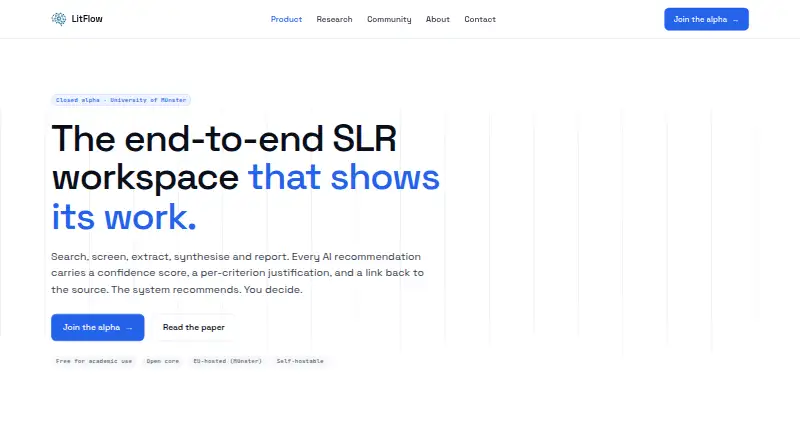
LitFlow is a workspace for systematic literature reviews that spans search, screening, extraction, synthesis, and reporting. Search tools include database search, snowballing, and AI-generated synonyms. During screening, AI proposes a verdict for each criterion with a confidence score, justification, and links to source passages; researchers make the decisions. Suggestions and human decisions are logged with timestamps, actors, and rationales. Users can create extraction schemas that an LLM pre-fills with source links, then organize themes on a qualitative coding board. Methods reports include PRISMA information, Cohen’s κ, and an audit trail. Users can bring keys for Gemini, Claude, OpenAI, or Mistral, or use open-source models hosted by the University of Münster. The project is operated by the university’s research team in Münster, Germany, and describes use across medicine, software engineering, and social sciences. LitFlow is in closed alpha on University of Münster infrastructure in the EU, and maintainers approve new cohort members. Academic use is free; there is no commercial tier.
Who it suits
LitFlow suits researchers conducting systematic reviews who want a logged workflow for screening, extraction, and reporting. The project describes its workflow for medicine, software engineering, and social sciences, though access to the closed alpha requires maintainer approval.
What it does well
- AI screening links suggestions to source passages.
- Researchers retain screening decisions.
- Logs AI suggestions and human decisions.
- Academic use is free.
What to know first
- Closed alpha requires maintainer approval.
- No commercial tier is listed.
- OSF and Zenodo integration remain under consideration.
Limits
The free Academic use plan is limited to academic use, is in closed alpha, and requires maintainer approval. The plan has no commercial tier; institutional self-hosting is described as a planned open-core release.
Plans
| Plan | Billed and limits | Price |
|---|---|---|
| Academic use | Free for academic use · closed alpha; maintainer approval required · no commercial tier | Free |
As litflow.org lists them, read 8 Oct 2026. The maker's own page has the final word.
Getting started
- Visit the LitFlow website and contact the team about joining the closed alpha.
- Wait for maintainer approval to join a cohort.
- Use LitFlow on the web.
Verdict
LitFlow offers a documented review workflow with AI suggestions while leaving decisions to researchers. Access is limited to an approved closed-alpha cohort, and the listed free plan is for academic use.
Questions
Is LitFlow free?
Yes. The Academic use plan is listed as free. It is for academic use and has no commercial tier.
Can anyone sign up now?
LitFlow is in closed alpha, and maintainers approve new cohort members.
Which platforms does LitFlow support?
The listed platforms are web and self-hosted. The hosted closed-alpha instance runs on University of Münster infrastructure in the EU; institutional self-hosting is planned.
Which AI providers can I use?
Users can bring their own keys for Gemini, Claude, OpenAI, or Mistral, or use open-source models hosted by the University of Münster.
Who operates LitFlow?
The website is operated by the LitFlow research project at the University of Münster, a public-law body in Münster, Germany.
Does LitFlow integrate with OSF or Zenodo?
OSF and Zenodo integrations are listed as features under consideration.
Facts from LitFlow's own pages
- AI providers
- Users can bring their own keys for Gemini, Claude, OpenAI, or Mistral, or use open-source models hosted by the University of Münster. · litflow.org, 8 Oct 2026
- AI screening
- For each record, AI proposes per-criterion verdicts with confidence scores, justifications, and links to source passages, while the researcher makes the decisions. · litflow.org, 8 Oct 2026
- Audit trail
- AI suggestions and human decisions are logged with timestamps, actors, and rationales. · litflow.org, 8 Oct 2026
- Availability
- LitFlow is in closed alpha, and maintainers approve new cohort members. · litflow.org, 8 Oct 2026
- Data protection
- The maker says the hosted instance runs on EU infrastructure under GDPR and personal data is pseudonymised in research outputs. · litflow.org, 8 Oct 2026
- Extraction and synthesis
- The workflow includes custom extraction schemas with LLM pre-fill and source links, plus a qualitative coding board for thematic structure. · litflow.org, 8 Oct 2026
- Founded
- 2025 · litflow.org, 28 Sept 2026
- Headquarters
- Münster, Germany · litflow.org, 28 Sept 2026
- Hosting
- The closed alpha runs on University of Münster infrastructure in the EU, and an open-core release is planned for institutional self-hosting. · litflow.org, 8 Oct 2026
- Integration roadmap
- OSF and Zenodo integration are listed as features under consideration. · litflow.org, 8 Oct 2026
- Maker
- The website is operated by the LitFlow research project at the University of Münster, a public-law body in Münster, Germany. · litflow.org, 8 Oct 2026
- Purpose
- LitFlow is an AI-augmented systematic literature review workspace covering search, screening, extraction, synthesis, and reporting. · litflow.org, 8 Oct 2026
- Reporting
- LitFlow reports PRISMA information, Cohen’s κ, and an audit trail in a publication-ready methods report. · litflow.org, 8 Oct 2026
- Search
- Search features include database search, snowballing, and AI-generated synonyms. · litflow.org, 8 Oct 2026
- Support and participation
- The project invites users to contact the team, propose features, contribute code, and join evaluation activities. · litflow.org, 8 Oct 2026
- Target users
- LitFlow is rooted in information systems research and says its workflow is used across medicine, software engineering, and the social sciences. · litflow.org, 8 Oct 2026
- Website privacy
- The website privacy policy says it uses no cookies or tracking or analytics technologies, and its server logs retain shortened IP addresses for at most seven days. · litflow.org, 8 Oct 2026
Where LitFlow stands on Freedom251
- AI Literature Review Software#15 of 38
- Systematic Review Software#14 of 30