Freedom251 › AI Literature Review Software

INRA
What INRA is
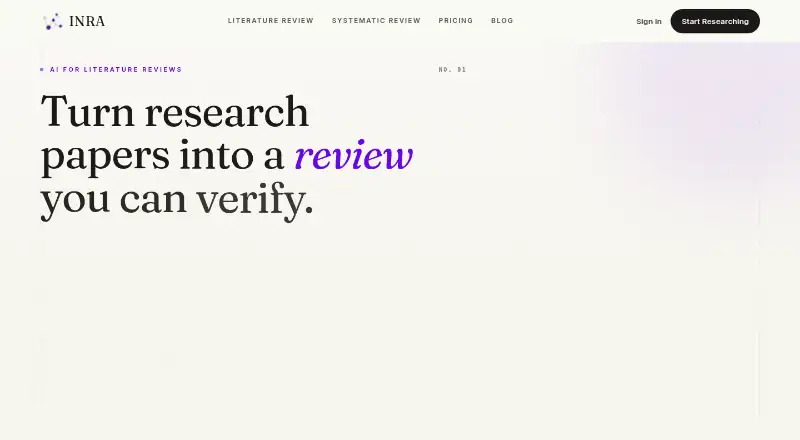
INRA is a web-based tool for AI-assisted narrative literature reviews and systematic review workflows. Its narrative process can search for or import papers, organize findings into a structured draft, and link citations to source records and original papers; supporting passages appear when available. SLR Copilot supports citation import and deduplication, screening, full-text review, data extraction, risk-of-bias assessment, and review-record exports. The system may suggest screening decisions and assist extraction, but reviewers make final decisions and can record conflicts and exclusion reasons. Narrative reviews retrieve records through Semantic Scholar, PubMed Central, and arXiv, while SLR Copilot supports searches through PubMed, OpenAlex, and Semantic Scholar. Users can add PDFs and supported Zotero or Mendeley sources. Narrative reports export to Word, PDF, or LaTeX, with source metadata in BibTeX or CSV; systematic review outputs include PRISMA 2020 flow diagrams and study lists in formats such as RIS, BibTeX, CSV, and Excel. INRA says search may omit papers or full text, with coverage varying by field, date, indexing, and access rights. A free plan is available; paid plans start at $7.50 per user per month, billed annually.
Who it suits
INRA suits researchers drafting narrative reviews or teams conducting systematic reviews, particularly in clinical and health sciences. Reviewers who need to verify source coverage and make final screening decisions should account for those steps.
What it does well
- Supports narrative and systematic review workflows.
- Provides citation links and supporting passages when available.
- Exports narrative reports and systematic review records in multiple formats.
- Reviewers can record conflicts and exclusion reasons.
- Offers a free plan.
What to know first
- Search may omit papers or full text.
- Coverage varies by field, publication date, indexing, and access rights.
- Paid plans start at $7.50 per user per month, billed annually.
Limits
The free plan is available, while Professional costs $120.00 per year ($10.00/month billed annually) and Teams & Institutions costs $90.00 per seat per year ($7.50 per seat/month billed annually) with a minimum of three seats. Search coverage can omit papers or full text and varies by field, publication date, indexing, and access rights.
Plans
| Plan | Billed and limits | Price |
|---|---|---|
| Professional | $120.00 per year (= $10.00/month, billed annually) · Unlimited narrative literature reviews · Full SLR Copilot access · Priority email support · Word, PDF, LaTeX, and review-data export | $120 a year |
| Teams & Institutions | $90.00 per seat per year (= $7.50 per seat/month, billed annually) · Minimum three seats · Everything in Professional · Centralised user management and billing · Dedicated onboarding and support options | $90 a year |
As inra.ai lists them, read 30 Sept 2026. The maker's own page has the final word.
Getting started
- Open the INRA website and create an account on the web platform
- Choose the free plan or a paid plan
- Start a narrative review or open SLR Copilot
- Search supported indexes or import papers, PDFs, citation files, Zotero, or Mendeley sources
- Review AI suggestions, make final screening decisions, and export the report or review records
Verdict
INRA combines narrative drafting with structured systematic-review steps and a range of exports. Its stated search coverage can vary, so it is worth checking whether the available records meet the needs of a particular review.
Questions
Is there a free plan?
Yes. INRA offers a free plan. Paid pricing starts at $7.50 per user per month when billed annually.
What does Professional cost?
Professional is listed at $120.00 per year, equivalent to $10.00 per month billed annually.
What does Teams & Institutions cost?
It is listed at $90.00 per seat per year, equivalent to $7.50 per seat per month billed annually, with a minimum of three seats.
Which platforms and sources are supported?
INRA runs on the web. Narrative reviews use Semantic Scholar, PubMed Central, and arXiv; SLR Copilot supports PubMed, OpenAlex, and Semantic Scholar.
Which export formats are available?
Narrative reports export to Word, PDF, and LaTeX with BibTeX or CSV metadata. SLR Copilot exports PRISMA 2020 diagrams and study lists in RIS, BibTeX, CSV, and Excel.
Who operates INRA?
INRA.AI is owned and operated by Taman Labs.
Facts from INRA's own pages
- Citation review
- Citations link to source records and original papers, and supporting passages are shown when available. · inra.ai, 30 Sept 2026
- Company
- INRA.AI is owned and operated by Taman Labs. · inra.ai, 30 Sept 2026
- Coverage limitation
- INRA says its search may not include every paper or full text and that coverage varies by field, publication date, indexing, and access rights. · inra.ai, 30 Sept 2026
- Exports
- Narrative reports export to Word, PDF, or LaTeX with source metadata in BibTeX or CSV; SLR Copilot exports PRISMA 2020 flow diagrams and study lists in formats including RIS, BibTeX, CSV, and Excel. · inra.ai, 30 Sept 2026
- Headquarters
- INRA's LinkedIn company page lists its headquarters as Cranston, Rhode Island. · linkedin.com, 30 Sept 2026
- Integrations
- Users can add PDFs and supported Zotero or Mendeley sources to narrative reviews; SLR Copilot accepts citation files and full-text PDFs. · inra.ai, 30 Sept 2026
- Intended users
- The site presents narrative reviews for topic overviews, thesis backgrounds, and grant proposals, and SLR Copilot for team-based clinical and health-science reviews. · inra.ai, 30 Sept 2026
- Narrative reviews
- The narrative workflow searches for or imports papers, organizes findings into a structured review draft, and lets users inspect citations. · inra.ai, 30 Sept 2026
- Privacy and security
- INRA says it encrypts data in transit and at rest, uses access controls, and does not sell personal information; research queries and uploaded content may be processed by service providers for AI features. · inra.ai, 30 Sept 2026
- Purpose
- INRA provides AI-assisted workflows for drafting narrative literature reviews and managing systematic reviews. · inra.ai, 30 Sept 2026
- Research sources
- Narrative reviews retrieve records through Semantic Scholar, PubMed Central, and arXiv, while SLR Copilot supports searches through PubMed, OpenAlex, and Semantic Scholar. · inra.ai, 30 Sept 2026
- Systematic reviews
- SLR Copilot supports citation import and deduplication, title and abstract screening, full-text review, data extraction, risk-of-bias assessment, and review-record exports. · inra.ai, 30 Sept 2026
- Team decisions
- AI may suggest screening decisions and assist extraction, but reviewers make final decisions and can record conflicts and exclusion reasons. · inra.ai, 30 Sept 2026
Where INRA stands on Freedom251
- AI Literature Review Software#14 of 38
- Literature Review Software#13 of 28