Freedom251 › Process Orchestration Software

Cadence
What Cadence is
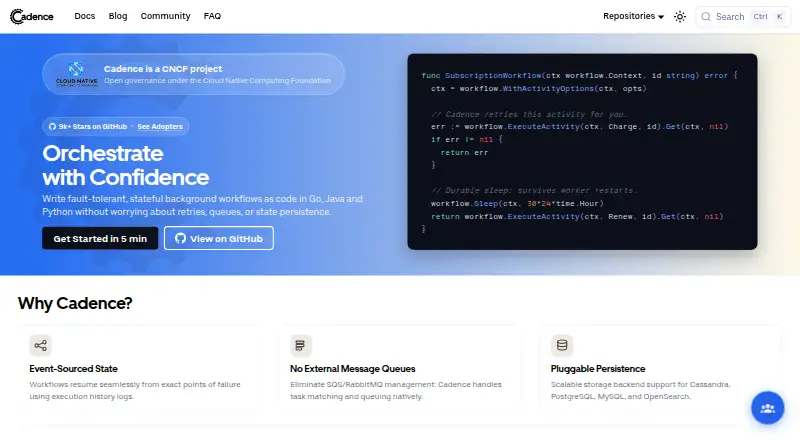
Cadence is an open-source workflow engine for developers building fault-tolerant distributed applications that need to preserve state. Its durable workflows can resume after process restarts, infrastructure failures or pauses. Official SDKs are available for Go, Java and Python, with a community Ruby client. Scheduling supports recurring runs, overlap policies, pausing, updates, backfills and execution history. Deployment options include embedded SQLite, Docker Compose and Kubernetes with Helm; the project also lists a managed Uber cluster for Uber internal teams. Production integrations include Cassandra, MySQL or PostgreSQL for workflow history, and Elasticsearch, OpenSearch or Apache Pinot for visibility. Kafka is listed for search indexing, while Prometheus, StatsD and M3 support metrics. TLS can be configured for backing-service connections, and SDK connections to the frontend support mutual TLS. A custom data converter can compress or encrypt workflow payloads, or replace large payloads with external-storage references. Cadence is free, with no license key, usage limits or per-execution fee. It is self-hosted, and workflow code must be deterministic because Cadence can replay it to rebuild state after a failure.
Who it suits
Cadence is aimed at application developers writing workflows and platform engineers running it as shared infrastructure. It suits teams prepared to operate a self-hosted deployment and write deterministic workflow code.
What it does well
- Resumes workflows after failures and pauses
- Offers official Go, Java and Python SDKs
- Supports SQLite, Docker Compose and Kubernetes deployments
- No license key, usage limits or per-execution fee
- Payloads can be encrypted or compressed
What to know first
- Workflow code must be deterministic
- Self-hosted deployment requires operating the infrastructure
Limits
The free open-source plan has no usage limits or per-execution fee. Workflow code must be deterministic because Cadence may replay it to reconstruct state after a failure.
Plans
| Plan | Billed and limits | Price |
|---|---|---|
| Open source Cadence | No license key · no usage limits · no per-execution fee | Free |
As cadenceworkflow.io lists them, read 9 Oct 2026. The maker's own page has the final word.
Getting started
- Visit the Cadence website.
- Choose a deployment option: embedded SQLite, Docker Compose, or Kubernetes with Helm.
- Select an official Go, Java, or Python SDK, or the community Ruby client.
- Configure storage integrations for workflow history and visibility as needed.
- Write deterministic workflow code and configure connections, including TLS where needed.
Cadence is an open-source workflow engine for developers building fault-tolerant, stateful distributed applications. It suits application developers who write long-running workflows and platform engineers running orchestration as shared infrastructure. Its strongest case is durable execution without per-run charges; the trade-off is operating it yourself and writing replay-safe, deterministic code.
Overview
Cadence turns workflow logic into durable functions that can resume after process restarts, infrastructure failures, or deliberate pauses. That makes it a serious foundation for stateful background processes rather than a simple task list. Event triggers, automatic retries, execution observability, and human approvals cover the control points many production workflows need.
The project dates to 2017 and is open source. You can deploy it with embedded SQLite, Docker Compose, or Kubernetes through Helm. A managed Uber cluster is also described for Uber internal teams, but Cadence's general deployment model remains self-hosted. Readers comparing categories can place it alongside Process Orchestration Software and Workflow Orchestration Software.
Key features
Durable, replayable workflows
Cadence reconstructs workflow state by replaying code, so workflow code must be deterministic. This is a meaningful engineering constraint: teams gain recovery across failures, but ordinary nondeterministic behavior can break replay and demands discipline from developers.
Scheduling and operations
Schedules handle recurring runs, overlap policies, pausing, updates, backfills, and execution history. Those controls suit recurring data, maintenance, and business processes where operators need to revise timing without losing a record of prior executions.
Integrations and protection
Official SDKs cover Go, Java, and Python, with a community Ruby client. Production workflow history can use Cassandra, MySQL, or PostgreSQL; visibility can use Elasticsearch, OpenSearch, or Apache Pinot. Kafka supports search indexing, while Prometheus, StatsD, and M3 provide metrics. TLS is configurable for backing-service connections, and frontend SDK connections support mutual TLS.
A custom data converter can compress or encrypt payloads, or replace large payloads with references to external object storage. This gives platform teams practical control over sensitive or oversized workflow data, though implementation remains their responsibility. Community support runs through Stack Overflow, CNCF Slack, GitHub Issues, and contributors rather than a stated commercial support tier.
Pricing
| Plan | Price | What it includes |
|---|---|---|
| Open source Cadence | free | No license key, no usage limits, and no per-execution fee |
The free plan is the whole product's open-source distribution, not a capped starter edition. There are no seat quotas, execution allowances, or per-run charges published for it, making cost predictable at scale. The cost shifts to your own infrastructure, deployment, storage, security, and operations work because the model is self-hosted.
Platforms
Cadence is offered through an API, web interface, Linux deployment, and self-hosted operation. Kubernetes with Helm and Docker Compose cover common infrastructure paths, while embedded SQLite offers a lighter deployment option. The listed SDK languages make it most natural for teams already building services in Go, Java, or Python; Ruby support comes from the community.
Who it's for
Choose Cadence when your engineering team needs durable, stateful workflows that survive failures and pauses, and when it can operate the underlying service and databases. It is particularly suitable as shared infrastructure for platform teams supporting multiple application workflows. It is a weaker fit for organizations seeking a hosted, low-operations workflow product or for developers unwilling to design around deterministic replay.
Pros and cons
Pros
- Durable functions resume after process and infrastructure failures, preserving long-running work.
- Scheduling includes overlap rules, backfills, pausing, updates, and execution history instead of only fixed recurring triggers.
- No license key, usage limits, or per-execution fees make the open-source plan suitable for high-volume workloads.
- Broad storage, visibility, messaging, metrics, and payload-protection integrations support production architectures.
- Mutual TLS and configurable TLS address transport security between SDKs and services.
Cons
- Self-hosting leaves deployment, databases, upgrades, and operational reliability with your team.
- Replay requires deterministic workflow code, imposing rules that can complicate application design.
- Ruby has only a community client, unlike the official Go, Java, and Python SDKs.
- Support is community-based, with no stated paid support plan.
Alternatives
Joget is a freemium, multi-platform option if you need a free three-user tier and a broader low-code application focus. Bonita suits teams wanting a free, community-supported plan capped at 150 process instances per month. Camunda is worth choosing when a self-managed development plan and a freemium path are preferable.
Dapr fits developers seeking free durable workflows with native integrations and workflow visualizers for development and non-critical workloads. Bizagi Modeler is a simpler modeling choice, with a free one-user plan and local storage. Cloudflare Workflows is the alternative for API and web workloads using Workers Free, with shared request and CPU limits.
Hatchet offers a hosted-style pay-as-you-go route with 1 million free runs and events per month. Inngest is a freemium managed option with a five-seat, 50,000-execution free plan and a $99 a month Pro starting tier.
Verdict
Cadence is a strong choice for engineering-led organizations that need durable, replay-safe workflows and are prepared to run orchestration infrastructure themselves. Its open-source economics, recovery model, scheduling controls, and integration breadth are compelling. Look elsewhere if you want a hosted service, minimal operational ownership, or workflow code that cannot reliably satisfy deterministic replay.
Verdict
Cadence combines durable workflow execution with scheduling and a range of deployment and storage integrations. Its replay requirement and self-hosted model are important considerations for teams evaluating it.
Questions
How much does Cadence cost?
The Open source Cadence plan costs nothing and has no per-execution fee.
Is Cadence open source?
Yes. Cadence is an open-source workflow engine, and the plan requires no license key.
What languages have Cadence SDKs?
Official SDKs are listed for Go, Java, and Python. A community Ruby client is also listed.
How can Cadence be deployed?
Options include embedded SQLite, Docker Compose, and Kubernetes with Helm. A managed Uber cluster is listed for Uber internal teams.
Which storage systems does Cadence integrate with?
Cassandra, MySQL, or PostgreSQL are listed for workflow history. Elasticsearch, OpenSearch, or Apache Pinot are listed for visibility.
What is a key workflow requirement?
Workflow code must be deterministic because Cadence may replay it to reconstruct state after a failure.
Facts from Cadence's own pages
- Deployment
- Deployment options include embedded SQLite, Docker Compose, and Kubernetes with Helm; the page also lists a managed Uber cluster for Uber internal teams. · cadenceworkflow.io, 9 Oct 2026
- Durable workflows
- Workflows are durable functions that Cadence can resume across process restarts, infrastructure failures, and pauses. · cadenceworkflow.io, 9 Oct 2026
- Founded
- 2017 · cadenceworkflow.io, 28 Sept 2026
- Languages
- The project lists official SDKs for Go, Java, and Python, and a community Ruby client. · cadenceworkflow.io, 9 Oct 2026
- Messaging and metrics
- The integrations page lists Kafka for search indexing and Prometheus, StatsD, or M3 for metrics. · cadenceworkflow.io, 9 Oct 2026
- Notable constraint
- Workflow code must be deterministic because Cadence may replay it to reconstruct state after a failure. · cadenceworkflow.io, 9 Oct 2026
- Payload protection
- A custom data converter can compress or encrypt workflow payloads, or replace large payloads with references to external object storage. · cadenceworkflow.io, 9 Oct 2026
- Scheduling
- Schedules support recurring workflow runs, overlap policies, pausing, updates, backfills, and execution history. · cadenceworkflow.io, 9 Oct 2026
- Security
- TLS is configurable on backing service connections, and SDK connections to the frontend support mutual TLS. · cadenceworkflow.io, 9 Oct 2026
- Storage integrations
- The production integrations page lists Cassandra, MySQL, or PostgreSQL for workflow history, and Elasticsearch, OpenSearch, or Apache Pinot for visibility. · cadenceworkflow.io, 9 Oct 2026
- Support
- The project points users to Stack Overflow, CNCF Slack, GitHub Issues, and community contributors for support. · cadenceworkflow.io, 9 Oct 2026
- What it does
- Cadence is an open-source workflow engine for building fault-tolerant, stateful distributed applications. · cadenceworkflow.io, 9 Oct 2026
- Who it is for
- Cadence targets application developers writing workflows and platform engineers operating Cadence as shared infrastructure. · cadenceworkflow.io, 9 Oct 2026
Where Cadence stands on Freedom251
- Process Orchestration Software#5 of 31
- Workflow Orchestration Software#10 of 38