Freedom251 › Process Orchestration Software
Dapr
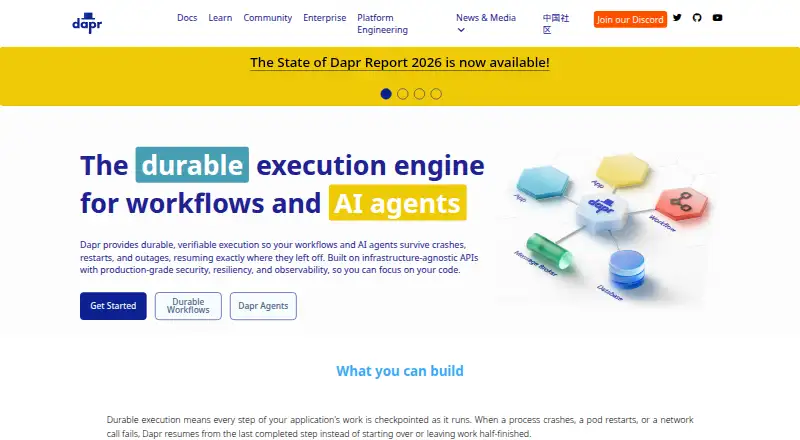
What Dapr is
Dapr is an open-source runtime for building durable workflows, AI agents, and distributed applications. Its workflows handle long-running, stateful processes with retries, timers, human approvals, and sagas. AI agents can use checkpointed plans to recover after failures. For service-to-service communication, Dapr offers HTTP or gRPC calls with discovery, tracing, and error handling. Other APIs cover pub/sub, state, actors, jobs, secrets, configuration, bindings, distributed locks, and cryptography. Dapr runs as a sidecar process or container, keeping its runtime code outside the application. It can be hosted on Kubernetes or self-hosted on Windows, Linux, macOS, and physical or virtual machines. Security includes mTLS encryption in transit, access policies, and automatic certificate rotation. Stable SDKs are available for .NET, Python, Java, Go, PHP, and JavaScript; C++ and Rust SDKs are in development. Dapr is free and open source. Paid Dedicated Cloud starts at $1,199 a month, and BYOC starts at $1,599 a month; both include a first 14 days free.
Who it suits
Dapr suits developers building distributed services, durable workflows, or AI agents, especially teams deploying on Kubernetes or self-hosted infrastructure. Stable SDKs cover six languages, with two more in development.
What it does well
- Free and open source.
- Workflows support retries, timers, approvals, and sagas.
- mTLS encryption is enabled by default.
- Stable SDKs cover six languages.
- Runs on Kubernetes or self-hosted machines.
What to know first
- Dedicated Cloud starts at $1,199 a month.
- BYOC starts at $1,599 a month.
- C++ and Rust SDKs are still in development.
Limits
Cloud Free is for development and non-critical workloads. Dedicated Cloud and BYOC each include a first 14 days free; their listed starting prices are $1,199 a month and $1,599 a month, respectively.
Plans
| Plan | Billed and limits | Price |
|---|---|---|
| Cloud Free | development and non-critical workloads · durable workflows · native integrations · workflow visualizers | Free |
| Dedicated Cloud | Starting price · first 14 days free · single-tenant · fully managed · compute, storage and networking included · 99.95% availability with Select and Premium support | $1,199 a month |
| BYOC | Starting price · first 14 days free · data plane in your cloud · control plane in Diagrid cloud · data sovereignty and localization · 99.95% availability | $1,599 a month |
| Enterprise Server | Priced for your deployment · on-premises · air-gapped and disconnected environments supported · namespace isolation | On request |
As dapr.io lists them, read 1 Oct 2026. The maker's own page has the final word.
Getting started
- Visit the Dapr website.
- Choose the open-source Cloud Free plan or review the Dedicated Cloud and BYOC options.
- Use the Dapr CLI to run applications with sidecars and review sidecar logs.
- Deploy on Kubernetes or self-host on Windows, Linux, macOS, or physical or virtual machines.
Dapr is an open-source runtime for distributed applications, with durable workflow and agent capabilities. It suits teams building services across infrastructure they operate; its breadth is a strength, but adopting the sidecar runtime adds an operational responsibility.
Its central advantage is a shared set of APIs for service communication, workflows, messaging, state, and other building blocks. Teams that want a managed deployment can choose Diagrid’s cloud plans, though they start at $1,199 a month.
Overview
Dapr exposes HTTP and gRPC APIs through a sidecar container or process, keeping runtime code out of application code. Its component model separates those APIs from the underlying resource: for example, teams can switch between RabbitMQ and Kafka through configuration rather than changing application code.
The scope goes well beyond workflow orchestration. One runtime covers service invocation, pub/sub, state, secrets, actors, jobs, configuration, bindings, distributed locks, and cryptography. That consolidation is useful for teams that need several of these capabilities, but Dapr is a broader commitment than a focused workflow library. Stable SDKs are available for .NET, Python, Java, Go, PHP, and JavaScript; C++ and Rust SDKs are in development.
Key features
Durable workflows and agents
Workflows support long-running, stateful processes with retries, timers, human approvals, and sagas. Workflow versioning and audit logs suit processes that need continuity and traceability, while checkpointed plans let AI agents recover from failures. This is a meaningful fit for work that must survive crashes, restarts, or outages, rather than just coordinate short-lived tasks.
Service communication and resilience
Service invocation provides HTTP or gRPC calls with service discovery, distributed tracing, and error handling. Dapr also supports configurable retries, back-offs, circuit breakers, and timeouts. Security features are on by default, with communication encrypted in transit using mTLS; additional controls include App IDs, namespaces, access policies, topic scoping, API tokens, and automatic certificate rotation. This gives service teams a consistent base for communication and resilience, though they still need to configure the controls to fit their deployment.
Operations and integrations
The CLI runs applications with sidecars, reviews sidecar logs, and lists services in self-hosted and Kubernetes environments. Dapr emits metrics, logs, and traces and supports W3C Trace Context and OpenTelemetry. Official integrations include AWS, Azure, KEDA, GitHub Actions, the Dapr Kubernetes Operator, Kratix Marketplace, and Argo CD. Framework integrations include ASP.NET Core, Spring Boot, Flask, and Express; Dapr Agents is a Python framework for durable LLM-powered agents.
Applications can run on Kubernetes or self-hosted on Windows, Linux, macOS, and clusters of virtual or physical machines across cloud and edge environments. That flexibility is valuable when teams need deployment control, but it also leaves them responsible for operating the runtime unless they choose a managed plan.
Pricing
Open source and Cloud Free
Dapr’s open-source option is free, and the Cloud Free plan costs nothing. Cloud Free is aimed at development and non-critical workloads and includes durable workflows, native integrations, and workflow visualizers. It is a useful starting point for evaluation and lower-stakes work, not the plan to choose for a critical production workload.
Managed cloud plans
Dedicated Cloud starts at $1,199 a month, billed monthly, with the first 14 days free. It is single-tenant and fully managed, with compute, storage, and networking included, plus 99.95% availability with Select and Premium support. It suits teams seeking a managed, dedicated environment, but the starting price makes it a substantial step up from open source.
BYOC starts at $1,599 a month, billed monthly, with the first 14 days free. Its data plane runs in your cloud while the control plane runs in Diagrid cloud; it includes data sovereignty and localization and 99.95% availability. Choose it when keeping the data plane in your own cloud matters enough to justify the higher starting price.
Enterprise Server
Enterprise Server has custom pricing, priced for your deployment. It supports on-premises, air-gapped, and disconnected environments, with namespace isolation. It is the option for deployments that cannot use the managed cloud plans, but its cost depends on the deployment.
Diagrid also provides enterprise support for open-source Dapr across three tiers, with commitments covering response times, security patching, architecture reviews, and training. That gives teams a support path without requiring a cloud plan.
Platforms
Dapr supports API-based applications and runs on Linux, macOS, and Windows. Deployment options include self-hosting and Kubernetes, spanning virtual and physical machines across cloud and edge environments.
Who it's for
Dapr is best suited to teams building distributed services, long-running workflows, or durable AI agents that need a consistent runtime across infrastructure. It is particularly compelling when a project needs several of its APIs, wants to swap underlying components through configuration, or needs workflows to recover from failure. Teams that need only a narrow orchestration tool, or do not want to operate a sidecar runtime, should weigh that breadth against the added operational commitment.
Pros and cons
- Pros: Broad APIs for workflows, service invocation, pub/sub, state, and more let teams consolidate distributed-application capabilities behind one runtime.
- Pros: Sidecar-based HTTP and gRPC APIs keep Dapr runtime code out of application code, while the component model can change resources such as RabbitMQ and Kafka through configuration.
- Pros: Workflow retries, timers, human approvals, sagas, versioning, and audit logs support complex processes that need to endure and remain traceable.
- Pros: Self-hosting across operating systems and Kubernetes gives teams deployment choices across cloud and edge environments.
- Cons: Self-hosting means taking responsibility for operating and configuring another runtime.
- Cons: C++ and Rust SDKs are still in development, so teams using those languages do not have the stable SDK option available in the six supported languages.
- Cons: Managed cloud plans start at $1,199 a month, a substantial cost for teams that want managed operation rather than self-hosting.
Alternatives
For a wider comparison of orchestration tools, see Process Orchestration Software. Choose Bonita if its free plan’s 150 process instances per month and community support match your process needs. Camunda is another option with free self-managed development and testing. Consider Bizagi Modeler when its free plan’s single user, unlimited processes and models, and local storage fit a modeling-focused need.
Cloudflare Workflows is an alternative with a free Workers plan that includes 100,000 shared daily requests, 10 ms CPU per invocation, and 1 GB-month storage. Hatchet offers a free pay-as-you-go tier with 1M runs and 1M events per month. Inngest may suit teams seeking a free plan with five seats, 50k executions, and 500k events ingested, or a Pro plan starting at $99 a month. Restate offers 50k durable actions per month free and a cloud plan from $75 per month. Trigger.dev has a free plan with $5 monthly credits, 20 concurrent runs, unlimited tasks, and five team members.
Verdict
Choose Dapr if your team needs durable workflows alongside service communication and supporting APIs, and values running the same sidecar-based runtime across infrastructure it controls. Its breadth, component model, and failure recovery are the strongest reasons to adopt it. Look elsewhere if you need only focused orchestration or want managed operation without a substantial monthly starting price.
Verdict
Dapr brings workflow, service communication, and supporting APIs behind a sidecar-based runtime. The free open-source option is distinct from its paid managed cloud plans.
Questions
Is Dapr free?
Dapr is free and open source. Cloud Free is listed as free for development and non-critical workloads.
What do the paid cloud plans cost?
Dedicated Cloud starts at $1,199 a month, and BYOC starts at $1,599 a month. Both list a first 14 days free.
Where can Dapr run?
Dapr runs on Kubernetes or self-hosted on Windows, Linux, and macOS, as well as on physical or virtual machines.
Which programming languages have stable SDKs?
Stable SDKs are available for .NET, Python, Java, Go, PHP, and JavaScript. C++ and Rust SDKs are in development.
What does Dapr provide for workflows?
Its workflows support long-running stateful processes, retries, timers, human approvals, and sagas. Workflow versioning is also supported.
Who provides enterprise support?
Diagrid provides enterprise support for open-source Dapr across three tiers, with commitments covering response time, security patching, architecture review, and training.
Facts from Dapr's own pages
- AI agents
- Dapr enables AI agents to reason, call tools, and recover from failure with checkpointed plans. · dapr.io, 1 Oct 2026
- APIs
- Dapr provides APIs for state management, secrets, bindings, actors, configuration, distributed locks, cryptography, jobs and conversations. · docs.dapr.io, 1 Oct 2026
- Building blocks
- Dapr provides APIs for workflow, service invocation, pub/sub, state, actors, jobs, secrets, configuration, bindings, distributed locks, and cryptography. · dapr.io, 1 Oct 2026
- CLI
- The Dapr CLI runs applications with sidecars, reviews sidecar logs, and lists services in self-hosted and Kubernetes environments. · docs.dapr.io, 1 Oct 2026
- Component model
- Dapr components decouple APIs from underlying resources so implementations such as RabbitMQ and Kafka can be changed through component configuration without changing application code. · dapr.io, 1 Oct 2026
- Deployment
- Dapr applications run on Kubernetes or self-hosted on virtual or physical machines across cloud and edge environments. · dapr.io, 1 Oct 2026
- Founded
- 2019 · dapr.io, 28 Sept 2026
- Frameworks
- Dapr has integrated frameworks including ASP.NET Core, Spring Boot, Flask and Express, and Dapr Agents is a Python framework for durable LLM-powered agents. · docs.dapr.io, 1 Oct 2026
- Hosting
- Dapr can run self-hosted on Windows, Linux or macOS and on Kubernetes or clusters of physical or virtual machines. · docs.dapr.io, 1 Oct 2026
- Integrations
- Official integrations include AWS, Azure, KEDA, GitHub Actions, the Dapr Kubernetes Operator, Kratix Marketplace, and Argo CD. · docs.dapr.io, 1 Oct 2026
- Microservices
- Service-to-service calls include service discovery, mTLS, retries, and distributed tracing through one API. · dapr.io, 1 Oct 2026
- Observability
- Dapr emits metrics, logs and traces and supports W3C Trace Context and OpenTelemetry. · docs.dapr.io, 1 Oct 2026
- Open source origin
- Microsoft announced Dapr as an open source project on October 16, 2019. · opensource.microsoft.com, 1 Oct 2026
- Project status
- Dapr was accepted into CNCF incubation in 2021 and became a graduated CNCF project on October 30, 2024. · cncf.io, 1 Oct 2026
- Pub/sub
- Dapr supports the publish-subscribe pattern between applications. · dapr.io, 1 Oct 2026
- Purpose
- Dapr provides durable, verifiable execution so workflows and AI agents survive crashes, restarts, and outages. · dapr.io, 1 Oct 2026
- Resiliency
- Dapr supports configurable retries, back-offs, circuit breakers, and timeouts. · dapr.io, 1 Oct 2026
- SDK languages
- Stable SDKs are available for .NET, Python, Java, Go, PHP, and JavaScript; C++ and Rust SDKs are in development. · docs.dapr.io, 1 Oct 2026
- Security
- Dapr uses automatically enabled mutual TLS between sidecars, App IDs, namespace isolation and policy-based access controls for services, topics, components and secrets. · docs.dapr.io, 1 Oct 2026
- Security controls
- Dapr supports App IDs, namespaces, access policies, topic scoping, mTLS, API tokens, and automatic certificate rotation. · docs.dapr.io, 1 Oct 2026
- Service invocation
- Service invocation provides HTTP or gRPC communication with service discovery, distributed tracing and error handling. · dapr.io, 1 Oct 2026
- Sidecar architecture
- Dapr exposes HTTP and gRPC APIs as a sidecar container or process, so application code does not include Dapr runtime code. · docs.dapr.io, 1 Oct 2026
- Support
- Diagrid pricing lists portal, email and Slack support, unlimited support calls, onboarding support and tiered response times for commercial offerings. · diagrid.io, 1 Oct 2026
- Workflow
- Dapr workflows support long-running, stateful processes with retries, timers, human approvals, and sagas. · dapr.io, 1 Oct 2026
Where Dapr stands on Freedom251
- Process Orchestration Software#7 of 31