
Bubble
by Bubble
What Bubble is
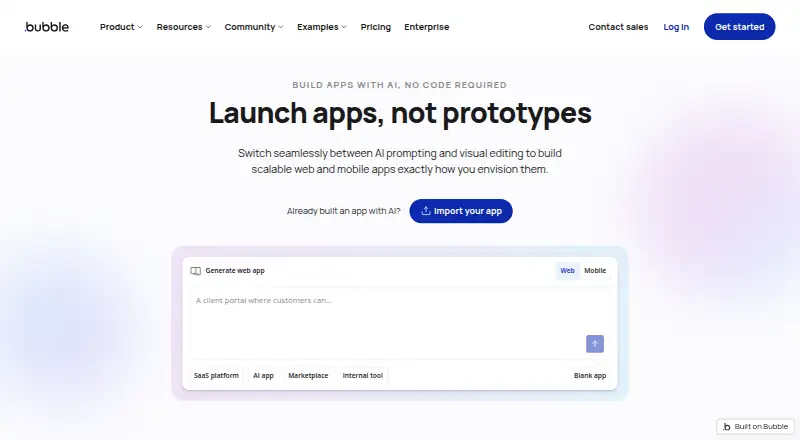
Bubble is a platform for building web and mobile apps, with web, iOS, and Android projects supported on one platform. A project’s web and mobile apps can use the same backend, database, workflows, and API connections. Bubble includes a built-in database and user authentication, and can connect to services such as Stripe and Google Maps. Native mobile apps can be published to the iOS and Android app stores. Users can build an app before upgrading to launch it. The free plan includes one app editor, 50K workload units per month, and six hours of server logs. Paid Web + Mobile plans start with Starter at $59 a month, billed annually; that tier includes 175K workload units per month, two days of server logs, five build submissions per month, and three live app versions. Growth and Team add editors and other capacity, while Enterprise offers custom workload units, hosting location choice, a customizable server, and dedicated support. Bubble lists a 14-day trial that converts to a paid Starter subscription unless canceled. Starting it triggers a temporary $1 card pre-authorization, which expires within 5-10 business days. The company, operated by Bubble Group, Inc., was founded in 2012 and is headquartered in New York, NY.
Who it suits
Bubble suits people who want to build web and mobile apps with a shared backend, database, workflows, and API connections. Its plans also accommodate teams that need multiple app editors, and its Enterprise tier includes dedicated support.
What it does well
- Build apps before upgrading to launch.
- Web and mobile apps can share backend resources.
- Includes a built-in database and user authentication.
- Native apps can be published to iOS and Android stores.
- Production-ready apps include security scanning.
What to know first
- Free plan has one app editor.
- Free plan includes 50K workload units per month.
- Starter requires annual billing at $59 a month.
- Trial converts to paid Starter unless canceled.
Limits
The free plan includes one app editor, 50K workload units per month, and six hours of server logs. Starter costs $59 a month billed annually and includes 175K workload units per month, two days of server logs, five build submissions per month, and three live app versions.
Plans
| Plan | Billed and limits | Price |
|---|---|---|
| Free — Web + Mobile | 1 app editor · 50K workload units/mo · 6 hours of server logs | Free |
| Starter — Web + Mobile | Billed annually · 175K workload units/mo · 2 days of server logs · 5 build submissions/mo · 3 live app versions | $59 a month |
| Growth — Web + Mobile | Billed annually · 250K workload units/mo · 2 app editors · 10 custom branches · 14 days of server logs · 10 build submissions/mo · 5 live app versions | $209 a month |
| Team — Web + Mobile | Billed annually · 500K workload units/mo · 5 app editors · 25 custom branches · 20 days of server logs · 20 build submissions/mo · 8 live app versions | $549 a month |
| Enterprise — Web + Mobile | Custom workload units · Choice of hosting location · Customizable server · Dedicated support team · Pay by invoice or ACH | On request |
| Free | — | Free |
| Growth | billed annually | $209 a month |
| Starter Web only | paid annually | $32 a month |
The first 8 of 11 plans, as bubble.io lists them, read 22 Sept 2026. The maker's own page has the final word. Every plan
Getting started
- Visit bubble.io.
- Build an app on the free plan before upgrading to launch.
- Choose a Web + Mobile plan when ready to launch.
- For the 14-day trial, cancel before it ends to avoid automatic conversion to paid Starter.
Overview
Bubble is a no-code platform for building web and native mobile apps around a shared project foundation. It suits builders who want one backend, database, workflows, and API connections to support apps across web, iOS, and Android. Its biggest strength is that shared setup; its main trade-off is that launching requires a paid plan, and the higher tiers become expensive for teams.
Key features
A Bubble project can include web, iOS, and Android apps, and native mobile apps can be published to the iOS and Android app stores. Those versions can share the same backend, database, workflows, and API connections. That can keep a multi-platform project coordinated, though the plan’s workload and publishing allowances still shape how much activity it can support.
Bubble includes a built-in database, user authentication, and API integrations. It can connect to services such as Stripe and Google Maps, giving builders common pieces for apps that handle users, data, and external services. Production-ready apps include security scanning, and Bubble describes its security and performance as enterprise-grade for scaling apps.
The free plan is useful for building before launch: it allows 50K workload units per month, one app editor, and six hours of server logs. That is enough room to develop a project, but the single-editor cap limits collaboration and the short log history gives little time to review older activity.
Pricing
Bubble uses a freemium model. The Free plan costs nothing and is for projects under construction. It supports web and mobile app building with one editor, 50K workload units per month, and six hours of server logs. It is a practical starting point, but projects ready to launch need a paid plan.
Starter costs $59 a month, billed annually. It is the launch tier, with 175K workload units per month, two days of server logs, five build submissions per month, and three live app versions. Builders moving from development to a live project gain more operating room, but the annual billing term and capped submissions and versions matter.
Growth costs $209 a month, billed annually. It raises the workload allowance to 250K units per month and includes two app editors, 10 custom branches, 14 days of logs, 10 build submissions per month, and five live app versions. This is a better fit for a small team that needs parallel editing and more project history, though the price is a steep step up from Starter.
Team costs $549 a month, billed annually. Its 500K monthly workload units, five editors, 25 custom branches, 20 days of logs, 20 build submissions per month, and eight live app versions support a larger team and heavier release cadence. The extra collaboration capacity is substantial, but the cost makes it a poor fit for a solo builder or a project still proving itself.
Enterprise has custom pricing, custom workload units, a choice of hosting location, a customizable server, and a dedicated support team; payment can be by invoice or ACH. It is aimed at organizations that need tailored scale and support rather than a fixed tier. A separate Starter Web only plan costs $32 a month, paid annually, for web-only projects.
The 14-day trial automatically converts to a paid Starter subscription unless canceled. Bubble performs a temporary $1 card pre-authorization, which expires within 5-10 business days.
Platforms
Bubble supports web, iOS, and Android. Native mobile apps can be published to both major app stores, while web and mobile versions can share project infrastructure. Choose it when those platforms need to work from one project; a web-only project can use the lower-priced Starter Web only plan.
Who it's for
Bubble is best suited to builders who want to develop an app before launch, then carry web and mobile versions forward on one shared backend. The free tier suits early building, Starter suits a project ready to launch, and Growth or Team makes more sense when multiple editors and larger workload allowances are needed. It is less suitable for someone who needs a permanently free live product or wants several collaborators on the free tier.
Pros and cons
- Pro: Web and mobile apps can share a backend, database, workflows, and API connections, keeping a multi-platform project together.
- Pro: The free plan supports app building before launch, with 50K monthly workload units and no paid commitment during development.
- Pro: Growth and Team add editors, custom branches, longer logs, and more build submissions for collaborative work.
- Con: Free includes only one editor and six hours of logs, limiting collaboration and the time available to inspect server activity.
- Con: Launching starts at $59 a month billed annually, while collaborative tiers rise to 209.00 USD and $549 a month.
- Con: The trial becomes a paid Starter subscription unless canceled, so the 14-day trial requires an active cancellation decision.
Alternatives
For a broad comparison, browse No-code app builders, No-Code Development Platforms, No-Code AI App Builders, or AI App Builders.
- Mendix is another freemium option with a free plan and support for web, mobile, desktop, Linux, and self-hosted platforms.
- FlutterFlow has a free plan for up to two projects, with limits on credits, AI requests, and API endpoints; consider it if those allowances fit your project.
- Zoho Creator offers a free plan limited to one user and one app, with caps of 1,000 records and 250 MB storage.
- Retool has a free plan and supports web, mobile, API, and self-hosted platforms; its Team plan is listed at $10/mo per builder and $5/mo per internal user.
- Lovable has a free plan with daily build credits, monthly Cloud and AI credits, and unlimited workspace members.
- MIT App Inventor is a free educational platform for building Android and iOS apps.
- Oracle APEX has a free option included with supported Oracle Database editions and supports web and self-hosted platforms.
- Clappia offers a free plan with no time limit, 100 users, 400 monthly submissions, and 400 workflow step executions per month.
Verdict
Choose Bubble if you want to build web and native mobile apps on one shared backend and can budget for a paid plan when it is time to launch. Its free development tier and unified project foundation make it a strong fit for apps intended to span platforms. Look elsewhere if a free live plan, multiple free editors, or a lower-cost launch tier is essential; also cancel the trial in time if you do not want Starter billing to begin.
Verdict
Choose Bubble if you want to build web and mobile apps that share a backend, database, workflows, and API connections. The free plan supports building before launch, while a paid plan is needed for projects ready to launch. Look elsewhere if a single-editor free plan is too limited or you do not want a trial that converts to paid Starter unless canceled.
Questions
Is Bubble free?
Yes. Its free plan costs 0.00 USD and includes one app editor, 50K workload units per month, and six hours of server logs.
How much does a paid plan cost?
Starter — Web + Mobile is $59 a month, billed annually. Growth is $209 a month and Team is $549 a month, both billed annually.
Which platforms does Bubble support?
Bubble supports web, iOS, and Android apps. Native mobile apps can be published to the iOS and Android app stores.
Does Bubble include a database and authentication?
Yes. Bubble lists a built-in database and user authentication.
Does the trial automatically become paid?
Yes. The 14-day trial converts to a paid Starter subscription unless canceled. It also uses a temporary $1 card pre-authorization that expires within 5-10 business days.
Who makes Bubble?
Bubble is operated by Bubble Group, Inc. The company was founded in 2012 and is headquartered in New York, NY, United States.
Facts from Bubble's own pages
- API integrations
- Yes · manual.bubble.io, 22 Sept 2026
- App types
- both · manual.bubble.io, 22 Sept 2026
- Builder Community
- Bubble reports nearly 6 million builders using the platform. · bubble.io, 27 Sept 2026
- Built-in database
- Yes · manual.bubble.io, 22 Sept 2026
- Enterprise Security
- Bubble provides enterprise-grade security and performance for scaling apps. · bubble.io, 27 Sept 2026
- Company Name
- Bubble is operated by Bubble Group, Inc. · bubble.io, 27 Sept 2026
- Dedicated Support
- Enterprise includes a dedicated support team. · bubble.io, 27 Sept 2026
- Founded
- 2012 · bubble.io, 23 Sept 2026
- Free App Editor
- The Free plan includes one app editor. · bubble.io, 27 Sept 2026
- Free App Building
- Users can build any app for free before upgrading when ready to launch. · bubble.io, 27 Sept 2026
- Free plan
- Yes · manual.bubble.io, 22 Sept 2026
- Free Server Logs
- The Free plan includes six hours of server logs. · bubble.io, 27 Sept 2026
- Free Workload
- The Free plan includes 50K workload units per month. · bubble.io, 27 Sept 2026
- Headquarters
- New York, NY, United States · bubble.io, 23 Sept 2026
- Service Integrations
- Bubble can connect with services such as Stripe and Google Maps. · bubble.io, 27 Sept 2026
- Mobile publishing
- Yes · manual.bubble.io, 22 Sept 2026
- Native App Publishing
- Native mobile apps can be published to iOS and Android app stores. · bubble.io, 27 Sept 2026
- Security Scanning
- Production-ready Bubble apps include security scanning. · bubble.io, 27 Sept 2026
- Shared Backend
- Web and mobile apps in a project can share the same backend, database, workflows, and API connections. · bubble.io, 27 Sept 2026
- Paid from
- 59 · manual.bubble.io, 22 Sept 2026
- Team App Editors
- The Growth plan includes two app editors, while Team includes five. · bubble.io, 27 Sept 2026
- Annual Transactions
- Bubble apps process more than $1 billion in transactions per year. · bubble.io, 27 Sept 2026
- Trial Conversion
- If not canceled, the trial automatically becomes a paid Starter subscription. · manual.bubble.io, 27 Sept 2026
- Trial Card Check
- Bubble performs a temporary $1 card pre-authorization that expires within 5-10 business days. · manual.bubble.io, 27 Sept 2026
Where Bubble stands on Freedom251
- Front End Tools#1 of 28
- No-code app builders#12 of 177
- Browser Based#4 of 34
- AI App Builders#6 of 39
- Low Code No Code Software#4 of 26
- App Generation#5 of 29
- No Code Platform#5 of 29
- Drag and Drop App Builder Software#7 of 34
- No-Code Development Platforms#8 of 36
- Startup App Builder#7 of 30
- No-Code AI App Builders#8 of 29
- Full Stack Generators#9 of 26