
Black Magic Debug
What Black Magic Debug is
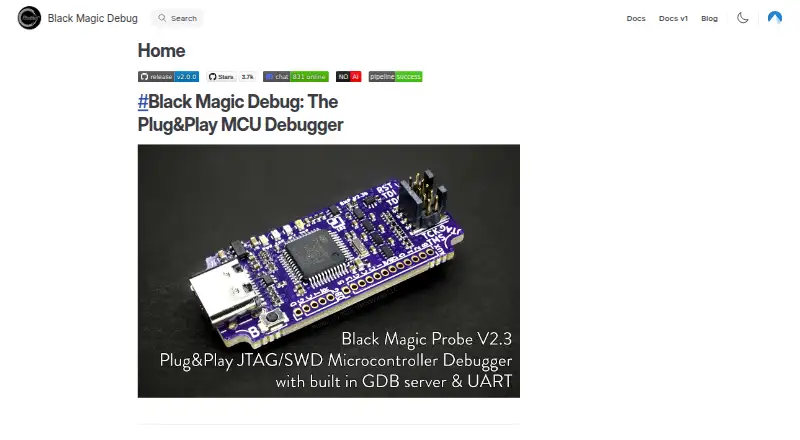
Black Magic Debug is a free JTAG/SWD debugger for embedded microcontrollers. Its firmware includes a GDB server with automatic target detection, so users can debug without target-specific configuration scripts. Debugging tools include watchpoints, flash memory breakpoints, memory and register examination, and flash programming. The listed target platforms are ARM Cortex-M, ARM Cortex-A, and RISC-V, and remote debugging is supported.
The probe connects to a computer as a standard USB CDC ACM virtual serial device; Linux and macOS need no special drivers for this interface. Black Magic Debug supports Windows, Linux, and macOS. Its GDB server also supports semihosting and host I/O, Serial Wire Output, and USB DFU firmware upgrades. Documentation includes usage guides for PlatformIO and STM32CubeIDE.
The project can also be compiled as a desktop application and used with BMP, ST-Link, FTDI-MPSSE, SEGGER J-Link, and CMSIS-DAP adapters. Programming is a little slower in desktop-app mode, though BMP development may be faster because firmware upload is not needed. Getting started requires a Black Magic Probe and a suitable toolchain for the target processor. The project describes itself as open source, and its supported-hardware page marks Probe V2.3 active while several older models are legacy and not in production.
Who it suits
Black Magic Debug suits embedded software developers who want control over their build systems and testing environments. It is intended for users debugging supported microcontrollers with a compatible probe and processor toolchain, including people using PlatformIO or STM32CubeIDE.
What it does well
- Automatic target detection avoids target-specific configuration scripts.
- Provides watchpoints, flash breakpoints, memory and register examination, and flash programming.
- Supports semihosting, Serial Wire Output, and USB DFU firmware upgrades.
- Runs on Windows, Linux, and macOS.
- Open-source project with guides for PlatformIO and STM32CubeIDE.
What to know first
- Requires a compatible Black Magic Probe and a suitable target toolchain.
- Programming is a little slower in desktop-app mode.
- Several older probe models are legacy and not in production.
Limits
The free software requires compatible probe hardware and a suitable toolchain. Programming is a little slower in desktop-app mode.
Plans
| Plan | Billed and limits | Price |
|---|---|---|
| Black Magic Debug software | JTAG/SWD debugger for embedded microcontrollers · requires compatible probe hardware and a suitable toolchain | Free |
As black-magic.org lists them, read 8 Oct 2026. The maker's own page has the final word.
Getting started
- Visit https://black-magic.org/.
- Get a Black Magic Probe and a suitable toolchain for the target processor.
- Connect the probe to a Windows, Linux, or macOS host over USB.
- Use the documentation's PlatformIO or STM32CubeIDE guide if applicable.
- Use the GDB server for debugging, or compile the project as a desktop application with a supported adapter.
Black Magic Debug is a free JTAG/SWD debugger for embedded microcontrollers, aimed at professional developers who want control over their build and test setup. Its automatic target detection and integrated GDB server suit ARM and RISC-V work, though using it requires compatible probe hardware and a target toolchain.
Overview
The GDB server detects targets without target-specific configuration scripts, which can reduce setup work when moving between supported targets. Remote debugging is supported, and the target-platform listing includes ARM Cortex-M, ARM Cortex-A, and RISC-V. This is a focused embedded-development tool, not a general debugger for everyday application software.
The probe connects to a host as a standard USB CDC ACM virtual serial device; Linux and macOS need no special drivers. Windows, Linux, and macOS are supported. Hardware availability deserves attention: Black Magic Probe V2.3 is active, while several older models are legacy and no longer in production.
Key features
Watchpoints, flash memory breakpoints, and memory and register examination support tracking program state and diagnosing faults. Flash programming also lets developers use the same setup to write firmware. Semihosting/host I/O and Serial Wire Output support target output, while USB DFU firmware upgrades provide a way to update probe firmware.
Documentation includes usage guides for PlatformIO and STM32CubeIDE, useful starting points for developers using those environments. The project also invites questions and suggestions through its chat and aims to cover getting started with microcontroller development and debugging.
Pricing
Black Magic Debug software: free. The free plan provides the JTAG/SWD debugger software without a paid tier, but it does not remove the need to obtain a compatible Black Magic Probe and a suitable toolchain for the target processor. There are no stated seat, quota, or renewal terms.
Platforms
The software supports Windows, Linux, and macOS hosts. The standard USB CDC ACM connection avoids special driver installation on Linux and macOS. The project can also be compiled as a desktop application, which can use BMP, ST-Link, FTDI-MPSSE, SEGGER J-Link, and CMSIS-DAP adapters. The trade-off is slightly slower programming in desktop-app mode; BMP development may be faster because firmware upload is not needed.
Who it's for
Black Magic Debug is best suited to professional embedded software developers who want control over their build systems and testing environments, especially those working with supported microcontrollers and willing to manage their own toolchain and hardware. Its open-source nature lets users inspect the project, and automatically built firmware images are available for official hardware. It is a poorer fit for someone seeking a debugging setup without compatible probe hardware or a target-specific toolchain.
Pros and cons
- Pro: Automatic target detection avoids target-specific configuration scripts, reducing setup overhead.
- Pro: Debugging, flash programming, semihosting/host I/O, and Serial Wire Output cover several common embedded workflows.
- Pro: Windows, Linux, and macOS support gives developers flexibility in host choice.
- Con: A compatible probe and suitable target toolchain are required, so the free software is not a complete hardware-free setup.
- Con: Programming is a little slower in desktop-app mode, and older probe models are legacy rather than in production.
Alternatives
pyOCD is another free open-source project, and may suit readers seeking an alternative debugger. OpenOCD is also free and open source, distributed through operating-system packages or source code. For a general open-source debugger, GDB is free with source code available; LLDB is another free open-source option and supports Android and iOS as well as desktop platforms.
IDA Pro may suit readers who need disassembly and cloud-based decompilers: its free tier covers x86-32 and x86-64 disassembly with two cloud-based decompilers, while IDA Pro Essential costs 1099.00 USD. Perl Debugger is a free alternative for Perl, included with Perl and requiring the program to compile correctly before debugging. PonyDebugger is a free Apache License 2.0 option with an iOS client and gateway server. FlowStorm is free and open source, with no monetary cost. See more debuggers.
Verdict
Choose Black Magic Debug if you are an embedded developer who wants a free, inspectable JTAG/SWD setup with automatic target detection and useful firmware-debugging functions. Its strongest case is the integrated GDB server and coverage of embedded workflows across major desktop hosts. Look elsewhere if you cannot source compatible probe hardware, or if desktop-app programming speed is a priority.
Verdict
Choose Black Magic Debug if you need a free JTAG/SWD debugger with automatic target detection and control over your embedded development setup. It supports multiple host systems and useful debugging functions, but you need compatible probe hardware and a suitable toolchain. Consider the desktop-app programming speed and the status of older probe models when choosing hardware.
Questions
How much does Black Magic Debug cost?
The listed plan is free.
Is there a free plan?
Yes. Black Magic Debug has a free plan.
Which operating systems does it support?
It works with Windows, Linux, and macOS.
What hardware and targets does it support?
Getting started requires a Black Magic Probe and a suitable toolchain. Listed target platforms are ARM Cortex-M, ARM Cortex-A, and RISC-V.
Is Black Magic Debug open source?
Yes. The project describes Black Magic Probe as open source.
Does it support integrations or remote debugging?
Documentation includes usage guides for PlatformIO and STM32CubeIDE, and remote debugging is supported.
Facts from Black Magic Debug's own pages
- Additional capabilities
- The GDB server supports semihosting/host I/O, Serial Wire Output, and USB DFU firmware upgrades. · black-magic.org, 8 Oct 2026
- Additional features
- The project lists Semihosting/Host IO, Serial Wire Output support, and USB DFU firmware upgrades. · black-magic.org, 8 Oct 2026
- Compatibility limit
- The documentation says programming speed is a little slower when using the desktop app, though BMP development may be faster because no firmware upload is needed. · black-magic.org, 8 Oct 2026
- Debug features
- It supports watchpoints, flash memory breakpoints, memory and register examination, and flash programming. · black-magic.org, 8 Oct 2026
- Debugging features
- It supports watchpoints, flash memory breakpoints, memory and register examination, and flash programming. · black-magic.org, 8 Oct 2026
- GDB server
- Black Magic Debug firmware implements a GDB server that supports automatic target detection and does not require target-specific configuration scripts. · black-magic.org, 8 Oct 2026
- Hardware requirement
- Getting started says users need a Black Magic Probe and a suitable toolchain for the target processor. · black-magic.org, 8 Oct 2026
- Hardware status
- The supported-hardware page marks Black Magic Probe V2.3 active and several older probe models as legacy and not in production. · black-magic.org, 8 Oct 2026
- Host support
- The debugger works with Windows, Linux, and Mac environments. · black-magic.org, 8 Oct 2026
- Integrations
- The documentation includes usage guides for PlatformIO and STM32CubeIDE. · black-magic.org, 8 Oct 2026
- Intended users
- The project focuses on professional embedded software developers who want control over their build systems and testing environments. · black-magic.org, 8 Oct 2026
- Purpose
- Black Magic Debug is a mostly plug-and-play JTAG/SWD debugger for embedded microcontrollers. · black-magic.org, 8 Oct 2026
- Security and trust
- The project describes Black Magic Probe as open source, saying users can inspect it, and its FAQ says automatically built firmware images are available for official hardware. · black-magic.org, 8 Oct 2026
- Standalone app
- The project can be compiled as a desktop application and can use BMP, ST-Link, FTDI-MPSSE, SEGGER J-Link, and CMSIS-DAP adapters. · black-magic.org, 8 Oct 2026
- Standalone app limitation
- The site says programming is a little slower in the standalone app mode, though BMP development may be faster because firmware upload is not needed. · black-magic.org, 8 Oct 2026
- Support
- The site invites users with questions or suggestions to join the project chat and says its documentation aims to cover getting started with microcontroller development and debugging. · black-magic.org, 8 Oct 2026
- Supported environments
- The project states that it works with Windows, Linux, and Mac environments. · black-magic.org, 8 Oct 2026
- Supported processors
- The project describes support for ARM Cortex-M and Cortex-A based microcontrollers. · black-magic.org, 8 Oct 2026
- Target detection
- The GDB server provides automatic target detection and does not require target-specific configuration scripts. · black-magic.org, 8 Oct 2026
- Targets
- The site says the debugger targets ARM Cortex-M and Cortex-A microcontrollers. · black-magic.org, 8 Oct 2026
- USB interface
- The probe connects to the host as a standard USB CDC ACM virtual serial device, which the site says needs no special drivers on Linux or macOS. · black-magic.org, 8 Oct 2026
Where Black Magic Debug stands on Freedom251
- Debuggers#1 of 27