OpenOCD
What OpenOCD is
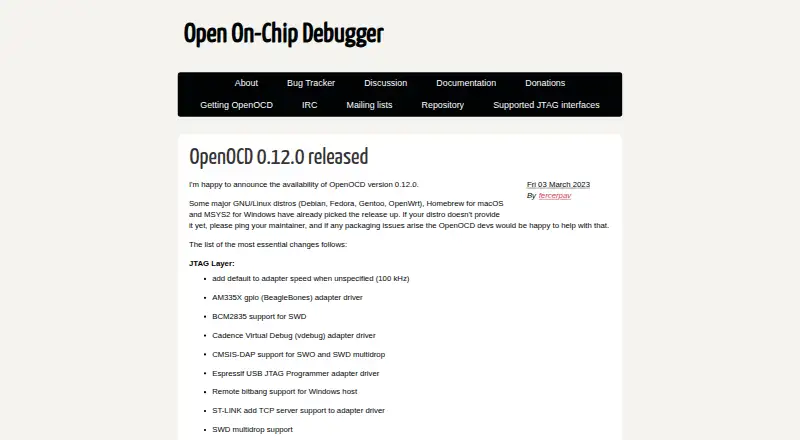
OpenOCD is free, open-source software for debugging, in-system programming, and boundary-scan testing of embedded target devices through a debug adapter. It communicates with targets using JTAG or Serial Wire Debug (SWD), and can operate as a server for GDB clients. Users can interact through Telnet or GDB, while its Tcl interface is intended for machine control; configuration files can include commands, and the project documents a Tcl scripting API. Listed target architectures include ARM, MIPS, RISC-V, Xtensa, ARC, AVR32, and others. The 0.12.0 release notes list support for Espressif ESP32, ESP32-S2, and ESP32-S3 cores, Raspberry Pi Pico RP2040, Zephyr, and a no-RTOS option. OpenOCD also lists remote debugging and exception breakpoints. It is available for Linux, macOS, Windows, and self-hosted setups, and the project says it is packaged in operating-system repositories and provides its source repository. Community binary builds are identified for Windows, GNU/Linux, and macOS, but are unofficial. Linux usually requires a udev rule for debug-adapter access; Windows requires driver configuration for each peripheral.
Who it suits
OpenOCD suits developers working with embedded target devices and debug adapters, including users of JTAG or SWD and GDB workflows. Host setup may require access rules or driver configuration.
What it does well
- Free open-source software
- Supports JTAG and SWD transports
- Can serve GDB clients
- Lists remote debugging and exception breakpoints
What to know first
- Linux usually needs a udev rule for adapter access
- Windows requires driver configuration for each peripheral
- Community binary builds are unofficial
Plans
| Plan | Billed and limits | Price |
|---|---|---|
| OpenOCD | Open-source software · distributed through operating-system packages or source code | Free |
As openocd.org lists them, read 7 Oct 2026. The maker's own page has the final word.
Getting started
- Visit the OpenOCD website
- Install OpenOCD from a popular operating-system repository or access its source repository
- Choose a supported host platform: Linux, macOS, Windows, or self-hosted
- Configure debug-adapter access, including a udev rule on Linux or peripheral drivers on Windows
- Connect to OpenOCD through GDB or Telnet, or use its Tcl machine interface
Verdict
OpenOCD provides debugging, programming, and boundary-scan tools across a range of listed targets and interfaces. Check host setup requirements and verify whether a community binary is appropriate, since those builds are unofficial.
Questions
Is OpenOCD free?
Yes. Its free plan is listed as free, and it is open-source software distributed through operating-system packages or source code.
Which platforms does OpenOCD support?
The listed platforms are Linux, macOS, self-hosted, and Windows.
Can OpenOCD work with GDB?
Yes. It can run as a server that accepts GDB client connections, and users can interact with it through GDB.
Which target architectures are listed?
They include ARM, MIPS, RISC-V, Xtensa, ARC, AVR32, DSP563xx, DSP5680xx, eSi-RISC, and STM8.
Does OpenOCD offer a free trial?
No. The listed free trial is no; OpenOCD has a free plan.
Facts from OpenOCD's own pages
- Command interfaces
- Users can interact with OpenOCD through Telnet or GDB, and its Tcl interface is intended as a machine interface. · openocd.org, 7 Oct 2026
- Community
- The project describes itself as an active open-source project supported by software and hardware developers around the world. · openocd.org, 7 Oct 2026
- Debug protocols
- The guide describes JTAG and Serial Wire Debug (SWD) adapter transports for communicating with targets. · openocd.org, 7 Oct 2026
- GDB support
- OpenOCD can run as a server that accepts connections from GDB clients. · openocd.org, 7 Oct 2026
- Host setup
- On Linux, running OpenOCD usually requires installing a udev rule to grant access to debug adapters; Windows requires driver configuration for each peripheral. · openocd.org, 7 Oct 2026
- Installation
- The project says OpenOCD is packaged in popular operating-system repositories and also provides access to its source repository. · openocd.org, 7 Oct 2026
- Purpose
- OpenOCD provides debugging, in-system programming, and boundary-scan testing for embedded target devices using a debug adapter. · openocd.org, 7 Oct 2026
- RTOS
- The 0.12.0 release notes list support for Zephyr and a no-RTOS option. · openocd.org, 7 Oct 2026
- Scripting
- OpenOCD configuration files can contain commands, and the guide documents a Tcl scripting API. · openocd.org, 7 Oct 2026
- Security and compliance
- The official pages reviewed provide no security certification or compliance claim. · openocd.org, 7 Oct 2026
- Supported targets
- The 0.12.0 release notes list support for Espressif ESP32, ESP32-S2, and ESP32-S3 cores and Raspberry Pi Pico RP2040. · openocd.org, 7 Oct 2026
- Unofficial binaries
- The project page identifies community-provided binary builds for Windows, GNU/Linux, and macOS, and labels them unofficial. · openocd.org, 7 Oct 2026
Where OpenOCD stands on Freedom251
- Debuggers#4 of 27