Freedom251 › Network Packet Analyzer Software

Arkime
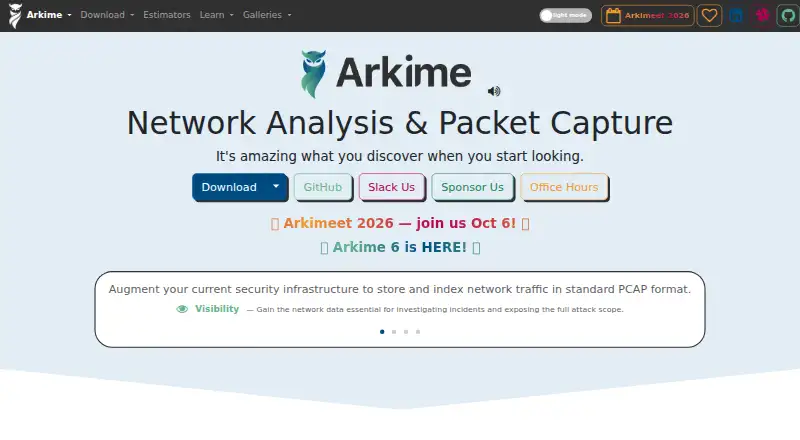
What Arkime is
Arkime is a free, open-source network analysis and session search tool that passively watches traffic and creates searchable session records. It parses network layers 3–7 and indexes fields such as protocols, DNS names, HTTP headers, TLS/JA4 fingerprints, file hashes, and GeoIP in OpenSearch or Elasticsearch. Operators can save full packets in standard PCAP format or use metadata-only capture, with rules to choose which traffic is retained. Users can search sessions, inspect packet data, and export results as PCAP or CSV. Cont3xt enriches supported IP, domain or hostname, URL, email, hash, and phone indicators from commercial and OSINT sources, including VirusTotal, Censys, and Shodan; phone enrichment is limited to the U.S. Parliament groups clusters and displays issues and Elasticsearch health. Capture capacity can grow by adding machines or more CPU and disk. Installation guidance covers Linux, recommends Debian or Ubuntu LTS, and links to a container guide. OpenSearch or Elasticsearch is required for session metadata.
Who it suits
Arkime suits security and network teams that need searchable traffic sessions and packet-level investigation. It is aimed at operators comfortable providing OpenSearch or Elasticsearch and managing a Linux or container deployment.
What it does well
- Stores full packets in standard PCAP format.
- Supports metadata-only capture with traffic selection rules.
- Exports search results as PCAP or CSV.
- Capture can scale with more machines, CPU, or disk.
- Authentication options include OIDC.
What to know first
- Requires OpenSearch or Elasticsearch for session metadata.
- Phone indicator enrichment is limited to the U.S.
- Anonymous authentication is not recommended.
Limits
The free Arkime plan has no paid-only features or license fees. It requires OpenSearch or Elasticsearch for session metadata, and Cont3xt phone enrichment is limited to the U.S.
Plans
| Plan | Billed and limits | Price |
|---|---|---|
| Arkime | Open source · No paid-only features · No license fees | Free |
As arkime.com lists them, read 3 Oct 2026. The maker's own page has the final word.
Getting started
- Open the Arkime website and review its installation guide.
- Prepare a Linux host; the guide recommends Debian or Ubuntu LTS and links to container installation instructions.
- Set up OpenSearch or Elasticsearch to store session metadata.
- Configure capture to store full packets in PCAP or run in metadata-only mode, and set rules for traffic to save.
- Configure authentication and restrict database and viewer ports as recommended in the architecture guidance.
Overview
Arkime is an open-source system for turning passively observed network traffic into searchable session records. It is a strong fit for teams investigating traffic across their own networks that can run Linux capture infrastructure and an OpenSearch or Elasticsearch service. Its appeal is the choice between metadata-only operation and full-packet retention, without license fees; the trade-off is the infrastructure and security work that choice entails.
Key features
Arkime parses layers 3–7 and indexes session fields including protocols, DNS names, HTTP headers, TLS/JA4 fingerprints, file hashes, and GeoIP. Investigators can search those records, inspect packet data, then export results as PCAP or CSV. That progression from filtering sessions to reviewing packets is useful for investigations, but the required OpenSearch or Elasticsearch database makes Arkime part of a larger system rather than a standalone analyzer.
Capture can save full packets in standard PCAP format or run in metadata-only mode, with rules to select which traffic is retained. This lets operators choose how much investigative detail to keep, but they must make and manage those retention decisions. Arkime supports remote capture, flow analysis, CLI tools, and both capture sources. It does not decrypt traffic, so it is a poor fit when decrypted payloads are a requirement.
Cont3xt enriches supported IP, domain or hostname, URL, email, hash, and phone indicators from commercial and OSINT sources, including VirusTotal, Censys, and Shodan. It also supports custom links and downloadable reports; phone enrichment is limited to the U.S. Parliament groups Arkime clusters and surfaces cluster issues and Elasticsearch health, giving operators a separate view of deployment status.
Pricing
Arkime is free: its Arkime plan costs nothing and is open source, with no license fees or paid-only features. That makes it accessible to teams able to supply and operate the required infrastructure. The free price does not remove the need to run OpenSearch or Elasticsearch, capture machines, and storage; those operational responsibilities are central to the cost decision.
Platforms
Arkime supports API access, Linux, self-hosted deployment, and a web interface. Its installation guide recommends Debian or Ubuntu LTS and also links to a container installation guide. Capture can scale horizontally by adding machines or vertically with more CPUs and disk, which gives operators two ways to respond as traffic demands grow.
Security configuration matters: the architecture guide recommends firewall restrictions on database and viewer ports and routing operator access through a central viewer, potentially behind a reverse proxy. Authentication modes include basic, form, digest, header, and OIDC; anonymous authentication is not recommended. The project provides a Slack workspace and office hours for questions, with GitHub Issues for bugs and feature requests, and directs security reports to Intigriti or [email protected].
Who it's for
Arkime suits security and network teams that need searchable session history and packet inspection, and have the skills to deploy and secure Linux capture systems alongside OpenSearch or Elasticsearch. Its configurable capture mode can serve teams prioritizing metadata or those that need PCAP retention. It is less suitable for organizations seeking a managed, self-contained viewer or traffic decryption.
Pros and cons
- Pros: Full PCAP or metadata-only capture, with rules for selecting retained traffic, lets teams tune investigative depth to their needs.
- Pros: Searchable layer 3–7 fields, packet inspection, and PCAP or CSV export support a practical investigation workflow.
- Pros: No license fees and no paid-only features keep software access unrestricted.
- Cons: OpenSearch or Elasticsearch is required for session metadata, adding a substantial dependency to deploy and maintain.
- Cons: Arkime does not decrypt traffic, excluding workflows that depend on decrypted payload analysis.
- Cons: Operators must handle capture, storage, database, and access security themselves.
Alternatives
For a broader directory of tools, browse Network Protocol Analyzers, Digital Forensics Software, Network Packet Capture Software, and Network Packet Analyzer Software.
- Scapy is a free option for teams working with Python 3.7+ that want a GPLv2 tool across Linux, macOS, Windows, web, API, or self-hosted environments.
- termshark is a free choice for users who want a MIT-licensed tool on desktop platforms and already have tshark 1.10.2 or higher.
- NETCAP may suit teams looking for an open-source CLI with 66+ audit record types and community support on its free Core plan; its Pro plan is $548 a month.
- NetworkMiner is another freemium option, with a free edition and GPLv2 source written in managed C# on .NET Framework.
- PacketSnitch is a paid product with a free plan and free trial for teams comparing another packet-analysis option.
- Ettercap is a free, open-source alternative.
- Kismet is a free and open-source alternative with no paid plan or usage limit stated.
- OpenGrep is a free open-source static analysis engine with a CLI.
Verdict
Choose Arkime if your team needs searchable network sessions, packet inspection, and control over packet retention, and can operate the Linux and OpenSearch or Elasticsearch infrastructure behind it. The lack of license fees and flexible capture are compelling; look elsewhere if you need traffic decryption or a system that does not depend on infrastructure you manage.
Verdict
Arkime offers session search, packet inspection, and flexible packet retention without license fees. It requires an OpenSearch or Elasticsearch deployment, so teams should account for that dependency and its operation.
Questions
How much does Arkime cost?
The listed plan is free, with no license fees.
What does Arkime need to store session metadata?
Arkime requires OpenSearch or Elasticsearch.
Can Arkime save full packets?
Yes. It can store packets in standard PCAP format or run as a metadata-only engine, with rules to select traffic.
What platforms does Arkime support?
The listed platforms are API, Linux, self-hosted, and web. Installation guidance covers Linux and links to a container guide.
What authentication options are documented?
Arkime documents basic, form, digest, header, and OIDC authentication modes. It warns against anonymous authentication.
What indicator data can Cont3xt enrich?
It supports IP, domain or hostname, URL, email, hash, and phone indicators. Phone enrichment is limited to the U.S.
Facts from Arkime's own pages
- API
- Documented common, viewer, WISE and Cont3xt APIs are available, but the project warns that they can change. · arkime.com, 14 Oct 2026
- API authentication
- Viewer API calls use HTTP digest authentication and many endpoints require database field names. · arkime.com, 14 Oct 2026
- API learning method
- The documentation recommends inspecting browser JavaScript calls because the UI uses the same APIs. · arkime.com, 14 Oct 2026
- Authentication
- Arkime documents authentication modes including basic, form, digest, header, and OIDC, and warns that anonymous authentication is not recommended. · arkime.com, 3 Oct 2026
- Capture modes
- Deployments can keep only enriched session metadata, save selected packets or retain full PCAP. · arkime.com, 14 Oct 2026
- Connections graph
- The Connections page visualizes relationships between selected source and destination fields. · arkime.com, 14 Oct 2026
- Cont3xt
- Cont3xt enriches indicators through integrations such as VirusTotal, Censys and Shodan and can produce reports. · arkime.com, 14 Oct 2026
- Database dependency
- A working OpenSearch or Elasticsearch cluster is required before installing Arkime sensors. · arkime.com, 14 Oct 2026
- Database requirement
- Arkime requires OpenSearch or Elasticsearch to store network-session metadata. · arkime.com, 3 Oct 2026
- Deployment
- The installation guide covers Linux, recommends Debian or Ubuntu LTS, and also links to a container installation guide. · arkime.com, 3 Oct 2026
- Docker
- Official Docker images have been provided since version 5.5.0 and contain all Arkime applications. · arkime.com, 14 Oct 2026
- Documentation depth
- Documentation covers installation, FAQ troubleshooting, architecture, settings, supported protocols, plugins, APIs and contribution workflows. · arkime.com, 14 Oct 2026
- Extensibility
- The project documents capture rules, tagger plugins, command sockets, Python support, WISE sources and S3 storage. · arkime.com, 14 Oct 2026
- Founded
- 2012 · arkime.com, 28 Sept 2026
- Hardware guidance
- The installation guide recommends at least 4 GB OpenSearch JVM heap and no more than half of system memory for that heap. · arkime.com, 14 Oct 2026
- Independent security practice
- OpenSSF records Arkime as having achieved its Best Practices badge in October 2023. · bestpractices.dev, 14 Oct 2026
- Integrations
- Arkime uses OpenSearch or Elasticsearch for indexed metadata and offers WISE threat-intelligence integration. · github.com, 14 Oct 2026
- Investigation
- Users can search sessions, inspect packet data, and export search results as PCAP or CSV. · arkime.com, 3 Oct 2026
- Licence
- Arkime is distributed under the permissive Apache License 2.0. · github.com, 14 Oct 2026
- Limit: deployment complexity
- The installation guide requires separate sensor and search-database components, credentials, initialization and service configuration. · arkime.com, 14 Oct 2026
- Limit: packet loss troubleshooting
- The FAQ has dedicated troubleshooting for dropped packets and disk-queue problems, indicating capture performance can require tuning. · arkime.com, 14 Oct 2026
- Limit: storage operations
- The independent source indicates that retaining complete traffic creates substantial data volumes that must be indexed and stored. · securityscientist.net, 14 Oct 2026
- Packet capture
- Arkime can store full packets in standard PCAP format or run as a metadata-only engine, with rules to select which traffic is saved. · arkime.com, 3 Oct 2026
- Packet export
- Search results can be exported as PCAP or CSV for use in other tools. · arkime.com, 14 Oct 2026
Where Arkime stands on Freedom251
- Network Packet Analyzer Software#1 of 32
- Digital Forensics Software#1 of 30
- Network Protocol Analyzers#1 of 30
- Network Packet Capture Software#1 of 22