Freedom251 › Operating Systems
Apache NuttX
What Apache NuttX is
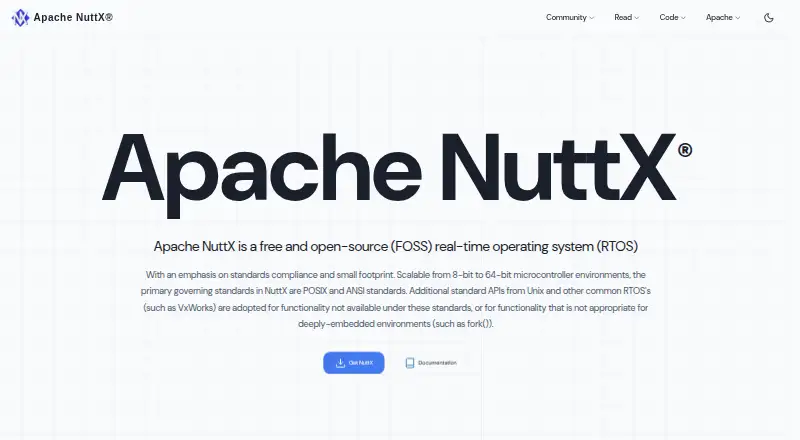
Apache NuttX is free software for development boards and embedded devices, with simulator targets also documented. It supports a wide range of CPU architectures: ARM, ARM64, AVR, AVR32, 8051, CEVA, ESP32 Xtensa, Intel x86 and x86_64, MIPS, m68k, RISC-V, SPARC, SuperH, TriCore, Xtensa, and Z80. This breadth makes it relevant to embedded projects using different processor families. NuttX provides a configurable build system and native configuration for boards and architectures, so developers can set up builds around their target hardware. Its APIs are oriented toward POSIX and ANSI standards. The binary loader supports ELF and NXFLAT modules. Projects can be deployed to physical embedded boards or devices, or run against documented simulator targets. The software has a free plan, and its website is nuttx.apache.org. The available facts describe it as embedded development software, with configuration, APIs, loading, and deployment centered on embedded targets and simulators.
Who it suits
NuttX suits developers building software for embedded boards and devices, especially when working across one of its listed CPU architectures. It may also suit projects that use simulator targets during development.
What it does well
- Free software with a free plan
- Supports a broad range of CPU architectures
- Configurable build system
- POSIX/ANSI-oriented APIs
- ELF and NXFLAT module loading
- Physical device and simulator deployment targets
What to know first
- Its stated targets are embedded devices and simulator environments
- The build system is configurable around boards and architectures
Plans
| Plan | Billed and limits | Price |
|---|---|---|
| Apache NuttX | Free and open-source software · Embedded RTOS; requires target-specific configuration and toolchain | Free |
As nuttx.apache.org lists them, read 15 Oct 2026. The maker's own page has the final word.
Getting started
- Visit https://nuttx.apache.org/
- Choose a development board, embedded device, or documented simulator target
- Configure the build system for the board or architecture
Apache NuttX is a free, open-source real-time operating system for embedded systems. It suits firmware teams that need one standards-oriented base across many microcontroller families and boards. Its flexibility is strongest when your team can handle target-specific drivers, configuration, and application validation.
Overview
NuttX is designed for a small footprint while scaling from 8-bit through 64-bit microcontroller environments. The project says it runs on more than 15 CPU architectures, including ARM, ARM64, AVR, ESP32 Xtensa, x86, MIPS, RISC-V, SPARC, SuperH, TriCore, Xtensa, and Z80. It also lists more than 300 supported hardware boards. That range is valuable for organizations maintaining firmware across varied silicon, although portability still depends on matching each board’s drivers and configuration.
More than 1,500 configuration templates cover prototyping and production starting points. This breadth can reduce initial setup work, but a template is not a finished product configuration: storage, peripherals, and application behavior still need to be integrated for the chosen device.
POSIX and ANSI standards are NuttX’s primary design references. The project treats POSIX as a development guideline rather than claiming the POSIX trademark. For networked applications, its BSD-compatible socket interface uses familiar operations such as socket, bind, connect, send, and receive, making the API direction recognizable to developers with conventional systems experience.
Key features
- Configurable build system: Native board and architecture configuration lets developers shape an image for a specific target. This is a practical advantage for constrained devices, but it places responsibility on the team to maintain the selected configuration and drivers.
- Optional filesystem layer: NuttX includes a scalable filesystem option with documented support for VFAT, ROMFS, littlefs, and NFS version 3 over UDP. Projects that do not need physical storage can use its pseudo root filesystem; mounting a true filesystem requires the appropriate storage drivers and filesystem support.
- Module loading: The binary loader supports ELF and NXFLAT modules, giving projects a defined way to load those module formats where their architecture and design call for it.
- Separate release artifacts: Downloads provide source packages for the operating system and integrated Apps separately, with hashes and signatures for releases. That separation helps teams control what enters a build and verify downloaded artifacts.
- Community and security channels: A main mailing list and Discord provide community contact, while vulnerability reports are requested by email before public disclosure. The project is maintained by volunteers, so support is community-led rather than a guaranteed commercial service.
Pricing
Apache NuttX costs nothing, billed as free and open-source software under the FOSS model. The plan includes source artifacts for the OS and integrated Apps. There is no free trial because the software is already free, and no seat, device, usage, or renewal charge is stated.
This single plan fits individual developers, universities, open-source contributors, and product teams that can fund their own engineering and support process. It does not bundle commercial support or remove the integration work associated with a particular board.
Platforms
NuttX is self-hosted and targets development boards, embedded devices, and documented simulator targets. Its stated architecture list spans ARM, ARM64, AVR, AVR32, 8051, CEVA, ESP32 Xtensa, Intel x86 and x86_64, MIPS, m68k, RISC-V, SPARC, SuperH, TriCore, Xtensa, and Z80. This is a strong fit for heterogeneous hardware portfolios, while teams seeking a hosted device-management service should look elsewhere.
Who it's for
Choose NuttX for embedded developers who value compact real-time firmware, POSIX/ANSI-oriented APIs, and broad board and CPU coverage. It is particularly suitable when a project may move between architectures or needs configurable builds for both prototypes and production devices.
It is less suitable for teams expecting a turnkey managed platform. Firmware developers must provide the relevant drivers and filesystem support, and they are responsible for validating function parameters and incoming data in custom applications. Generic checks can affect firmware performance and size, so safety and robustness remain application-level engineering decisions.
Pros and cons
Pros
- Wide hardware reach: More than 15 CPU architectures and over 300 boards support reuse across diverse embedded portfolios.
- Large configuration starting point: More than 1,500 templates can accelerate initial board setup and deployment planning.
- Familiar interfaces: POSIX/ANSI guidance and BSD-style sockets reduce the conceptual gap for developers coming from conventional operating systems.
- No licensing charge: The free FOSS plan removes subscription and per-device cost from the software budget.
Cons
- Application checks are your responsibility: Teams must validate inputs themselves, balancing protection against firmware size and performance.
- Volunteer-led support: Community channels are useful, but the project does not provide a stated commercial support commitment.
Alternatives
Apache Mynewt is another free, open-source embedded OS with development tools under the Apache License 2.0; choose it when that ecosystem better matches your team.
Contiki-NG is a free, open-source operating system under the 3-clause BSD license, worth considering when that licensing and platform combination suits the project.
FreeRTOS is a free MIT-licensed kernel and libraries, with commercial licenses and safety certification available through a strategic partner; it is the alternative to examine when those commercial options matter.
OpenWrt is free with no subscription or licensing fees and targets Linux and self-hosted environments, making it a different choice for supported networking-focused hardware.
Particle Device OS offers a free tier for 100 devices and 100K Data Operations per month plus paid tiers, so it fits projects that want a hosted, usage-metered model.
PX5 RTOS uses paid licensing, including a $5,000 one-time device/product package with source, perpetual rights, no royalties, and professional support; choose it when that support model justifies the cost.
Micrium OS is another free option for Linux, macOS, and Windows development environments.
VxWorks offers a freemium model with up to three online seats and is the alternative to consider when that licensing arrangement fits.
For broader comparisons, see the IoT Operating Systems and Operating Systems lists.
Verdict
Apache NuttX is a strong choice for embedded teams that need a free, compact RTOS spanning many architectures and boards, with configurable builds and familiar standards-oriented APIs. Look elsewhere if you need managed hosting, guaranteed commercial support, or a platform that absorbs board integration and application input validation for you.
Verdict
Choose Apache NuttX for embedded development when its supported architectures and POSIX/ANSI-oriented APIs fit your project. Its stated deployment targets are physical embedded devices and simulator targets.
Questions
How much does Apache NuttX cost?
It is free and has a free plan.
Which CPU architectures does it support?
The listed architectures are ARM, ARM64, AVR, AVR32, 8051, CEVA, ESP32 Xtensa, Intel x86 and x86_64, MIPS, m68k, RISC-V, SPARC, SuperH, TriCore, Xtensa, and Z80.
What devices can I use it with?
It is intended for development boards and embedded devices. Simulator targets are also documented.
What APIs and binary modules does it support?
Its APIs are POSIX/ANSI-oriented, and its binary loader supports ELF and NXFLAT modules.
Facts from Apache NuttX's own pages
- Applications repository
- The project maintains a separate nuttx-apps repository containing applications, examples and utilities. · nuttx.apache.org, 15 Oct 2026
- Architecture range
- The project targets microcontrollers and processors from 8-bit through 64-bit designs. · nuttx.apache.org, 15 Oct 2026
- Architecture support
- The project homepage says NuttX runs on more than 15 CPU architectures, including ARM, RISC-V, x86, and Xtensa. · nuttx.apache.org, 11 Oct 2026
- Board support
- The project advertises more than 300 supported hardware boards. · nuttx.apache.org, 15 Oct 2026
- Company profile
- LinkedIn lists NuttX as a public organization with 2–10 employees, Wilmington, Delaware headquarters and a 2007 founding year. · linkedin.com, 15 Oct 2026
- Configuration templates
- The home page advertises more than 1,500 configuration templates for prototyping and deployment. · nuttx.apache.org, 15 Oct 2026
- CPU support
- The home page lists support for more than 15 CPU architectures, including ARM, RISC-V, x86 and Xtensa. · nuttx.apache.org, 15 Oct 2026
- Documentation depth
- Documentation is generated with Sphinx from reStructuredText and includes installation, board, driver, API and contribution guidance. · nuttx.apache.org, 15 Oct 2026
- Drivers
- Documented driver frameworks cover USB host/device, serial, I2C, I2S, NAND, CAN, ADC, DAC, PWM, wireless, timers and watchdogs. · nuttx.apache.org, 15 Oct 2026
- Extensibility
- Architecture APIs, board configurations, driver skeletons, host tools and configuration variables are documented for adding platforms and features. · nuttx.apache.org, 15 Oct 2026
- Filesystem
- NuttX includes a virtual filesystem and filesystems such as FAT, ROMFS, CROMFS, TMPFS, BINFS, HOSTFS and procfs. · nuttx.apache.org, 15 Oct 2026
- Filesystems
- NuttX includes an optional scalable filesystem and documents support for filesystems including VFAT, ROMFS, littlefs, and NFS version 3 over UDP. · nuttx.apache.org, 11 Oct 2026
- Graphics and audio
- The feature set includes framebuffer and LCD graphics, VNC, a graphics library, widgets, audio codecs and media-player applications. · nuttx.apache.org, 15 Oct 2026
- Independent project activity
- Good First Issue reports about 4.1k stars, 1.7k forks, 383 of 447 outside pull requests merged in the last 30 days, and typical maintainer replies within one day. · goodfirstissue.org, 15 Oct 2026
- Independent technical praise
- Hysen Labs highlights POSIX portability, a simulator for evaluation and recent repository activity as strengths. · hysenlabs.com, 15 Oct 2026
- Latest release
- The downloads page lists version 13.1.0 released on October 4, 2026. · nuttx.apache.org, 15 Oct 2026
- License
- NuttX is distributed under the Apache License 2.0. · nuttx.apache.org, 15 Oct 2026
- Limit
- NuttX documents that its pseudo root filesystem can omit physical storage, while mounting true filesystems requires the relevant drivers and filesystem support. · nuttx.apache.org, 11 Oct 2026
- Limit: configuration burden
- The project documentation acknowledges that its hundreds of configuration options make maintenance substantially more complicated. · nuttx.apache.org, 15 Oct 2026
- Limit: footprint versus bare metal
- Hysen Labs notes that NuttX uses more memory than a minimal bare-metal scheduler because of its POSIX and filesystem capabilities. · hysenlabs.com, 15 Oct 2026
- Limit: host compiler support
- The documentation says SDCC-based builds are less exercised and may encounter compilation problems on insufficiently tested parts of NuttX. · nuttx.apache.org, 15 Oct 2026
- Limit: learning curve
- Hysen Labs says the configuration system can require substantial learning and that developers without Unix experience may face a steep learning curve. · hysenlabs.com, 15 Oct 2026
- Limit: open defects and requests
- Good First Issue lists open work for missing Nordic BLE controller support, RISC-V memory-management bugs, build errors and Raspberry Pi Pico W Wi-Fi crashes. · goodfirstissue.org, 15 Oct 2026
- Limit: scope
- Official documentation says Linux-level breadth is not a goal because small footprint takes priority in embedded environments. · nuttx.apache.org, 15 Oct 2026
Where Apache NuttX stands on Freedom251
- Operating Systems#2 of 42
- IoT Operating Systems#1 of 14