Freedom251 › IoT Operating Systems
Apache Mynewt
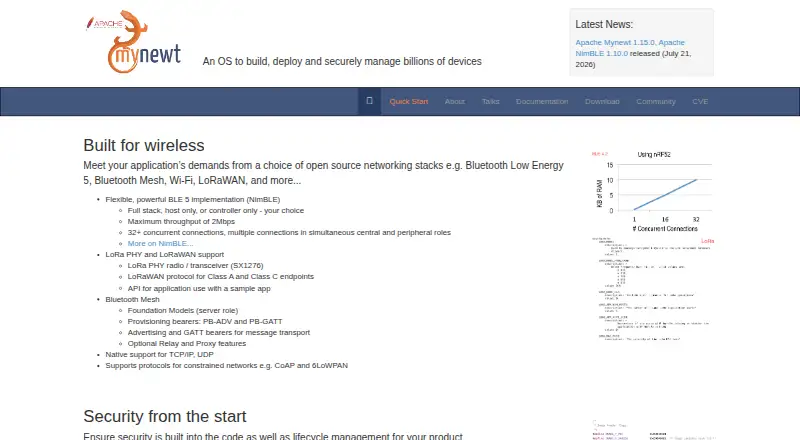
What Apache Mynewt is
Apache Mynewt is a real-time operating system and development toolkit for embedded systems, aimed at embedded and higher-level application developers. It is designed for Cortex-M0–M4, MIPS, and RISC-V microcontrollers, with a hardware abstraction layer and board support packages. Its wireless and networking support includes BLE 5, Bluetooth Mesh, LoRaWAN, TCP/IP, UDP, CoAP, and 6LoWPAN. NimBLE can be configured as a full stack, host only, or controller only, with up to 2 Mbps throughput and 32+ concurrent connections. Device features include remote firmware image management, logging, component and network statistics, and a sensor framework. Newt combines source package management with tools to build, debug, and install embedded applications. Security capabilities include device identity, secure boot, authenticated and encrypted communications, and secure over-the-air updates. Mynewt is free and available under Apache License 2.0. Newt installation instructions cover macOS, Linux, and Windows; the simulator runs natively on Linux, FreeBSD, and older macOS versions, with documented limits on Windows and newer macOS.
Who it suits
Mynewt suits developers building constrained embedded applications for supported microcontrollers. Its device-management, networking, and security features also fit projects that need remote updates and connected-device capabilities.
What it does well
- Targets Cortex-M0–M4, MIPS, and RISC-V microcontrollers.
- Includes BLE 5, LoRaWAN, and other networking support.
- Provides remote firmware image management and logging.
- Newt supports building, debugging, and installing applications.
- Free under Apache License 2.0.
What to know first
- Simulator has documented limits on Windows and newer macOS.
- Hardware support is focused on listed microcontroller families.
Plans
| Plan | Billed and limits | Price |
|---|---|---|
| Apache Mynewt | Open source embedded OS and development tools · Apache License 2.0 | Free |
As mynewt.apache.org lists them, read 4 Oct 2026. The maker's own page has the final word.
Getting started
- Visit the Apache Mynewt website.
- Install Newt using the instructions for Linux, macOS, or Windows.
- Use Newt to manage source packages and build, debug, or install an embedded application.
- For native simulation, use Linux, FreeBSD, or an older macOS version.
Apache Mynewt is a real-time operating system and development toolkit for embedded applications. It best suits developers building connected, resource-constrained devices who want networking and device-operation features alongside firmware tools. Its broad protocol support is compelling, but hardware fit and simulator constraints should guide the decision.
Overview
Mynewt pairs an embedded OS with Newt, which handles source packages as well as building, debugging and installing applications. That makes it a practical option for teams that need tooling across firmware development, not just an operating-system core. The Apache License 2.0 is a permissive open-source license for this project.
Intended applications range from doorbells to medical devices and power grids. Mynewt is designed for Cortex-M0–M4, MIPS and RISC-V microcontrollers, with a hardware abstraction layer and board support packages. That focus is useful for developers working with those targets, but it makes verifying board support an early requirement rather than an afterthought.
Key features
Networking and Bluetooth
Mynewt supports BLE 5, Bluetooth Mesh, LoRaWAN, TCP/IP, UDP, CoAP and 6LoWPAN. The range gives connected-device projects options across local wireless and network protocols. NimBLE can be configured as a full stack, host only or controller only, and supports up to 2 Mbps throughput and more than 32 concurrent connections. Those capabilities suit projects that need to tune the Bluetooth configuration or handle many simultaneous connections.
Device operations and security
Image management supports remote firmware updates, while logging, component and network statistics, and a sensor framework address common operational needs after deployment. Mynewt also describes auto-discovery and management using OIC 1.1, the Open Connectivity Foundation's IoT platform standard. Security features include device identity, secure boot, authenticated and encrypted communications, and secure over-the-air updates. Together, these features make the project relevant to devices that need update and monitoring capabilities as well as connectivity.
Build and development environment
Newt brings package management together with building, debugging and installing embedded applications. Installation instructions cover macOS, Linux and Windows, but simulator support is less uniform: it runs natively on Linux, FreeBSD and older macOS versions, with documented limits on Windows and newer macOS. Teams depending on simulation should confirm that their development environment is suitable before committing.
Pricing
Apache Mynewt is free: its plan costs nothing and includes the open-source embedded OS and development tools under the Apache License 2.0. There is no free trial because the project is free rather than trial-based. The plan is a natural fit for developers who can work with its supported hardware and manage their own development environment; no paid tier is described.
Platforms
Mynewt is categorized for Linux, macOS, self-hosted use and Windows. Newt installation instructions are provided for Linux, macOS and Windows, while native simulator support covers Linux, FreeBSD and older macOS versions. Windows and newer macOS have simulator limits, so platform compatibility depends on whether the project needs installation tooling alone or native simulation too.
Who it's for
Mynewt is best suited to embedded and higher-level application developers building connected devices around its supported microcontroller families. Its protocol breadth, NimBLE configurations, remote image management and security features are valuable when firmware must do more than run locally. It is a less direct fit when the target hardware is outside its stated design range or simulator compatibility is essential on a constrained platform.
Pros and cons
- Pros: Broad wireless and networking support, including BLE 5, LoRaWAN and 6LoWPAN, gives projects multiple connectivity paths.
- Pros: Newt combines package management with build, debug and installation tasks, reducing the need to treat those as separate workflows.
- Pros: Remote-update management, device statistics, logging and security features address development and operation of connected devices.
- Cons: The hardware focus is specific to Cortex-M0–M4, MIPS and RISC-V microcontrollers, so teams must establish target fit.
- Cons: Simulator support is limited on Windows and newer macOS, which can complicate workflows centered on those environments.
- Cons: Questions and help are directed to the dev mailing list, which may not suit teams seeking a different support channel.
Alternatives
IoT Operating Systems is a useful place to compare more options. Contiki-NG is another free, open-source operating system, with a 3-clause BSD license and Linux, macOS, self-hosted and Windows platforms; consider it when those platform and licensing terms are a better match.
Particle Device OS has a free plan capped at 100 devices and 100K Data Operations per month, as well as a paid Basic plan; choose it if those published device and operations terms fit your deployment. PX5 RTOS offers paid licensing, including a one-time-fee device/product license with perpetual use, full source code, no royalties and professional support; it may suit buyers seeking those terms.
Micrium OS is another free option with Linux, macOS and Windows platforms. VxWorks has a free plan for up to 3 seats online. OpenWrt, RT-Thread and TencentOS Tiny are also alternatives.
Verdict
Choose Apache Mynewt if your embedded project targets its microcontroller families and benefits from broad networking, configurable NimBLE and integrated device-operation tooling. Its free Apache-licensed offering is a strong reason to consider it. Look elsewhere if your hardware or simulator requirements fall outside its stated fit.
Verdict
Apache Mynewt brings an embedded operating system together with development tooling, networking stacks, and device operations. Review its hardware targets and simulator limits against your development environment.
Questions
How much does Apache Mynewt cost?
The listed plan is free. Apache Mynewt is available under Apache License 2.0.
Is there a free plan or trial?
A free plan is listed. There is no free trial.
Which platforms have Newt installation instructions?
Instructions are provided for macOS, Linux, and Windows.
Where does the simulator run natively?
The simulator runs natively on Linux, FreeBSD, and older macOS versions. The project documents simulator limits on Windows and newer macOS.
What hardware does Mynewt support?
It is designed for Cortex-M0–M4, MIPS, and RISC-V microcontrollers.
Where can users get help?
The project directs users and contributors to its dev mailing list for questions, discussion, and help.
Facts from Apache Mynewt's own pages
- Build tooling
- Newt combines source package management with building, debugging, and installing embedded applications. · mynewt.apache.org, 4 Oct 2026
- Developer platforms
- Newt installation instructions are provided for macOS, Linux, and Windows; the simulator runs natively on Linux, FreeBSD, and older macOS versions, with documented simulator limits on Windows and newer macOS. · mynewt.apache.org, 4 Oct 2026
- Device discovery
- The project describes auto-discovery and management using OIC 1.1, the IoT platform standard from the Open Connectivity Foundation. · mynewt.apache.org, 4 Oct 2026
- Device operations
- Mynewt includes image management for remote firmware updates, logging, component and network statistics, and a sensor framework. · mynewt.apache.org, 4 Oct 2026
- Downloads
- The download page lists Apache Mynewt Core 1.15.0 and Apache NimBLE 1.10.0, both released July 21, 2026. · mynewt.apache.org, 4 Oct 2026
- Hardware support
- Mynewt is designed for Cortex-M0–M4, MIPS, and RISC-V microcontrollers, with a hardware abstraction layer and board support packages. · mynewt.apache.org, 4 Oct 2026
- Intended use
- The project describes Mynewt as suitable for constrained embedded applications ranging from doorbells to medical devices and power grids. · mynewt.apache.org, 4 Oct 2026
- License
- Apache Mynewt is available under the Apache License, version 2.0. · mynewt.apache.org, 4 Oct 2026
- NimBLE
- The NimBLE implementation supports full-stack, host-only, or controller-only configurations, up to 2 Mbps throughput, and 32+ concurrent connections. · mynewt.apache.org, 4 Oct 2026
- Purpose
- Mynewt OS is a real-time operating system for embedded systems, aimed at embedded and higher-level application developers. · mynewt.apache.org, 4 Oct 2026
- Security
- Security features described by the project include device identity, secure boot, authenticated and encrypted communications, and secure over-the-air updates. · mynewt.apache.org, 4 Oct 2026
- Support
- The project directs users and contributors to the dev mailing list for questions, discussion, and help. · mynewt.apache.org, 4 Oct 2026
- Wireless stacks
- The project offers BLE 5, Bluetooth Mesh, LoRaWAN, TCP/IP, UDP, CoAP, and 6LoWPAN support. · mynewt.apache.org, 4 Oct 2026
Where Apache Mynewt stands on Freedom251
- IoT Operating Systems#3 of 14