Freedom251 › IoT Operating Systems
FreeRTOS
What FreeRTOS is
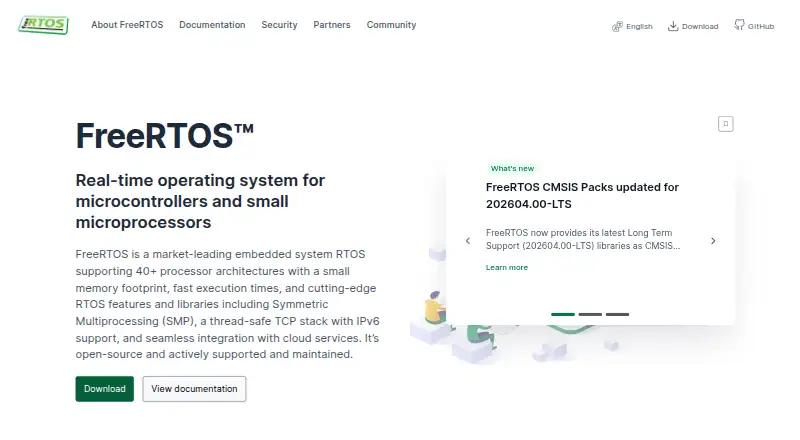
FreeRTOS is a real-time operating system for microcontrollers and small microprocessors. It supports more than 40 processor architectures, including RISC-V and ARMv8-M, and more than 15 toolchains. Its kernel includes Symmetric Multiprocessing, which can schedule work across identical processor cores that share memory, and its networking features include a thread-safe TCP stack with IPv6 support. Libraries for AWS IoT services are included, along with reference integrations that demonstrate security practices. The project is distributed under the MIT open-source license and is listed as free. LTS libraries receive security updates and critical bug fixes for two years. Preconfigured demos are available for official ports, and Windows and Linux ports plus QEMU projects let users experiment without special hardware. The maker also lists community contributions and professional support through its partner ecosystem. Deployment is described for embedded physical devices; cloud images are not verified.
Who it suits
FreeRTOS suits developers building for microcontrollers or small microprocessors who need broad processor and toolchain support. Its Windows and Linux ports and QEMU projects can also help those exploring the system without special hardware.
What it does well
- Supports more than 40 processor architectures.
- Compatible with more than 15 toolchains.
- Includes a thread-safe TCP stack with IPv6.
- LTS libraries get fixes and security updates for two years.
What to know first
- Cloud image deployment is not verified.
- Free trial is not available.
Limits
The FreeRTOS plan is free. LTS libraries receive security updates and critical bug fixes for two years; commercial licenses and safety certification are available through a strategic partner.
Plans
| Plan | Billed and limits | Price |
|---|---|---|
| FreeRTOS | MIT-licensed kernel and libraries; commercial licenses and safety certification are also available through a strategic partner | Free |
As freertos.org lists them, read 11 Oct 2026. The maker's own page has the final word.
Getting started
- Visit the FreeRTOS website.
- Choose an official port and use its preconfigured demo.
- Follow the demo documentation to build and configure the project.
- Use a Windows or Linux port or a QEMU project to experiment without special hardware.
FreeRTOS is a real-time operating system for microcontrollers and small microprocessors, best suited to teams building embedded products across varied processor architectures. Its broad port support and two-year LTS maintenance make it a capable free starting point, though embedded projects still need hardware-specific integration.
Overview
FreeRTOS combines a kernel and libraries for embedded devices with ports, demos and reference integrations. Support for more than 40 processor architectures and 15 toolchains gives developers room to work across different hardware and build environments. That breadth is useful when a project spans device families, but it does not remove the work of configuring and validating a target-specific build.
The MIT license permits use for any purpose. AWS IoT libraries and reference integrations add a path into AWS services, while the integrations demonstrate security best practices. That makes FreeRTOS a natural fit for AWS-connected devices; teams using other cloud services should weigh that emphasis against their own integration needs.
Key features
- Symmetric multiprocessing: SMP schedules tasks across multiple identical processor cores that share memory. It suits hardware with that configuration, but does not imply support for unlike cores.
- Networking: A thread-safe TCP stack with IPv6 support gives networked devices core connectivity capabilities within the FreeRTOS feature set.
- Architecture and toolchain support: More than 40 processor architectures, including RISC-V and ARMv8-M, and more than 15 toolchains offer broad choice for embedded development.
- AWS IoT libraries: Libraries and reference integrations support AWS IoT services, with security practices demonstrated in the integrations.
- Getting started: Preconfigured demos are available for official ports, with documentation for building and configuring projects. Windows and Linux ports and QEMU projects let developers experiment without special hardware.
- Long-term maintenance: LTS libraries receive security updates and critical bug fixes for two years, a defined maintenance window for teams that need ongoing fixes.
Pricing
The FreeRTOS plan costs free and includes the MIT-licensed kernel and libraries. There is no free trial because the product is free. The license permits use for any purpose, so this plan suits both evaluation and commercial development. Commercial licenses and safety certification are also available through a strategic partner, though no price is stated for those options.
The two-year LTS maintenance period applies to LTS libraries and covers security updates and critical bug fixes. It is a useful support window for products that need continued maintenance, but it is time-bounded. The published plan does not establish a device quota or seat limit.
Platforms
FreeRTOS is listed for Linux and Windows. Its deployment target is embedded physical devices: microcontrollers and small microprocessors. Windows and Linux ports, along with QEMU projects, support desktop evaluation without dedicated hardware; those ports do not make FreeRTOS a general-purpose desktop operating system.
Who it's for
FreeRTOS is suited to developers building embedded products who want a permissively licensed kernel, broad processor and toolchain coverage, and a defined two-year LTS maintenance period. It is especially relevant when the target hardware is supported by an official port or demo, or when AWS IoT libraries fit the product.
It is less compelling for teams seeking a turnkey cloud deployment or a general-purpose operating system. Its stated deployment focus is physical embedded devices, and the project’s broad compatibility still leaves target-specific building and configuration to the development team.
Pros and cons
- Pro: The MIT-licensed kernel and libraries cost nothing and can be used for any purpose under that license.
- Pro: Support for 40+ processor architectures and 15+ toolchains offers substantial flexibility across embedded targets.
- Pro: Two years of security updates and critical bug fixes for LTS libraries give projects a clear maintenance period.
- Pro: Windows, Linux and QEMU projects allow evaluation without special hardware.
- Con: LTS maintenance is limited to two years, which may not match a product’s full support life.
- Con: AWS IoT libraries and integrations favor AWS-connected projects; teams targeting other services may need a different integration path.
Alternatives
Apache Mynewt is another free, open-source embedded OS with development tools under the Apache License 2.0; consider it if that licensing and tools combination better fits the project.
Contiki-NG offers a free operating system under a 3-clause BSD license, a possible fit for teams preferring those terms.
OpenWrt is free with no subscription or licensing fees; compare it when evaluating another no-fee operating system.
Particle Device OS has a free tier for 100 devices and 100K Data Operations per month, with a Basic plan at $299 a month. It may suit readers whose needs fit those device and operations allowances.
Apache NuttX is a free and open-source OS with source artifacts for the OS and integrated apps; consider it when self-hosted deployment is the relevant fit.
PX5 RTOS offers paid licensing options, including a one-time Device/Product Licensing plan at 5000.00 USD. Consider it if a paid licensing model is preferable.
Micrium OS is another option to compare.
VxWorks offers a free plan for up to 3 seats online; consider it if that seat-limited plan fits your needs.
Browse more options in IoT Operating Systems and Operating Systems.
Verdict
Choose FreeRTOS for embedded development when broad architecture support, an MIT-licensed kernel and libraries, and two years of LTS fixes are the priorities. Its free plan makes it accessible for commercial projects as well as evaluation. Look elsewhere if your project needs a different integration focus or a maintenance commitment beyond the LTS window.
Verdict
FreeRTOS combines embedded operating-system features with wide architecture support and a two-year LTS maintenance period. Its listed plan is free under the MIT license.
Questions
How much does FreeRTOS cost?
Its listed FreeRTOS plan is free. Commercial licenses and safety certification are also available through a strategic partner.
Is FreeRTOS open source?
Yes. It is distributed under the MIT open source license and can be used for any purpose under that license.
Which platforms does it support?
The listed platforms are Linux and Windows. Windows and Linux ports and QEMU projects can be used to experiment without special hardware.
What hardware and development environments does it support?
FreeRTOS supports more than 40 processor architectures and more than 15 toolchains. Its device types are microcontrollers and small microprocessors.
How long are LTS libraries maintained?
LTS libraries receive security updates and critical bug fixes for two years.
Who publishes FreeRTOS?
AWS identifies itself as the publisher. Richard Barry's biography says he founded the FreeRTOS project in 2003.
Facts from FreeRTOS's own pages
- Architecture support
- The product supports more than 40 processor architectures and more than 15 toolchains. · en.freertos.org, 11 Oct 2026
- AWS IoT
- FreeRTOS includes libraries for AWS IoT services, and its IoT reference integrations demonstrate security best practices. · en.freertos.org, 11 Oct 2026
- Company
- AWS identifies itself as the publisher in the site footer, and Richard Barry's biography says he founded the FreeRTOS project in 2003. · en.freertos.org, 11 Oct 2026
- Desktop evaluation
- The quick start guide says FreeRTOS Windows and Linux ports and QEMU projects can be used to experiment without special hardware. · en.freertos.org, 11 Oct 2026
- Ecosystem
- The maker describes an ecosystem of integrated IDE and productivity tools, alongside architecture, semiconductor, training, software, and board support package partners. · en.freertos.org, 11 Oct 2026
- Getting started
- Preconfigured demos are available for official ports, and their documentation describes building and configuring the demo projects. · ecos.freertos.org, 11 Oct 2026
- Kernel features
- The product includes Symmetric Multiprocessing (SMP), which can schedule tasks across multiple identical processor cores that share memory. · sbop.freertos.org, 11 Oct 2026
- License
- FreeRTOS is distributed under the MIT open source license and can be used for any purpose under that license. · en.freertos.org, 11 Oct 2026
- LTS maintenance
- FreeRTOS LTS libraries receive security updates and critical bug fixes for two years. · en.freertos.org, 11 Oct 2026
- Networking
- The FreeRTOS feature set includes a thread-safe TCP stack with IPv6 support. · en.freertos.org, 11 Oct 2026
- Purpose
- FreeRTOS is a real-time operating system for microcontrollers and small microprocessors. · en.freertos.org, 11 Oct 2026
- Support
- The maker lists community contributions and professional support through its partner ecosystem. · en.freertos.org, 11 Oct 2026
Where FreeRTOS stands on Freedom251
- IoT Operating Systems#5 of 14
- Operating Systems#16 of 42