Freedom251 › Operating Systems
AlmaLinux OS
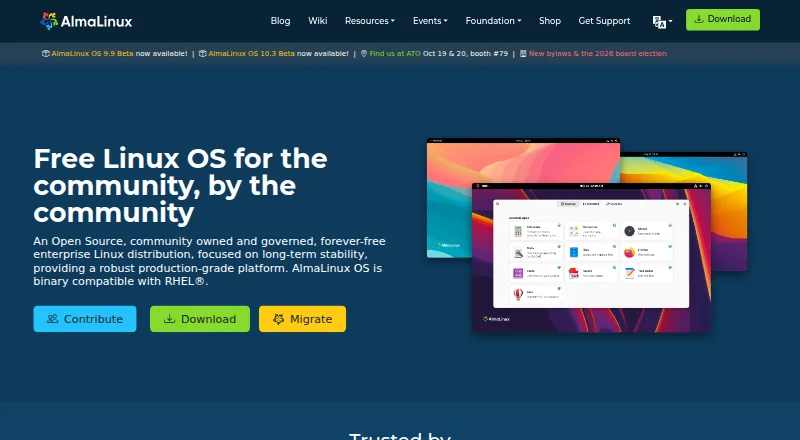
What AlmaLinux OS is
AlmaLinux OS is a free, open-source, community-owned enterprise Linux distribution that is binary compatible with RHEL. The project presents it as an option for users who need an enterprise-grade distribution without a commercial license agreement, including those seeking a CentOS Linux replacement. It can be deployed on servers, workstations, virtual machines, cloud instances, containers, Raspberry Pi devices, and WSL environments. ISO downloads cover x86_64, aarch64, ppc64le, and s390x; official cloud images are available for Amazon AWS, Generic Cloud, Google Cloud, Microsoft Azure, OpenNebula, and Oracle Cloud Infrastructure. The project also provides container images, Vagrant images, and live media with GNOME, GNOME Mini, KDE, XFCE, and MATE options. A WSL image provides a terminal environment on Windows. The Foundation publishes security and bug-fix errata, and packages are GPG-signed and verified by default. Community support is available through forums, chat, and Reddit; commercial support is offered separately. Stable updates and security patches are planned for 8.x until 2029 and 9.x until 2032.
Who it suits
It suits users seeking a free enterprise Linux distribution without a commercial license agreement, including people looking for a CentOS Linux replacement. It also offers deployment choices across hardware, cloud, containers, and WSL.
What it does well
- Free enterprise Linux distribution with no fees
- Binary compatible with RHEL
- ISO downloads cover four architectures
- Packages are GPG-signed and verified by default
- Community support is available through forums, chat, and Reddit
What to know first
- Minor versions reach end of life when the next minor version releases
- Commercial support is offered separately
Limits
The AlmaLinux OS plan is free. Minor versions reach end of life when the next minor version is released; the stated update plans run through 2029 for 8.x and 2032 for 9.x.
Plans
| Plan | Billed and limits | Price |
|---|---|---|
| AlmaLinux OS | forever · enterprise Linux distribution · RHEL binary compatibility · no license fees or usage charges | Free |
As almalinux.org lists them, read 15 Oct 2026. The maker's own page has the final word.
Getting started
- Visit the AlmaLinux website.
- Choose a deployment route such as an ISO, cloud image, container image, Vagrant box, live media, Raspberry Pi, or WSL image.
- Select an available architecture or desktop option that fits your environment.
- Install or launch the selected image and use DNF for package updates.
AlmaLinux OS is a free, community-owned enterprise Linux distribution built for binary compatibility with RHEL. It suits organizations and individuals who want an enterprise-oriented system without a commercial license, including those moving from CentOS Linux. Its broad deployment choices and long planned support lifetimes make it a credible server and cloud option, though commercial support costs extra.
Overview
Stewarded by the AlmaLinux OS Foundation, a 501(c)(6) nonprofit with a community-elected board, the project is designed to offer an enterprise Linux option without a commercial license agreement. Binary compatibility with RHEL is central to its appeal, particularly for users seeking a CentOS Linux replacement. The project began in 2021.
Its scope extends from servers to workstations, virtual machines, cloud instances, containers, Raspberry Pi devices and Windows Subsystem for Linux (WSL). That breadth is useful for teams standardizing on one distribution across varied environments, but it does not make AlmaLinux a general-purpose answer for every desktop or network appliance need.
Key features
Deployment range
ISO downloads cover x86_64, aarch64, ppc64le and s390x; some releases also list x86_64_v2 and i686 userspace. Official cloud images target Amazon AWS, Generic Cloud, Google Cloud, Microsoft Azure, OpenNebula and Oracle Cloud Infrastructure. OCI, Docker and UBI-compatible container images and Vagrant images for Libvirt, VirtualBox, Hyper-V, VMware and Parallels add options for development and virtualization.
Live Media comes with GNOME, GNOME Mini, KDE, XFCE and MATE. A WSL image provides the terminal environment on Windows. This makes AlmaLinux unusually adaptable across infrastructure and evaluation setups, although desktop variety does not change its enterprise-Linux focus.
Security and maintenance
The Foundation publishes errata for security issues and bug fixes, with analysis of their significance. Packages are GPG-signed and verified by default when installed. OpenSCAP, SCAP Workbench, OVAL streams and CIS tooling support auditing and hardening, which gives administrators practical tools for compliance work rather than leaving that workflow entirely to third parties. The project states that AlmaLinux OS 9.2 is FIPS 140-3 validated and Common Criteria certified.
Stable, tested updates and security patches are planned for 8.x until 2029 and 9.x until 2032, with about 10 years of support per major version. Minor versions reach end of life when the next minor version is released, so administrators should plan minor-version updates rather than assume each one remains supported for the full major-version lifetime.
Pricing
AlmaLinux OS costs free. The free plan is the distribution itself, with no fees or charges; it is the fit for users who can manage deployment and maintenance themselves and are comfortable relying on community channels. There is no free trial because the software is free to use.
Commercial support is offered separately by providers including Cybertrust Japan and TuxCare. For organizations that need paid assistance, that is a route to consider, but it means the no-fee distribution does not itself include commercial support. Community support is available through forums, chat and Reddit.
Platforms
AlmaLinux supports Linux and self-hosted deployments and offers a WSL image for Windows. The choices span bare metal, virtual machines, cloud images, containers, live media, Vagrant boxes, Incus/LXC and Raspberry Pi. DNF handles package updates, while updateinfo provides errata information; cloud images support cloud-init. RPM/DNF repositories and Docker and OCI images suit teams already using those package and container workflows.
Who it's for
Choose AlmaLinux when you need an enterprise-grade Linux distribution without a commercial license agreement, especially for RHEL-compatible workloads or as a CentOS Linux replacement. Its architecture coverage, cloud images and long planned major-version support suit infrastructure teams deploying across mixed hardware and cloud environments. The compliance tooling and package verification are useful for administrators who need security and audit workflows built into their Linux operations.
Look elsewhere if commercial support must be included in the distribution price, or if your priority is a different Linux ecosystem rather than RHEL compatibility. The community support channels may suit self-sufficient users, but they are not a substitute for a paid support relationship when that is a requirement.
Pros and cons
- Pros: No-fee access to an RHEL-compatible enterprise distribution makes it a practical choice for users avoiding a commercial license agreement.
- Pros: Cloud, container, VM, desktop and WSL options cover a wide range of deployment contexts without limiting the project to servers.
- Pros: Security errata, default package verification and compliance tooling give administrators concrete ways to track and harden systems.
- Pros: Planned support through 2029 for 8.x and 2032 for 9.x supports long-lived deployments.
- Cons: Commercial support is separate, so organizations needing provider-backed assistance must arrange and pay for it independently.
- Cons: Minor releases end support when the next minor release arrives, requiring a regular update cadence even within a supported major version.
Alternatives
Rocky Linux is another free, community-supported Linux distribution with a 10-year support lifecycle; consider it if that alternative better fits your selection of an enterprise Linux system. CentOS Stream is a free software distribution available for download, and may suit readers seeking that option rather than AlmaLinux's stated role as a CentOS Linux replacement.
Debian is a free operating system whose official distribution packages are free to use and redistribute, making it an alternative for readers who prefer that package ecosystem. Fedora Linux is also free; most variants recommend 40GB of disk space and 4GB of RAM, a useful consideration when comparing system requirements.
Kubuntu is free to download, use, distribute and modify, so it is an option for readers focused on that desktop-oriented distribution. Manjaro Linux is another free Linux distribution, with enterprise services offered separately on a quote basis. pfSense is a freemium firewall and router software option, rather than an enterprise Linux distribution. OPNsense is another freemium alternative with community and business editions.
Browse more options in Operating Systems.
Verdict
AlmaLinux OS is a strong choice for administrators and organizations that want a free, RHEL-compatible system with broad deployment options, security tooling and a long planned major-version lifecycle. Its main trade-off is that commercial support is separate, and minor-version transitions still require attention. Choose it when compatibility and self-managed operations matter more than bundled vendor support; look elsewhere when paid support must come with the distribution.
Verdict
AlmaLinux OS offers broad deployment options, security errata, and community support without a distribution fee. Its stated update plans vary by major version, and commercial support is separate.
Questions
How much does AlmaLinux OS cost?
The AlmaLinux OS plan is free, with no fees or charges. Commercial support is available separately.
Is AlmaLinux OS open source?
Yes. It is an open-source, community-owned Linux distribution stewarded by the AlmaLinux OS Foundation.
Which platforms and architectures does it support?
Listed platforms include Linux, self-hosted environments, and Windows through WSL. ISO downloads are available for x86_64, aarch64, ppc64le, and s390x.
What support is available?
Community support is available through forums, chat, and Reddit. Commercial support is offered by listed providers, including Cybertrust Japan and TuxCare.
How long are updates planned?
Stable updates and security patches are planned for AlmaLinux OS 8.x until 2029 and 9.x until 2032. The stated support lifecycle is about 10 years per major version.
Facts from AlmaLinux OS's own pages
- Architectures
- Supported primary architectures are x86_64, aarch64, ppc64le and s390x. · wiki.almalinux.org, 15 Oct 2026
- Certifications
- The project states that AlmaLinux OS 9.2 is FIPS 140-3 validated and Common Criteria certified. · almalinux.org, 29 Sept 2026
- Cloud images
- Official cloud images are provided for Amazon AWS, Generic Cloud, Google Cloud, Microsoft Azure, OpenNebula, and Oracle Cloud Infrastructure. · almalinux.org, 29 Sept 2026
- Cloud integrations
- Official images are provided for AWS, Google Cloud, Microsoft Azure, OpenNebula and Oracle Cloud Infrastructure. · almalinux.org, 15 Oct 2026
- Company size
- LinkedIn lists AlmaLinux as a nonprofit software-development organization with 2–10 employees. · linkedin.com, 15 Oct 2026
- Compliance
- AlmaLinux OS 9.2 is stated to have FIPS 140-3 validation and to appear on the NIST active list. · almalinux.org, 15 Oct 2026
- Compliance tools
- AlmaLinux provides OpenSCAP, SCAP Workbench, OVAL streams, and CIS tooling to audit or harden systems. · almalinux.org, 29 Sept 2026
- Container integrations
- The project publishes OCI, Docker and UBI-compatible container images through Docker Hub, Quay.io and GitHub. · almalinux.org, 15 Oct 2026
- Containers and virtual machines
- The project provides OCI, Docker, and UBI-compatible container images, plus Vagrant images for Libvirt, VirtualBox, Hyper-V, VMware, and Parallels. · almalinux.org, 29 Sept 2026
- Desktop media
- Live images are offered with GNOME, GNOME Mini, KDE, XFCE and MATE. · almalinux.org, 15 Oct 2026
- Desktop options
- Live Media images are offered with GNOME, GNOME Mini, KDE, XFCE, and MATE desktop options. · almalinux.org, 29 Sept 2026
- Documentation and support
- Documentation covers installation, migration, security, cloud images, containers, WSL, repositories and troubleshooting, with forums, chat and mailing lists for community support. · wiki.almalinux.org, 15 Oct 2026
- Founded
- The Foundation says it was founded in March 2021 to own and manage AlmaLinux OS. · wiki.almalinux.org, 15 Oct 2026
- Governance
- The AlmaLinux OS Foundation is a US 501(c)(6) nonprofit that owns and manages the project. · almalinux.org, 15 Oct 2026
- Headquarters
- LinkedIn lists headquarters in Fort Myers, Florida. · linkedin.com, 15 Oct 2026
- Installation formats
- Boot, minimal and DVD ISO images are available for each supported architecture, with checksum and signature verification instructions. · wiki.almalinux.org, 15 Oct 2026
- License
- The distribution compilation is licensed under GPLv2, while included packages retain their individual upstream licenses; unique non-OS software may use GPLv3 and libraries may use MIT. · almalinux.org, 15 Oct 2026
- Limit: beginner usability
- G2 reviewers report that installation and configuration can be CLI-focused and require prior Linux knowledge. · g2.com, 15 Oct 2026
- Limit: ecosystem size
- PhoenixNAP’s comparison says AlmaLinux has slower access to new software, fewer AlmaLinux-specific packages and less cloud-tooling dominance than Ubuntu. · phoenixnap.com, 15 Oct 2026
- Limit: software freshness
- G2 reviewers say the stability-first approach can delay newer packages and require manual hardware or configuration work. · g2.com, 15 Oct 2026
- Migration
- The project supplies almalinux-deploy for migrations from several Enterprise Linux distributions and ELevate for major-version upgrades. · wiki.almalinux.org, 15 Oct 2026
- Notable news: AlmaLinux 10.3 beta
- The project announced AlmaLinux 10.3 beta on September 10, 2026, including ModSecurity and OWASP Core Rule Set return, Podman 6 changes and new toolchains. · almalinux.org, 15 Oct 2026
- Package policy
- Packages are generally limited to what is in RHEL, while additional software is expected to come from repositories such as EPEL. · wiki.almalinux.org, 15 Oct 2026
- Package verification
- AlmaLinux packages are GPG-signed and verified by default when installed. · almalinux.org, 29 Sept 2026
Where AlmaLinux OS stands on Freedom251
- Operating Systems#1 of 42
- Server Operating System#1 of 29