Freedom251 › Alumni Management Software

Alumni OS
What Alumni OS is
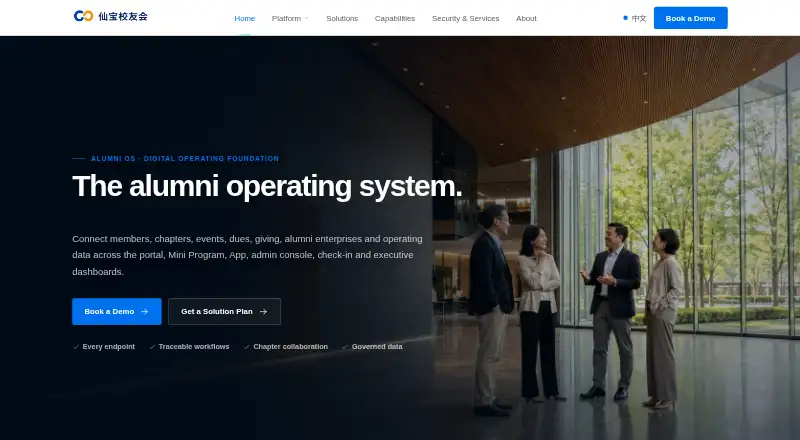
Alumni OS is a platform for universities and alumni organizations to manage member relationships, chapters, events, dues, giving, alumni enterprises, and operational data. It brings member-facing services and administrative work together across a portal, Mini Program, mobile app, admin console, event check-in, and dashboards. Members can verify their identity, use digital alumni cards and directories, register for events, manage tickets, and review dues or giving history. The platform also supports lifelong services.
Its CRM brings profiles, identities, chapters, contacts, historical records, tags, engagement timelines, and follow-up work into shared member records. Organizations can administer multi-level chapters, including member onboarding, leadership terms, and annual work. Event tools cover discovery, registration, payment, tickets, access, and reminders; dues and giving workflows include rules, campaigns, orders, refunds, ledgers, and reconciliation. Audience building and analytics can use cohort, region, sector, chapter, and behavior, with insights into growth, chapter health, event conversion, and fund trends. The interface is described as native Chinese and English. Projects can assess SaaS, dedicated, or private deployment, with delivery that may include migration, training, launch support, and ongoing improvement. Pricing is on request.
Who it suits
Alumni OS suits university alumni offices, schools and faculties, regional or sector chapters, and education groups managing alumni services. It also serves alumni members who need access to identity tools, directories, events, dues, giving records, and other lifelong services.
What it does well
- Combines member, chapter, event, dues, and giving workflows.
- Provides identity verification and digital alumni cards.
- Supports multi-level chapter administration and scoped access.
- Offers engagement analytics by cohort, region, sector, and behavior.
- Includes Chinese and English user interfaces.
What to know first
- Pricing is available on request.
- Payment, invoicing, and finance depend on qualified third-party integrations.
Plans
| Plan | Billed and limits | Price |
|---|---|---|
| Custom project plan | Tailored scope and delivery; SaaS, dedicated, and private deployment options assessed per project | On request |
As szztz.com lists them, read 9 Oct 2026. The maker's own page has the final word.
Getting started
- Visit the Alumni OS website.
- Contact the company about a custom project plan and pricing.
- Assess SaaS, dedicated, or private deployment for the project.
- Plan data inventory, cleaning, mapping, and trial migration as part of delivery.
- Arrange role-based training and launch support.
Alumni OS is an alumni administration platform for universities and education groups coordinating members and activity across chapters. It suits organizations that need member services tied to institutional operations. Its broad scope is a strength, but payment, invoicing and finance depend on third-party integrations.
Overview
The platform connects alumni profiles, chapter administration, events, dues, giving and alumni-enterprise activity across a portal, Mini Program, app, admin console, check-in tools and dashboards. That joined-up approach can help an alumni office coordinate services and track activity in one system. The trade-off is a project-led model: delivery, deployment and integrations need to be shaped around each institution.
Key features
Shared profiles combine verified identity, roles, tags, interactions and service history. CRM tools link those records to chapters, contacts, historical information, engagement timelines and follow-up work. This is useful for offices that need outreach and service history to carry across activities, rather than sit in separate event or chapter records.
Chapter management covers multiple levels, including onboarding, terms, leaders, members and annual work. Roles and data access can reflect headquarters, schools, regions, sectors and cohorts. That flexibility suits institutions with layered governance, although the organization’s structures will need to be considered in project design.
Members can verify identity, use digital alumni cards and directories, register for events, access tickets, review dues and giving history, and use lifelong services. Event tools cover discovery, registration, payment, tickets, access and reminders. Dues and giving workflows include membership rules, campaigns, orders, refunds, ledgers and reconciliation. The important boundary is that payment, invoicing and finance require qualified third-party integrations.
Engagement tools can build audiences by cohort, region, sector, chapter and behavior, while dashboards cover growth, chapter health, event conversion and fund trends. Privacy controls include consent, field classification, masking, export controls, audit logs and account-closure workflows. The maker says compliance assessments are planned around each project, so organizations with specific obligations should establish how those requirements will be addressed during scoping.
Projects can connect approved identity, master-data, payment, messaging and other institutional services. SaaS, dedicated and private deployment options can be assessed per project. Delivery may include data inventory, cleaning, mapping, trial migration and verification, alongside defined backup cycles, recovery objectives and response plans. Discovery, phased delivery, role-based training, launch support and continuing review are part of the maker’s described approach. The native Chinese and English interface broadens its fit for bilingual communities.
Pricing
Alumni OS uses a custom project plan with custom pricing. Scope and delivery are tailored, and SaaS, dedicated and private deployments are assessed per project. This approach can accommodate institutions with distinct governance or deployment needs, but buyers should request a project-specific price and clarify integration costs, migration work and ongoing support before committing. No standard seat or member allowance is stated.
Platforms
Alumni OS supports Android, iOS, web, API and self-hosted deployment. The range suits institutions combining member-facing services with internal systems and deployment requirements; the right configuration depends on the project.
Who it's for
University alumni offices, schools and faculties, regional or sector chapters, and education groups are the clearest fit. It is particularly suited to organizations managing multiple chapter levels and connecting member services with institutional data. A smaller organization seeking a self-serve, fixed-price package may find the project-based approach less direct.
Pros and cons
- Pros: A connected set of member, chapter, event, dues and giving workflows can support coordinated alumni operations.
- Pros: Organization-level access scopes, privacy controls and several deployment options address needs common to institutions with complex structures.
- Pros: Migration, training and launch support can be included in delivery, reducing the burden of moving an established operation.
- Cons: Custom project pricing makes costs harder to compare without a scoped proposal.
- Cons: Payment, invoicing and finance depend on third-party integrations, adding a dependency to core financial workflows.
- Cons: Project-specific delivery and deployment require buyer involvement in defining scope, integrations and recovery expectations.
Alternatives
Compare alumni management software if you want to survey the category before choosing a platform.
- Scholva Alumni Network is worth considering for a smaller community that can start with its free plan for up to 200 students.
- AlumniMS offers a free plan for up to 100 members, with 15 platform modules, a custom subdomain and basic analytics; choose it if that cap and feature set suit your needs.
- AlumUnion has a free institution platform with no setup, subscription or per-member charge, though online payment fees apply.
- Feending has a free plan with unlimited users and one administrator, making it a possible starting point for organizations prioritizing a no-cost entry tier.
- AlmaShines offers paid annual plans with defined administrator, alumni and profile-field limits; consider it if those capped plans fit your scale.
- Anthology Encompass is another paid alumni platform for Android, iOS and web.
- PeopleGrove Engagement Hub is a paid web platform with a free plan.
- Almabase uses custom pricing based on needs and alumni size, making it another option for institutions seeking a tailored quote.
Verdict
Alumni OS is a strong candidate for universities and education groups that need member records, chapter operations, events, dues and giving connected in a project-shaped platform. Its main advantage is the breadth of linked workflows, backed by migration and launch support. Look elsewhere if you need a standard package with transparent pricing or want payment and finance to work without third-party integrations.
Verdict
Choose Alumni OS if an education organization needs member records, chapter administration, events, dues, and giving in a connected platform. Its project delivery can include migration, training, and launch support. Organizations should account for third-party integrations for payment, invoicing, and finance, and request a project-specific price.
Questions
How much does Alumni OS cost?
Pricing is on request. Its custom project plan has tailored scope and delivery.
Which platforms does Alumni OS support?
The listed platforms are Android, iOS, web, API, and self-hosted.
Can an organization choose its deployment model?
SaaS, dedicated, and private deployment options can be assessed for each project.
Does Alumni OS handle payments and invoicing itself?
Payment, invoicing, and finance depend on qualified third-party integrations.
What languages are available?
The site describes a native Chinese and English user interface.
Who is Alumni OS for?
It is presented for university alumni offices, schools or faculties, regional or sector chapters, and education groups, as well as alumni members.
Facts from Alumni OS's own pages
- Access controls
- Roles, capabilities and data scopes can follow headquarters, schools, regions, sectors, cohorts and other chapter levels. · szztz.com, 8 Oct 2026
- Alumni profiles
- It combines verified identity, roles, tags, interactions, and service history in a shared member profile. · szztz.com, 9 Oct 2026
- Audience
- The platform is presented for university alumni offices, schools or faculties, regional or sector chapters, and alumni members. · szztz.com, 9 Oct 2026
- Chapter management
- It supports multi-level chapters spanning headquarters, schools, regions, sectors, cohorts, and classes. · szztz.com, 9 Oct 2026
- CRM
- The CRM links alumni profiles, identities, chapters, contacts, historical records, tags, engagement timelines and follow-up work. · szztz.com, 8 Oct 2026
- Deployment
- SaaS, dedicated, and private deployment options can be assessed for a project, with campus identity and data integrations available. · szztz.com, 9 Oct 2026
- Dues and giving
- Dues and giving features include membership rules, campaigns, orders, refunds, ledgers, and reconciliation; payment, invoicing, and finance depend on third-party integrations. · szztz.com, 9 Oct 2026
- Engagement and analytics
- The product supports audience building by cohort, region, sector, chapter, and behavior, plus insights into growth, chapter health, event conversion, and fund trends. · szztz.com, 9 Oct 2026
- Events
- Event workflows include creation, approval, invitations, registration, charges, check-in, surveys, and review. · szztz.com, 9 Oct 2026
- Headquarters
- 11F, Building B, Nano University Science Park, No. 388 Ruoshui Road, Suzhou Industrial Park, Jiangsu, China · szztz.com, 28 Sept 2026
- Integrations
- Projects can connect approved identity, master-data, payment, messaging, and other institutional services. · szztz.com, 9 Oct 2026
- Intended users
- The site describes the product for university alumni offices, school or faculty associations, regional or sector chapters, and schools or education groups. · szztz.com, 8 Oct 2026
- Languages
- The site describes a native Chinese and English user interface. · szztz.com, 9 Oct 2026
- Member experience
- Members can use identity verification, digital alumni cards, directories, event registration and tickets, dues and giving history, and lifelong services. · szztz.com, 8 Oct 2026
- Migration and recovery
- Delivery can include data inventory, cleaning, mapping, trial migration, verification, and defined backup cycles, recovery objectives, and response plans. · szztz.com, 9 Oct 2026
- Payment boundary
- Payment, invoicing and finance depend on qualified third-party integrations. · szztz.com, 8 Oct 2026
- Privacy controls
- Privacy measures include consent, field classification, masking, export controls, audit logs and account-closure workflows. · szztz.com, 8 Oct 2026
- Product
- Alumni OS connects members, chapters, events, dues, giving, alumni enterprises, and operating data across a portal, Mini Program, app, admin console, check-in, and executive dashboards. · szztz.com, 9 Oct 2026
- Product scope
- Alumni OS connects members, chapters, events, dues, giving, alumni enterprises and operating data across a portal, Mini Program, app, admin console, check-in and dashboards. · szztz.com, 8 Oct 2026
- Security and privacy
- The maker describes role and organization scopes, consent, field classification, masking, export controls, audit logs, and account-closure workflows; it says compliance assessments are planned around each project. · szztz.com, 9 Oct 2026
- Support
- The maker describes role-based training, launch support, and continuous review as part of its delivery process. · szztz.com, 9 Oct 2026
- Support and delivery
- The company describes discovery, phased delivery, migration, training, launch support and continuous improvement. · szztz.com, 8 Oct 2026
Where Alumni OS stands on Freedom251
- Alumni Management Software#10 of 23