Freedom251 › SaaS Accounting Software

Akaunting
by Akaunting
What Akaunting is
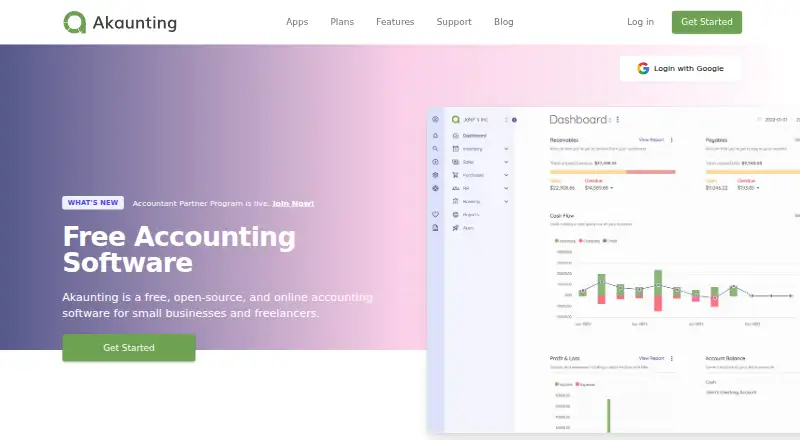
Akaunting is web-based accounting software for businesses handling invoices, receipts, inventory, bank feeds, and accountant access. It supports invoice creation, receipt capture, inventory tracking, and bank feeds; automated reconciliation is not available. Akaunting was founded in 2017, and web is its listed platform, including for mobile use. A free plan is available, alongside cloud and on-premise plans. The pricing note says paid plans start at $8/mo (annual). Listed cloud plans are billed monthly: Standard Cloud costs $12 a month for 1 company, 1 user plus 1 accountant, 1,000 invoices, and 4 apps. Premium Cloud costs $36 a month for 10 companies, 10 users, 10,000 invoices, and 10 apps; Elite Cloud costs $84 a month for 30 companies, 30 users, 30,000 invoices, and 30 apps. Ultimate Cloud is $218 a month for unlimited companies, users, and invoices, with all apps included. On-premise options include Standard, Premium at $72 a year, and Elite at $168 a year. The maker is Akaunting. These plan limits distinguish the number of companies, users, invoices, and apps available across the cloud tiers.
Who it suits
Akaunting suits businesses that need web-based tools for invoicing, receipt capture, inventory tracking, and bank feeds, with accountant access available. Its cloud tiers cover different company, user, invoice, and app allowances, while on-premise plans are also listed.
What it does well
- Creates invoices and captures receipts.
- Tracks inventory and supports bank feeds.
- Accountant access is available.
- Cloud plans include options up to unlimited companies, users, and invoices.
- A free plan is available.
What to know first
- Automated reconciliation is not available.
- The listed platform is web only, including on mobile.
- Standard On-Premise has no listed price.
Limits
Standard Cloud includes 1 company, 1 user plus 1 accountant, 1,000 invoices, and 4 apps. Higher listed cloud tiers raise these allowances, with Ultimate Cloud including unlimited companies, users, and invoices and all apps.
Plans
| Plan | Billed and limits | Price |
|---|---|---|
| Standard Cloud | billed monthly · 1 company · 1 user + 1 accountant · 1,000 invoices · 4 apps included | $12 a month |
| Premium Cloud | billed monthly · 10 companies · 10 users · 10,000 invoices · 10 apps included | $36 a month |
| Elite Cloud | billed monthly · 30 companies · 30 users · 30,000 invoices · 30 apps included | $84 a month |
| Ultimate Cloud | billed monthly · Unlimited companies · Unlimited users · Unlimited invoices · All apps included | $218 a month |
| Standard On-Premise | 1 company · 1 user + 1 accountant · 1,000 invoices | On request |
| Premium On-Premise | billed annually · 10 companies · 10 users · 10,000 invoices | $72 a year |
| Elite On-Premise | billed annually · 30 companies · 30 users · 30,000 invoices | $168 a year |
As akaunting.com lists them, read 20 Sept 2026. The maker's own page has the final word.
Getting started
- Visit https://akaunting.com/.
- Use Akaunting on the web, including on mobile.
- Choose the free plan or a listed cloud or on-premise plan.
- Select a cloud tier based on its company, user, invoice, and app allowances.
Akaunting is browser-based accounting software for freelancers, small businesses and accountants handling multiple companies. It brings invoicing, receipt capture, inventory tracking, bank feeds and accountant access into one web service. It is most convincing when you need flexible company and user capacity; businesses that depend on automatic transaction matching should be cautious.
Overview
Founded in 2017, Akaunting follows a freemium model with a free plan and paid options from $8 per month when billed annually. Its cloud and on-premise ranges start with a single-company setup and extend to unlimited companies on the top cloud tier. That span suits both a solo operator and an accounting practice, but the entry levels impose firm ceilings on invoices, users and companies.
The free option can cover a very small operation without a subscription. As activity grows, the practical question is whether your required invoice volume, team size and number of companies fit the selected allowance rather than simply whether the software is inexpensive.
Key features
Day-to-day accounting
Invoice creation handles billing inside the same system that stores receipts, reducing the need to split routine sales and purchase records across tools. Receipt capture is particularly useful for keeping expense evidence with the accounting workflow. Inventory tracking makes Akaunting more relevant to product businesses than an invoicing-only service.
Bank feeds can bring account data into the process, but Akaunting does not provide automated reconciliation. Someone must still review transactions and match them, so it is a weaker fit for organisations seeking a largely automatic bank-closing routine. Accountant access supports an external bookkeeper or adviser working alongside the business owner.
Scale and included apps
Cloud allowances increase sharply between tiers: from one company, one user plus one accountant and 1,000 invoices on Standard, to unlimited companies, users and invoices with every app on Ultimate. Included app counts also rise from four to 10 and then 30. Those quotas make the plan ladder predictable, but exceeding a lower tier means moving up rather than merely adding a little capacity.
Pricing
Cloud plans
- Standard Cloud: $12 a month, billed monthly. It covers one company, one user plus one accountant, 1,000 invoices and four apps. This is the sensible paid starting point for a single small business with a modest billing workload.
- Premium Cloud: $36 a month, billed monthly. Ten companies, 10 users, 10,000 invoices and 10 apps suit a growing firm or accountant serving several entities.
- Elite Cloud: $84 a month, billed monthly. Thirty companies, 30 users, 30,000 invoices and 30 apps target larger practices and multi-entity operations.
- Ultimate Cloud: $218 a month, billed monthly. Unlimited companies, users and invoices, with all apps included, removes the principal capacity constraints for a substantial portfolio.
On-premise plans
- Standard On-Premise: custom pricing. It includes one company, one user plus one accountant and 1,000 invoices, matching the basic capacity of Standard Cloud without a published price.
- Premium On-Premise: $72 a year, billed annually, for 10 companies, 10 users and 10,000 invoices.
- Elite On-Premise: $168 a year, billed annually, for 30 companies, 30 users and 30,000 invoices.
The on-premise Premium and Elite prices are annual terms, while the cloud prices above are monthly billing. Compare those terms alongside app allowances and company counts before choosing a deployment model.
Platforms
Akaunting is web-only, including its mobile availability. It works for teams comfortable using a browser, but it does not offer separate Android or iOS applications.
Who it's for
Choose it for a freelancer or small business that needs invoices, receipts and inventory in one browser service, or for an accountant managing several client companies. The higher tiers are appropriate when multiple users and entities are central to the work. It is less suitable for a team that requires automatic reconciliation or native mobile apps.
Pros and cons
Pros
- Useful core coverage: invoicing, receipt capture, inventory tracking, bank feeds and accountant access address common small-business workflows.
- Clear scaling path: cloud tiers progress from one company to unlimited companies, with matching increases in users and invoice quotas.
- On-premise choice: annual Premium and Elite options provide an alternative to monthly cloud billing.
- Free entry point: a free plan lets very small operations begin without a subscription.
Cons
- No automated reconciliation: bank-feed data still requires manual matching and verification.
- Web only: mobile users do not get dedicated Android or iOS apps.
- Strict lower-tier caps: Standard limits companies, users, invoices and apps, so expansion may require a higher plan.
- Top cloud tier is costly: Ultimate is $218 a month, justified mainly when unlimited capacity and all apps are necessary.
Alternatives
For broader platform coverage and a freemium alternative with Android, iOS and web support, compare FreeAgent. If you want a freemium system available on Android, iOS, self-hosted and web platforms, consider Odoo Accounting. Zoho Books is another freemium option with a free tier aimed at solopreneurs and micro businesses below its stated annual-revenue threshold. For inventory-focused limits, Zoho Inventory offers a free plan with 50 orders per month, one user and one location.
Zuora CPQ uses custom pricing for configurable quoting needs. Accounting Seed is a paid product with pricing on request. Campfire offers custom pricing based on organisational and transaction factors. Ordway uses a fixed subscription proposal scaled to transaction value and scope.
Industry-specific comparisons are available in SaaS Accounting Software, Salon Accounting Software, Gym Accounting Software and Bookkeeping Software.
Verdict
Akaunting is a strong choice for browser-based accounting that must cover invoicing, receipts, inventory and accountant collaboration, especially when several companies or users justify Premium, Elite or Ultimate capacity. Its main reason to look elsewhere is the lack of automated reconciliation, compounded by web-only access for teams that expect native mobile apps.
Verdict
Choose Akaunting if you need web-based accounting features such as invoicing, receipt capture, inventory tracking, bank feeds, and accountant access. Look elsewhere if automated reconciliation is essential, or compare the listed plan allowances against the number of companies, users, invoices, and apps you need.
Questions
Is Akaunting free?
A free plan is listed. Paid pricing is noted as starting at $8/mo (annual).
What are the listed cloud plan prices?
Standard Cloud is $12 a month, Premium Cloud is $36 a month, Elite Cloud is $84 a month, and Ultimate Cloud is $218 a month.
Can it create invoices and track inventory?
Yes. Invoice creation and inventory tracking are listed features.
Does Akaunting support automated reconciliation?
No. Automated reconciliation is listed as unavailable.
Which platforms are available?
Web is the listed platform, including for mobile use.
Who makes Akaunting?
The maker is Akaunting, which was founded in 2017.
Facts from Akaunting's own pages
- Accountant access
- Yes · akaunting.com, 20 Sept 2026
- Automated reconciliation
- No · akaunting.com, 20 Sept 2026
- Bank feeds
- Yes · akaunting.com, 20 Sept 2026
- Founded
- 2017 · akaunting.com, 28 Sept 2026
- Free plan
- Yes · akaunting.com, 20 Sept 2026
- Inventory tracking
- Yes · akaunting.com, 20 Sept 2026
- Invoice creation
- Yes · akaunting.com, 20 Sept 2026
- Mobile platforms
- web only · akaunting.com, 20 Sept 2026
- Receipt capture
- Yes · akaunting.com, 20 Sept 2026
- Paid from
- 8 · akaunting.com, 20 Sept 2026
Where Akaunting stands on Freedom251
- SaaS Accounting Software#3 of 25
- Accounting & Finance Software#4 of 26
- Gym Accounting Software#6 of 31
- Accounting APIs#6 of 27
- Core Financial Management#7 of 28
- Bookkeeping Software#20 of 75
- Bookkeeper Software#7 of 26
- Financial Management#8 of 29
- Salon Accounting Software#8 of 29