Outdated Drivers Are Slowing You Down
One free scan finds every outdated or missing driver and matches the right update for your exact hardware.Free scan · exact hardware matchWindows Errors? Fix Them Before They Spread
Repair common Windows errors and clear accumulated junk for a smoother, more stable PC - no reinstall needed.Free scan · no reinstallNeither AI nor human recommendations are consistently better for every reader. AI can quickly generate candidates from stated preferences or reading history; a knowledgeable person can ask follow-up questions and account for mood, context, and the reasons behind your likes and dislikes. A practical approach is to use AI for a first-pass list, then ask a reader, bookseller, or librarian to challenge it.
What “better” means for choosing your next book
A recommendation can be a strong match to your usual taste and still be the wrong book for your current mood. “Better” might mean speed, a close fit, a surprising discovery, or a thoughtful explanation. There is no direct evidence here establishing one universal winner for book recommendations, so the useful question is which method fits the decision you need to make.



As an Amazon Associate I earn from qualifying purchases.
| What you need | AI may be more useful when… | A person may be more useful when… |
|---|---|---|
| A quick list | You can describe your preferences or share relevant reading history and want many candidates. | You would rather receive a short, curated selection. |
| A nuanced match | You can give precise constraints and refine the results through feedback. | Mood, life circumstances, disliked tropes, or the reason you liked a book matters. |
| Something different | You explicitly ask for variety and the system has suitable data. | You want someone to suggest a book outside your established pattern. |
| An explanation | The system identifies which preferences it used and lets you correct them. | The recommender can explain a personal or contextual reason for the match. |
These are practical distinctions, not a result of a controlled test showing that one method produces more satisfying book choices.
Recommended Free Tools
What book-recommendation studies actually establish
A 2023 Springer Nature case study evaluated collaborative algorithms: methods that use patterns in multiple readers’ ratings to estimate how a user might rate books they have not rated. It tested matrix factorization using stochastic gradient descent and a book-based k-nearest-neighbor method on a modified Book-Crossing dataset containing 42,137 explicit ratings. That is the size of the dataset used in this case study, not a measure of accuracy or the total number of Book-Crossing ratings. The study compared algorithms, not algorithms with human recommenders or reader satisfaction. Springer Nature’s book-recommender case study also discusses collaborative, content-based, and hybrid approaches, alongside challenges such as context, diversity, implicit feedback, and explainability.
#1 Best Overall
Those challenges matter because a rating history does not necessarily reveal why a reader liked a book, what they want now, or what they hope to avoid. Predicted ratings are one possible measure of a recommender, not a complete measure of whether a person will enjoy the suggestion.
Where AI can fall short: narrow patterns and unclear reasoning
Recommendations can reflect imbalances in their data
A 2025 arXiv preprint by Kalra and Daniil studied thematic bias using the Book-Crossing dataset. In that study, about 20% of themes accounted for over 52% of unique books, and the authors reported statistically significant distribution disparities for 8 of 25 themes. They also found that readers with niche and long-tail interests received less personalized recommendations in their setting. These results are specific to the dataset and method; they do not show that every recommendation system behaves this way, or that humans always do better. Read the 2025 preprint on thematic bias in book recommendations.
If you use AI for discovery, ask for variety directly—for example, request options from underrepresented genres, translated works, or books unlike your recent reads. Treat those as instructions to test, not guarantees that the system’s catalogue or data is balanced.
Do these 3 things before closing this tab:
1Clear out junk files and repair common Windows errors2Scan for outdated or missing drivers - takes under a minute3Repair Windows errors before they cause bigger problemsA convincing explanation may not reveal how a model chose
An AI may say a book fits because of its atmosphere, pacing, or characters. That explanation can be useful to you without being a precise account of the system’s internal decision process. A 2024 review in Frontiers in Big Data distinguished natural-language justifications from explanations tied to recommendation-system mechanics. The review reported 232 articles in its search and found that six directly addressed LLMs explaining recommendations. The review of LLM-based explanations for recommendations concerns explanation research, not proof of book-recommendation accuracy.
Rank #3
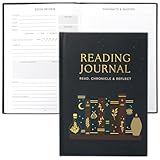
- Uplift Your Reading Experience: The all-in-one reading journals for book lovers help you to get the most out of your reading with dedicated sections for wish lists, book club readings, completed books, a reading tracker, book reviews, borrowed titles & much more
- Premium Finish & Features: ZICOTOs’ book journal reading log boasts a durable casebound binding and sturdy hardcover. With two ribbons to mark your place and an index to navigate 172 pages of comprehensive content, it's the perfect journal for organized note-taking
- Beautifully Designed to Inspire Your Reading: Featuring a timeless black hardcover with mystic design and gold foil accents, the reading journals are chic book accessories for reading lovers. A fabulous reading journal to stay organized & inspired with every turn of the page
- Convenient & Ready For Epic Reading Adventures: Sized at 5.9x8.34”, the aesthetic journal is great for note-taking on the go. Whether at book club meetings, on travels or cozy at home, the book journal for book lovers keeps track of your book lists, reflections & ideas
- Ultimate Gifts for Book Lovers: Simply fantastic gifts for avid or beginning readers, whether they're into motivational literature, romantic novels or thrilling mysteries. Thoughtful book lovers gifts that will be cherished and fully enjoyed
When an explanation matters, ask what specific preference a suggestion is intended to match—and check whether that reason actually fits you. A fluent rationale is not, by itself, evidence that the system used that factor internally.
Why a human can add context—and what the evidence does not show
A person can ask what you disliked about a book you abandoned, whether you want something comforting or challenging, and whether a particular theme is unwelcome right now. That conversation can surface information that a rating or reading list does not capture. It is a practical advantage of interactive advice, not a demonstrated finding that humans outperform AI in controlled book-selection studies.
Rank #4
A field experiment at a major German news outlet offers a useful but limited analogy. Its authors found that algorithmic recommendations performed better on average for clicks, while human editors did relatively better when the system had little user-specific data and when content or preferences varied. Counterfactual calculations estimated that combining the approaches could increase clicks by up to 13% in that setting. This was an estimate about clicks on a news website—not reader satisfaction, book sales, or the quality of book recommendations. Peukert and colleagues’ 2023 Management Science field experiment cannot establish which source is better for choosing a novel.
A 2026 ScienceDirect record describes an online study with 100 participants involving book and job recommendations and prompt guidance, but the available record does not provide enough outcome detail to identify a winner. The study record therefore does not support a claim about which recommendation source performed better.
Best Value
How to get more useful recommendations from either source
- State what you want now. Name a few books you enjoyed and what you liked about them—such as voice, pace, subject, or emotional tone. Add current constraints like length, genre, reading difficulty, or topics to avoid.
- Ask for a manageable shortlist. Request a brief list with a sentence explaining the intended match for each title. For AI, ask it to include options outside your usual pattern if discovery matters.
- Correct the reasoning. If a suggestion misses, explain why: perhaps the premise appealed but the writing style did not, or you want a similar mood without a particular trope. Ask a person or AI for a revised list using that correction.
- Check the titles before choosing. Confirm that each book exists and that the title and author are accurate. Treat suggestions as candidates, not as verified facts about a book’s contents.
- Use a human second opinion when context matters. A knowledgeable reader, bookseller, librarian, or book-club member can challenge a predictable list and ask questions that a profile may not answer.
Which should you ask first?
Start with AI if you want a fast first pass and can describe your preferences clearly. Start with a person if the choice depends on mood, personal context, sensitive themes, or the reasons behind your reactions to past reads. If you are unsure, combine them: let AI widen the candidate pool, then ask a human to question the matches and point you toward less obvious options. Neither source can guarantee that a book will suit you; the recommendation is a starting point, not a verdict.
Quick Recap
Product prices and availability are accurate as of the date/time indicated and are subject to change. Any price and availability information displayed on Amazon at the time of purchase will apply.




