Getting an AI model to run once is different from serving it reliably, securely, and affordably. In many production environments, that work depends on people who can operate the infrastructure around the model—often built with Linux, containers, Kubernetes, and other open-source tools. Those skills are useful, not universal prerequisites: the right stack and expertise depend on the workload and organization.
Why do AI engineers need Linux?
Linux is a common foundation for servers and cloud infrastructure. Knowing how to use its command line helps practitioners inspect files and processes, configure environments, read logs, and troubleshoot services. Those abilities can matter when an AI application moves from a notebook or development machine into a production environment.


As an Amazon Associate I earn from qualifying purchases.
That does not mean every AI engineer must be a system administrator. Model development, application engineering, infrastructure operations, and research have different day-to-day requirements. Linux familiarity is most valuable when your work touches the machines, containers, or services that run an application.
How do open source and cloud-native tools help AI scale?
Open-source infrastructure gives teams widely used tools and ecosystems for packaging, deploying, and operating software. Linux, containers, and Kubernetes address different layers: Linux provides the operating environment, containers package applications and dependencies, and Kubernetes coordinates containerized workloads across a cluster.
#1 Best Overall
The CNCF/LF Research 2025 Annual Cloud Native Survey describes Kubernetes as evolving from container orchestration toward an AI infrastructure platform. That is an account of ecosystem direction, not evidence that Kubernetes is required for every AI application. A smaller or simpler workload may not need a cluster at all.
In its January 20, 2026 announcement about the survey, CNCF reported that 82% of container users deploy Kubernetes in production, up from 66% in 2023. The denominator is surveyed container users—not all companies or all AI workloads—so the figures indicate adoption in that population rather than a universal requirement. The announcement also quotes Hilary Carter, senior vice president of research at the Linux Foundation, describing Kubernetes as an effective and reliable platform for modern production systems, including AI. That is Carter’s attributed view, not an independent comparative finding.
Rank #2
Sources: CNCF Annual Cloud Native Survey, Linux Foundation Research survey page, and CNCF’s January 20, 2026 announcement.
What cloud-native skills help run AI in production?
Production work extends beyond deploying a model. Depending on the system and role, teams may need to manage releases, keep services observable, respond to failures, protect systems and data, and understand infrastructure costs. The same capabilities apply to many software services, not just AI.
Rank #3
- Deployment and operations: package applications, manage configuration, and understand how services are released and updated.
- Observability and resilience: interpret logs and service signals, identify failures, and help keep systems available.
- Security and compliance: apply appropriate controls and understand the organization’s obligations.
- Cost awareness: monitor infrastructure use and make trade-offs between capacity, performance, and expense.
Workforce surveys also point to skills gaps in these adjacent areas. The Linux Foundation’s 2025 State of Tech Talent report announcement says 68% of organizations lacked AI/ML-skilled employees. It also reports gaps in cybersecurity/compliance (65%), FinOps/cost optimization (61%), cloud computing (59%), and platform engineering (56%). These are findings attributed to that report, not universal measures of the labor market.
The same announcement reports that 91% of organizations considered technical training effective for talent retention, while 84% said an open-source culture improves retention. These are survey findings, not guarantees that training or open-source adoption will produce the same results at every organization. Read the Linux Foundation’s June 23, 2025 announcement.
Do you need Kubernetes to work in AI?
No. Kubernetes is relevant when a team’s architecture and operational needs call for orchestrating containers across a cluster. It can be useful for production systems that need coordinated deployment and management, but learning it is not a condition for every AI role or project.
Start from the work you want to do. Someone focused on model development may prioritize machine-learning methods and application code; someone responsible for production infrastructure may need deeper Linux, cloud, and Kubernetes experience. Employers’ requirements vary, so use job descriptions and the systems in your environment to decide how much cluster administration to learn.
Best Value
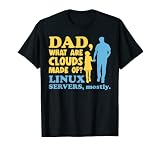
- Dad, what are clouds made of? Linux servers mostly.
- Linux engineer design with a funny computer tech pro quote perfect to wear as a sysadmin.
- Lightweight, Classic fit, Double-needle sleeve and bottom hem
What should you learn first: Linux, cloud, or Kubernetes?
For a learner new to infrastructure, a practical sequence is Linux command-line basics, then cloud and container fundamentals, followed by Kubernetes practice if the target role or system uses it. If you already have development or operations experience, you can start with the layer closest to your work and fill in gaps as needed.
- Build Linux fundamentals. Practice navigating the command line, managing files and processes, and inspecting logs. Linux Foundation Education’s Kubernetes and Cloud Native Essentials route presents command-line familiarity as a recommended starting point. See its LFS250 and KCNA bundle information.
- Learn how applications are packaged and run. Understand containers and the cloud environment relevant to your work before adding cluster complexity.
- Choose Kubernetes depth by role. Cluster operations, application development on Kubernetes, security, and AI/model development are distinct focuses. Practice the tasks your intended role requires rather than treating one path as mandatory for everyone.
- Show practical ability. Build a small project or document relevant workplace experience that demonstrates deployment, troubleshooting, security, resilience, or cost awareness. A course or certification can structure learning and act as an optional signal; it does not replace role-specific skills.
Linux Foundation Education lists Linux system administration, Kubernetes administration, and Kubernetes application-development learning paths. Its February 18, 2026 announcement says the updated Kubernetes Fundamentals (LFS258) course covers production skills such as managing, securing, and scaling applications, with hosted browser-based labs. Course content, availability, and terms can change. Explore Linux Foundation Education learning paths and read the LFS258 update announcement.
How to choose the right learning route
There is no single best credential or sequence for every learner. Match the learning format and focus to your starting point and target work.
Recommended Free Tools
Quick Recap
- New to IT or infrastructure: start with command-line and foundational system concepts before taking on cluster operations.
- Already a developer: focus on application packaging, deployment, and the platform your team actually uses.
- Moving into operations or platform engineering: prioritize Linux administration, cloud fundamentals, Kubernetes operations, security, observability, and cost management as they apply to your environment.
- Learning independently: a course with labs or a hands-on project can provide structure; workplace practice can deepen skills in the systems you will operate.
Product prices and availability are accurate as of the date/time indicated and are subject to change. Any price and availability information displayed on Amazon at the time of purchase will apply.




