Free tools Windows power users keep installed
One-click scans. No signup required.
A 2020 paper proposed that bacteria use a new RNA family, named Sensei, to sense iron. The paper was retracted in 2021 after concerns about the integrity and reproducibility of key data, and a later review says Sensei RNA was not an iron-responsive riboswitch. The headline therefore describes a historical claim, not a confirmed discovery.
What the 2020 study claimed
The paper, Discovery of iron-sensing bacterial riboswitches, was published online on 5 October 2020. It proposed a family of bacterial RNAs called Sensei, short for “Sense iron,” that could bind reduced iron, or Fe(II), and influence gene expression. In the proposed mechanism, iron binding changed the RNA’s structure and affected translation of a downstream gene. These were claims made by the original study, not findings that should now be treated as established. The National Centre for Biological Sciences record preserves the original abstract; Chemistry World’s 2020 report describes the proposed mechanism.
As an Amazon Associate I earn from qualifying purchases.
What are Sensei RNAs and riboswitches?
A riboswitch is an RNA element that can regulate gene expression by responding to a molecule. The 2020 study proposed Sensei as a previously unknown riboswitch family responding to Fe(II). That description is useful for understanding what the authors reported, but it does not establish that Sensei RNAs genuinely sense iron: the paper was subsequently retracted, and later work challenged the proposed response.
Do these 3 things before closing this tab:
1Scan for outdated or missing drivers - takes under a minute2Repair Windows errors before they cause bigger problems3Fix the driver behind crashes, sound loss and screen glitchesWhy was the paper retracted?
Nature Chemical Biology’s retraction notice, published on 29 June 2021, said the authors retracted the article because of issues involving data integrity and reproducibility. The notice identified similarities in native-gel backgrounds, possible duplicated western-blot bands, and inconsistent spacing in isothermal titration calorimetry (ITC) curves. It also said the authors no longer had access to raw data needed to verify salt-dependent binding affinities.
#1 Best Overall

- Assemble & Explore 3-D Paper Models to Investigate Key Science Concepts
- Perfect for Use at Home or in the Classroom
- Includes Extensive, Illustrated Background Information & 1 Set of Model Templates
- Satisfies Next Generation Science Standards
The authors’ notice stated: “Given that the key data supporting the iron ion-induced structural changes in Sensei RNAs—a central conclusion of the original paper—are now called into question, we believe that retraction of the work in its entirety is essential.” Read the journal’s retraction notice.
What does the later evidence say?
A 2022 review of iron-responsive riboswitches describes the Sensei findings as coming from a retracted article and reports that a Sensei-based fluorescent biosensor and ITC studies showed Sensei RNA was not, in fact, an iron-responsive riboswitch. That makes the present assessment clearer than simply calling the original claim unresolved: the proposed iron response was later challenged, and the paper supporting it was withdrawn. Read the 2022 review.
Rank #2

- This Detailed 6" Model Is Comprised Of 26 Detachable, Hand-Painted Parts
- Transparent Housing Lets You Easily View Internal Structures
- Some Fun Q&A To Test Your Knowledge
- Country Of Origin : United States
- 6" model contains 26 detachable parts
What the headline means now
“Entirely new way of sensing iron discovered in bacteria” was the wording of the 2020 news headline, written when the original study was being reported. It should not be read as a current scientific conclusion. The defensible account is that researchers proposed a bacterial RNA-based iron sensor, then retracted the paper after concerns about the evidence; a later review reports that Sensei RNA was not an iron-responsive riboswitch.
Quick Recap
Best Value

- CLASSROOM-SIZED VISUALIZATION – This enlarged, student-friendly model clearly displays all major organelles—including the nucleus, mitochondria, ER, Golgi, ribosomes, lysosomes, and centrioles—at a scale that makes complex cell anatomy easy to see and understand during lectures or independent study.
- BRIGHT, COLOR-CODED DESIGN – Each organelle is molded in a distinct, high-contrast color for instant visual differentiation. This intuitive layout accelerates identification, reinforces learning, and helps students quickly connect structure to function.
- STURDY, SPACE-SAVING STAND – The integrated white plastic base provides a stable, tip-resistant foundation for secure display on desks, podiums, or lab benches. Its compact size also ensures easy storage in crowded cabinets, keeping your teaching area neat and organized.
- DURABLE, EASY-CLEAN SURFACE – Made with a smooth, non-porous finish that resists dust and fingerprints, this model stays classroom-ready through repeated use. Simply wipe with a dry cloth to restore its original clarity and brightness, year after year.
- CURRICULUM-ALIGNED LEARNING TOOL – Ideal for middle school, high school, and introductory college biology courses, this hands-on model bridges the gap between abstract textbook diagrams and real-world understanding—perfect for pre-lab prep, exam review, and science fair projects.
Rank #4
- Assemble & Explore 3-D Paper Models to Investigate Key Science Concepts
- Perfect for Classroom Use or Home Study
- Includes Enough Materials to Build 5 Models
- Satisfies Next Generation Science Standards
Rank #3
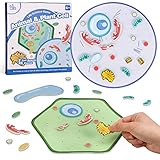
- EARLY BIOLOGY SCIENCE EDUCATION - Our early biology set included with plant and animal cell model, felt material design, soft of touch, hands-on placement of organelle pieces into the correct position, good for biology classroom teaching aid, also great for student learn and memory the biology cell
- FUN WAY TO LEARN CELL - Science should be kept fun, simple and engaging. We provide the instructions and biology knowledge guidance, kids can easily learn every single part of an animal cell or a plant cell and attach the different organelle pieces on the board to form a complete cell. They are also able to compare the differences between animal cells and plant cells
- EASY STORAGE - Package included with 2 Cell boards, 36 Organelle pieces, 50 Dot tapes, 1 Guide poster, and a durable jute bag, which bag can well store all pieces to keep your place tidy and clean. This can teach children to have good habit of staying organized. And the bag is also suitable for bring to school, back to home, outdoors or travel
- ATTRACT CHILDREN'S ATTENTION - This game set includes cartoon stylized and colorful playing pieces as well as a full color and easy-to-read poster, which more likely gets kids involved, makes them focused and makes learning fun. This is a great way to start a epic screen-free adventure into the magical microscopic world
- EDUCATIONAL GIFT FOR STUDENTS - This biology cell learning set is a great gift for students, teachers, animal lovers and anyone who love biology science. This new learning way must surprise your children and help them discover new learning fun every time. It is also an ideal gift for Birthday, Christmas, Thanksgiving, New Year or even for home school
Product prices and availability are accurate as of the date/time indicated and are subject to change. Any price and availability information displayed on Amazon at the time of purchase will apply.




