Recommended Free Tools
Stripe supports x402 in its machine-payments product, but x402 and Stripe are not equivalent choices. x402 is an open HTTP payment protocol whose fees and settlement depend on the scheme, network, and implementation. Stripe offers a managed machine-payment service with a documented fee of 1.5% per successful charge, rounded to the nearest cent, and settlement into a Stripe balance in fiat. The right comparison is the full payment flow, all-in cost, settlement destination, client readiness, and merchant operations—not a claim that one option is always free or faster.
What is the difference between x402 and Stripe?
x402 defines how an internet request can carry payment requirements and a payment payload. It is a protocol, not a single processor, network, or settlement service. A specific x402 integration combines a scheme, network, and often a facilitator; those choices determine what the buyer signs or transfers, what costs apply, and what counts as settlement. The x402 v2 specification describes the protocol’s core data types, while scheme and network implementations supply payment-specific behavior.
As an Amazon Associate I earn from qualifying purchases.
Stripe’s machine-payments product is a managed service for agent-facing payments. It supports x402 and routes funds into a Stripe balance in fiat, with Stripe reporting, multi-currency payouts, and refund tools. Its product terms and supported payment methods are specific to machine payments; do not assume the same fee, eligibility, or asset support applies to every Stripe product.
What are the fees for x402 compared with Stripe?
| Option | Documented fee or cost basis | What the figure covers |
|---|---|---|
| x402 | “Zero protocol fees”; nominal network fees may still apply, according to x402.org. | This describes the protocol fee layer, not the total cost of every deployment. A network, facilitator, wallet flow, or integration can add costs or constraints; calculate those for the specific scheme and network. |
| Stripe machine payments | 1.5% per successful charge, rounded to the nearest cent, according to Stripe’s machine-payments documentation. | Stripe says it does not charge gas or other network fees for this product. The stated percentage is a per-successful-charge fee, not a claim about every Stripe payment product. |
For a useful all-in comparison, include any facilitator or implementation charges alongside network costs for x402, then compare that total with Stripe’s documented machine-payment charge. A zero protocol fee does not mean a transaction is cost-free.
#1 Best Overall

- Use the, easy-to-use, and customizable POS to get started.
- Accept contactless payments, chip cards, Apple Pay, and Google Pay from anywhere, with improved connectivity, extended battery life, and enhanced security. Pay one low rate for every tap or dip.
- No long-term commitments or contracts, no monthly fees- and with offline payments, keep taking payments for up to 24 hours.
- Safely and securely accepts payments anywhere. Plus, get data security, 24/7 fraud prevention, and payment-dispute management at no extra cost.
- Use the, easy-to-use, and customizable POS to get started.
How does settlement work for x402 payments?
A typical x402 exchange makes payment part of an HTTP request-response cycle:
- The client requests an API resource.
- If the request has no acceptable payment, the server responds with HTTP 402 and payment requirements.
- The client selects an accepted scheme and network, then creates the required payment payload.
- The client retries the request with that payload.
- The server or a facilitator verifies the payment. If verification succeeds, the server fulfills the request and settlement proceeds according to the selected scheme.
- The server returns the resource and settlement information when successful.
Do not treat “settlement” as a universal promise that one transaction has been broadcast and finalized on-chain. In x402 v2, settlement can mean a durable payment commitment recorded through a ledger update, a prepaid proof bound to a request, escrow, or another scheme-defined state. The specification also allows settlement that is not yet the final charge. Check the selected implementation’s definition of finality, timing, and when the buyer’s asset moves.
Rank #2

- iPad to POS in Minutes: Slide in an iPad and download the included Square point of sale app to get started. No training or service visits needed.
- Your entire business in one place: Power every part of what you do, all on one device. That’s payments, your website, daily reporting, and so much more.
- No extra readers required: Super fast built-in payments mean far fewer cords, zero fears of disconnecting, and a cleaner counter from here on out.
- Keep selling, even offline: Keep taking payments with offline payments even when your Wi-Fi or connectivity is down. Just reconnect to the internet within 24 hours to upload transactions. Terms and conditions apply.
- Stay powered even without power: if you need to unplug or if you lose power, Square Stand can run off a full iPad battery. iPad-powered mode only on USB-C compatible version.
Scheme choices can change cost and timing
- Exact: a fixed-amount transfer.
- Upto: authorization up to a cap; the seller settles the actual usage amount up to that limit.
- EVM batch-settlement: escrow and off-chain vouchers can allow small charges to be redeemed in batches.
These are different payment behaviors, not interchangeable labels for one x402 settlement schedule. Confirm which scheme and network a service accepts before estimating latency, finality, or cost.
What Stripe documents about settlement
For its machine-payments product, Stripe says funds settle in fiat to the Stripe balance. Reporting and multi-currency payouts work as they do for other Stripe payments. Stripe also documents refunds through the API and Dashboard; for stablecoin refunds, the funds return to the token transfer’s “From” wallet address. These details describe this Stripe product, not every Stripe integration.
Rank #3

- Product Dimensions: You will receive 5 USB-C connector. Current: Maximum support 3A current; dimensions approximately 0.98x0.39 inches/25x10mm. The quantity is ample and sufficient for your daily needs.
- Reliable Materials: The USB-C adapter is made of plastic and brass, providing insulation. The metal construction is robust and stury for long-term use. It is for powering devices only and not for data transfer.
- Practical Design: This USB-C breakout features a solderless design, requiring no soldering tools. It's simple to use; a screwdriver is all you need for easy wiring, saving installation time and effort. Disassembly is also very convenient.
- Easy DIY: The loose USB-C port fix charging plug is clearly marked with positive "+" and negative "-" for easy soldering. It is compatible with USB interfaces and Type-C adapter boards.
- Versatile Use: This USB-C male to male adapter can be used to repair most USB-C devices, such as mobile phones, game consoles, tablets, speakers, LED lights, small household appliances, etc.
What does the buyer or API client have to do?
With x402
A compatible client can respond to an HTTP 402 challenge and retry with a payment payload, making payment a programmatic part of an API call rather than a browser checkout. But the client must be able to use the accepted asset, network, and scheme and produce the required payload. A caller that cannot handle the service’s payment requirements cannot complete the flow merely because the API uses HTTP.
With Stripe machine payments
Stripe positions its machine-payments service for agent payments and manages the Stripe-side payment and fiat balance. Its documentation lists USDC on Base and says individual charges can be as low as 0.01 USDC. Stripe also documents a unique deposit address for each payment as a privacy measure. Confirm that the specific agent, wallet setup, and API integration support the required flow before relying on those product capabilities.
Rank #4
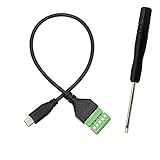
- Type C Male With Screw Terminal Block Cable can extend the length of the USB cable and DIY high-quality cables for data transmission and charging. The cable is 30cm long.
- USB-C Solderless terminal is fixed with screws, no soldering required. You only need to use stranded or solid wires and a small screwdriver (give screwdriver) to create custom wiring jigs. Simple and convenient, saving time and effort.
- This typec cable of 5 Pin pluggable screw terminal can connect a shielded wire, made cable has shielding function, can effectively shield the interference of external signals.
- This Type-c terminal cable plug is USB2.0, the bandwidth is 480MB/S, theoretically it can transmit 60MB of data per second (actual speed is about 20MB-60MB/S according to different cable lengths), the signal is stable and safe.
- Compact design and reliable connection are compatible with wide, suitable for mobile phones, tablets, computers and other devices with USB Type-C interfaces.
Which option fits your API?
| Decision point | x402 | Stripe machine payments |
|---|---|---|
| Cost model | No protocol fee according to x402.org, but network, facilitator, or implementation costs may apply. Calculate the actual combination. | 1.5% per successful charge rounded to the nearest cent; Stripe says it charges no gas or other network fees for this product. |
| Settlement destination | Defined by the chosen scheme, network, and facilitator; inspect whether settlement is a commitment, escrow state, or completed charge. | Fiat into a Stripe balance, with reporting and multi-currency payouts documented for the product. |
| Buyer readiness | Client must handle the 402 challenge and support the accepted asset, scheme, and network. | Agent/payment integration must support Stripe’s documented product flow and payment method. |
| Refunds and privacy | Address exposure, refund or reversal route, and dispute handling depend on the chosen implementation; verify them directly. | Refunds are available in the API and Dashboard; stablecoin refunds return to the transfer’s “From” wallet address. Stripe documents unique deposit addresses per payment. |
| Geography and rails | Support is a matrix of scheme, network, and facilitator capabilities rather than one universal rail. | Stripe documents availability for developers with a US legal entity and operations in all states except New York and Texas; its machine-payments documentation lists USDC on Base. |
Choose x402 when the intended client can implement its payment challenge and you want to select among compatible schemes and networks, accepting the work of evaluating that stack. Choose Stripe when the documented managed flow, fiat balance, and Stripe-side reporting and refund operations fit the API and the merchant meets the product’s eligibility requirements. In either case, validate the real client flow and total cost before committing.
Free tools Windows power users keep installed
One-click scans. No signup required.
What do x402’s reported usage figures show?
When accessed in 2026, x402.org displayed 75.41 million transactions, $24.24 million in volume, 94.06 thousand buyers, and 22 thousand sellers over the last 30 days. These are live figures reported by x402.org, not independently audited totals; the reviewed page did not establish its measurement methodology. Treat them as a dated snapshot, not permanent adoption statistics or proof that a particular x402 integration has comparable activity.
Does Stripe support x402?
Yes. Stripe’s machine-payments documentation describes an agent-facing payment service that supports x402. That does not make Stripe the definition of x402 or make every x402 scheme, network, asset, or facilitator available through Stripe. Check Stripe’s current product documentation and the actual payment requirements of the API you plan to call.
Quick Recap
Product prices and availability are accurate as of the date/time indicated and are subject to change. Any price and availability information displayed on Amazon at the time of purchase will apply.




