The Wii’s motion controls did not suddenly stop working; they stopped being enough on their own to keep the console selling. Nintendo’s own reporting points most directly to a shortage of appealing games, while competitors adopted motion control and practical limits made it a less suitable way to play for some people and games. The evidence supports several contributing pressures—not a single proven cause, and not the claim that motion control was merely a fad.
Motion control made the Wii distinctive—but distinction had a shelf life
Nintendo introduced the Wii in 2006 with wireless, motion-sensitive controllers as a defining part of its play proposition. The idea made familiar actions—swinging, pointing, and moving a controller—central to games that could be played in ways unlike conventional button-focused console play. Nintendo’s company history describes motion-sensitive controllers among the system’s advanced features.
As an Amazon Associate I earn from qualifying purchases.
That novelty helped set the Wii apart, but a console is sustained by reasons to buy and keep playing it. Once the basic interaction was familiar, motion control alone could not guarantee a continuing flow of compelling games or purchases. Nintendo’s explanations for the Wii’s weakening sales put software appeal at the center of the story.
Nintendo said the bigger issue was a shortage of strong games
Momentum weakened when the software lineup did
In its May 2010 financial results briefing, Nintendo president Satoru Iwata said Wii momentum had weakened during the first half of the fiscal year because strong software was scarce. He said a run of strong titles in the second half helped the system regain momentum around the year-end sales season. Even so, full-year Wii hardware shipments were below the prior year; Nintendo also noted that a price cut affected the comparison.
#1 Best Overall

- [Compatibility]: The Wii remote controller is compatible with Nintendo Wii and Wii U, supports all Wii games. Please note that the Wii console is not included. Batteries not included.
- [Built-in Motion Plus]: The built-in motion plus, more sensitive than the original Wii remote controller, can track movement more accurately, bringing you a more realistic game experience.
- Th wii nunchuck controller boasts a 3-axis motion sensor, akin to the Wii Remote. Its ergonomic design ensures a comfortable grip, promoting agility during gameplay.
- EASY SYNC STEPS -- Push the small button on the controller (where the batteries go) then push the red button on the Wii console (under the little door), then you’re able to synchronize with Nintendo Wii.
- LED indicators -- LED lights will indicate which player you're.
That account complicates the idea that people simply tired of moving a controller. When strong games arrived, Nintendo said, sales momentum improved. The hardware’s interaction model was not a substitute for software that gave people a reason to choose the console.
By fiscal 2011, appealing titles were Nintendo’s main explanation for falling unit sales
In April 2011, Nintendo reported lower global hardware and software unit sales for both Wii and Nintendo DS. It named the lack of appealing software titles that encouraged consumers to buy as the main reason for the decrease in unit sales in its fiscal 2011 results and fiscal 2012 forecast.
Rank #2

- Experience intuitive motion controls that deliver a unique social activity for the whole family.
- Every remote controller undergoes a rigorous inspection to ensure that each one is unparalleled.
- Easy synchronization by pressing the red sync button on both remote controller and console. Powered by 2 AA batteries(not included).
- Up to 4 remote controller can be connected at once by using built-in wireless technology powered by bluetooth.
- What you get: 2 * remote controller (no motion plus), 2 * nunchuk, 2 * silicone case, 2 * wrist strap.
Nintendo separately said the stronger yen and hardware price reductions contributed to lower net sales and profit measures. Those are financial factors, not the company’s stated main explanation for fewer units sold: currency changes affect how overseas sales translate into reported results, while lower prices affect revenue per device.
Motion control became less exclusive, while remaining a particular kind of play
Rivals adopted their own approaches
By 2012, motion interaction was no longer as distinctively associated with Nintendo. During a June 6, 2012 analyst Q&A, Iwata said that after Nintendo introduced motion control, it took other companies about three years to introduce their own approaches. That is Iwata’s account of the competitive timeline, offered in a discussion of Wii U differentiation—not an independently measured industry statistic. His statement appears in Nintendo’s 2012 E3 Analyst Q&A.
Rank #3
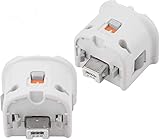
- Brand new and high quality.
- Connect Wii MotionPlus to your Wii Remote controller to increase accuracy and enhance play control on compatible games.
- Contains additional sensors that respond to your wrist's slightest motion for greater results with more economical movement.
- Compatible with a variety of Wii games.Perfect motion plus adapter for your Wii Remote controller.
- Allow it to more accurately capture complex motion and It tracks the player's movements in finer detail and with greater accuracy.
The arrival of competing motion systems helps explain why the Wii’s original feature became less of a unique selling point. But the available evidence does not establish that a particular rival directly caused Wii sales to fall.
Some households and games were a less natural fit
Motion-based play asks for more than a controller and a game: players may need room to move, and not everyone wants physical movement to be part of a gaming session. In an InvenSense Form S-1/A filed in 2013, the company identified possible adoption risks including satisfaction with conventional systems or the Wii, the space needed to play, and a preference for traditional exercise over simulated exercise. These were business-risk disclosures, not survey results showing how many consumers held any particular view.
Rank #4

- Multi-Functional-- Wii motion plus controllers are perfectly compatible with Nintendo Wii, Wii U, Wii consoles, Wii games or Wii sports, work well as original remote control.(Notice: It’s a third party product.)
- With Motion Senser -- Nintendo wii controller is equipped with motion sensor, which can judge movement and tilt, so as to obtain better results and improve accuracy.
- Multiple Configurations -- Remote Game Controllers combines the functions of pointer, speaker and shock vibration, powerful function design greatly improve your gaming experience.
- Easy SYNC Steps-- Wii remote controller white can be connected with the console via Bluetooth by simply pressing the sync button. Wireless receiving distance up to 8 meters.
- Plug & Play -- Dock both of your remote and plug it into any USB port. Package contents: 2 pack wii remote motion plus, 2 Silicone Case and 2 Wrist Strap. Powered by 2 AA batteries (not included).
In a separate 2012 InvenSense annual filing, the company also listed market saturation, a lack of compelling video-game titles, and alternative entertainment as possible risks to the gaming market. Together, such factors help explain why motion could be a strong feature for particular players and games without becoming the preferred format for every session.
Recommended Free Tools
Wii U changed the pitch, but did not reverse Wii’s decline
Nintendo launched Wii U in 2012 with a different central idea: a GamePad touchscreen that enabled other styles of play, including playing on the controller screen while the television was unavailable. Nintendo’s company history describes this off-TV play feature.
Best Value

- Nintendo Wii Remote Plus
The new system did not stop the older Wii and DS from losing sales. Nintendo’s fiscal 2013 results said a large decrease in Wii and DS hardware and software unit sales reduced net sales despite the Wii U launch and growth in 3DS sales. Nintendo also disclosed that Wii U hardware production costs were higher than its selling price that fiscal year. This shows that a successor’s new interaction proposition did not restore the Wii’s trajectory; it does not prove motion-control fatigue caused Wii U’s own commercial difficulties.
Social games and smartphones are not a proven single-cause explanation
As social games gained users, Nintendo’s results were also peaking and beginning to decline. At the company’s 2011 shareholder meeting, Iwata cautioned against treating the timing as proof of cause: “Two things can happen by cause or by coincidence, and I think it very important to find out which is true.” His remarks are in Nintendo’s 71st Annual General Meeting of Shareholders Q&A.
That distinction matters. Social games and mobile devices were part of a changing entertainment landscape, but the cited evidence does not establish that they caused Wii sales to decline. Nintendo’s more direct explanation for lower unit sales was insufficiently appealing software; other pressures provide context, not a definitive alternative verdict.
Free tools Windows power users keep installed
One-click scans. No signup required.
What best explains the Wii’s motion-control boom fading?
The strongest evidence points to the ordinary demands of a mature console: people needed attractive new games, and Nintendo said the lineup was not consistently providing them. Meanwhile, competitors adopted motion controls, and the format’s space and play-style requirements limited its fit for some households and situations. The Wii’s motion controls helped make the console distinctive, but distinction was not enough to sustain demand by itself.
There is no established statistic in the cited sources measuring how many owners stopped buying motion games because the controls felt tiring, repetitive, or no longer novel. Nor do the sources prove that a single rival or smartphones caused the decline. A careful answer is therefore not that motion control “failed,” but that the feature’s early appeal could not replace compelling software or remain unique indefinitely.
Quick Recap
Product prices and availability are accurate as of the date/time indicated and are subject to change. Any price and availability information displayed on Amazon at the time of purchase will apply.




