Free tools Windows power users keep installed
One-click scans. No signup required.
When people say the Super Nintendo is “running faster,” they usually do not mean the entire console is overclocked. The surprising variation is in the audio subsystem: real S-SMP/S-DSP hardware often produces samples slightly faster than Nintendo’s nominal 32,000 Hz target. A 2025 informal survey of 143 consoles measured an average of about 32,076 Hz at room temperature. That is almost unnoticeable in ordinary play, but it can undermine frame-perfect tool-assisted runs and complicate hardware preservation.
Which part of the SNES is faster?
The affected subsystem is the audio processing unit (APU), built around the S-SMP and S-DSP, not the main CPU or video circuitry. Its nominal clock chain is:
As an Amazon Associate I earn from qualifying purchases.
- 24.576 MHz ceramic resonator for the S-DSP
- 3.072 MHz internal S-DSP clock
- 1.024 MHz SPC700/S-SMP clock
- 32,000 Hz nominal DAC sample rate
The main system timing uses a quartz reference with better nominal accuracy. The audio hardware instead relies on a ceramic resonator, whose manufacturing tolerance, temperature response and long-term behavior can produce console-to-console differences. The practical description is therefore: the SNES audio subsystem is frequently clocked slightly above its nominal rate, and its exact timing varies by console. (S-SMP clock details; SNES timing reference.)
Recommended Free Tools
What the measurements show
| Measurement or reference | Result | What it supports |
|---|---|---|
| Nintendo-derived nominal audio rate | 32,000 Hz | Written design target |
| Earlier real-hardware emulator observations | About 32,040 Hz | Many consoles differed from the nominal value |
| 2025 informal survey of 143 consoles | 32,076 Hz average at room temperature | The sampled consoles averaged above specification |
| Survey cold-to-warm comparison | About 8 Hz average rise | Small thermal effect in that dataset |
| One freezer-to-room experiment | About 32 Hz change | Temperature can affect an individual unit |
| Community timing reference | Approximately 32,000–32,160 Hz | Substantial console-to-console variation |
The 143-console survey was informal and self-selected, so it is not a controlled census of every North American SNES, Super Famicom, PAL model or board revision. Results can also depend on calibration, test method, temperature, power conditions and whether the console is a 3-chip or 1-chip revision. The evidence establishes variation and an above-spec average in that sample; it does not prove that every console accelerates as it ages. (Ars Technica, March 15, 2025; measurement analysis.)
#1 Best Overall
![Nintendo Super Entertainment System SNES Classic Edition with Two 6-ft. Extension Cable [video game]](https://m.media-amazon.com/images/I/517MdbK-cqL._SL160_.jpg)
- Comes with 21 games pre-installed.
- Mini, classic edition. Will not play original SNES cartridges. Games come pre-installed on console.
Why use a ceramic resonator?
Ceramic resonators are cheaper than quartz crystals and are adequate when a design only needs to be close to its target. They are less precise and more sensitive to temperature and component variation. That made sense for a consumer console designed around games that tolerated small differences, but it does not guarantee identical behavior from hardware manufactured decades apart.
A resonator may drift or vary with conditions, yet no available comparison of a controlled 1990s population with today’s consoles demonstrates a universal, monotonic age-related speed increase. “Getting faster with age” remains a hypothesis, not an established law of SNES hardware. (secondary survey summary.)
Why emulators noticed before players did
Some late-era games behaved incorrectly when emulators used exactly 32,000 Hz for the DSP. Developers found that a value near 32,040 Hz, based on observed hardware, corrected those compatibility problems. This suggests that development and testing often happened on consoles whose audio clocks were already above Nintendo’s written target. It is useful historical evidence, but 32,040 Hz is not a universal specification for every original SNES. (reported emulator findings; historical discussion.)
How can an audio clock change gameplay timing?
The S-SMP and S-DSP run asynchronously relative to the main CPU. Games communicate with the APU through shared ports and timing-sensitive routines, sometimes waiting for or polling audio-related work. A difference of a few dozen hertz can move an operation across a frame boundary. That may change when a sound becomes available, whether a lag frame occurs, or the order in which later events are observed.
Rank #2
![SUPER NINTENDO CLASSIC EDITION CONSOLE Renewed [NINTENDO]](https://m.media-amazon.com/images/I/31OpAJQNQML._SL160_.jpg)
- The Super NES Classic Edition system has the original look and feel of the ’90s home console, only smaller. Plus, this one comes fully loaded with 21 games!
- Get your hands on some of the best 2-player games of the era, including Super Mario Kart and Street Fighter II Turbo: Hyper Fighting.
- The Super NES Classic Edition is compatible with the Classic Controller and Classic Controller Pro accessories. Just plug it in and play
- From your first ride on Yoshi to the final heart-pounding escape from Planet Zebes, the Super Nintendo Entertainment System is pure 16-bit retro gaming perfection.
This does not mean every game runs 0.2 percent faster. Most gameplay logic is not multiplied by the audio sample-rate difference. The precise claim is that audio/CPU interactions can alter timing-sensitive behavior. (APU architecture.)
Why tool-assisted runs can desynchronize
- A TAS movie supplies precisely timed inputs.
- The replay is expected to reach the same state on every run.
- A one-frame change can alter a room transition, random-number-generator state, enemy behavior or input alignment.
- After divergence, subsequent inputs may arrive at the wrong moments.
TASBot testing reported that some SNES runs desynchronize after only a few minutes on many consoles. That is an observation from the testing effort, not a universal failure rate for every model or game. (TASBot testing report; community discussion.)
- Emulator TAS: repeatable when emulator version, timing model, region and audio settings are fixed.
- Original-hardware verification: exposed to console-specific APU timing, temperature and startup behavior.
- Human speedruns: normally unaffected because players do not reproduce robotic, frame-perfect input sequences.
Why a crystal replacement is not a magic fix
Replacing the ceramic resonator with a precision quartz-based oscillator can narrow frequency uncertainty and establish a deliberate target. However, reported TASBot testing still found imperfect behavior after a quartz replacement. The remaining variation may involve internal APU synchronization, startup ordering, bus arbitration or jitter rather than oscillator frequency alone.
Do these 3 things before closing this tab:
1Repair Windows errors before they cause bigger problems2Scan for outdated or missing drivers - takes under a minute3Clear out junk files and repair common Windows errorsA clock mod is therefore an experimental standardization measure, not a guaranteed path to TAS-perfect hardware. It also requires opening a vintage console and matching the correct frequency, voltage, waveform and installation method to the specific revision. (quartz-mod results.)
Rank #3

- HD audio and video (720p), 16:9/4:3 aspect ratio switch (Patent Pending)
- High compatibility for NTSC AND PAL SNES cartridges (via bottom case switch)
- Hyperkin-engineered Pin Perfect (Patent Pending) technology sets a new standard for state-of-the-art, high-quality pins.
- (2) x "Scout" premium classic-style controller (8 ft. cable)
- 3 ft. HD cable, 6 ft. Micro USB charge cable with USB AC adapter, AV ports with AV cable
Does this matter to normal SNES owners?
For most players, the effect is tiny: music and sound effects may be microscopically faster or higher-pitched, usually below unaided perception. The console is not in immediate danger merely because its APU measures above 32,000 Hz, and compatibility problems are uncommon and game-specific.
The issue matters more if you are:
- Replaying TAS input files on original hardware
- Comparing an emulator with a particular console
- Developing or testing timing-sensitive software
- Capturing exact audio or frame-by-frame output
- Building preservation hardware intended to reproduce historical behavior
How to measure your own console
Community testers use a dedicated S-SMP/DSP clock-measurement ROM, commonly called smpspeed, loaded through a compatible flash cartridge. The test uses the SNES master clock as a reference and estimates the audio clock. See the methodology at Undisbeliever’s analysis and the TASVideos discussion.
- Use a known-good flash cartridge and a legally obtained test ROM.
- Record model, region, board revision if known, ambient temperature and cold/warm state.
- Run the test shortly after startup.
- Repeat after a fixed warm-up period.
- Repeat across several cold boots.
- Interpret the result as that console’s measured APU rate, not proof of aging, failure or a universal SNES rate.
A flash cartridge can introduce its own compatibility variables, and a test ROM measures only what its documented algorithm targets; it should not be assumed to measure the main CPU clock.
Quick wins for a faster PC:
Clear out junk files and repair common Windows errorsFree Scan →Fix the driver behind crashes, sound loss and screen glitchesFind Drivers →Choosing a repeatable reference platform
Original hardware
Best for authentic electrical, analog, controller, cartridge and display behavior. Its drawbacks are console-to-console variation, thermal effects, aging components and difficult TAS repeatability.
Rank #4

- From your first ride on Yoshi to the final heart-pounding escape from Planet Zebes, the Super Nintendo Entertainment System is pure 16-bit retro gaming perfection.
- Now a new, miniaturized version is here, pre-loaded with 21 of the all-time greatest games, like Super Mario Kart and the first-ever release of Star Fox 2! Just plug it in and play.
- Live out the golden age of 16-bit gaming like never before. Choose games from the menu, create save points, and more.
- The system comes bundled with an HDMI cable, an USB charging cable, two Super NES Classic Controllers, and 21 games, pre-installed and ready-to-play.
- “T” for Teen w/Mild Blood, Suggestive Themes, Violence
Software emulation
Useful for deterministic replay, logging, save states and debugging. Different emulator versions, audio backends, synchronization modes and region settings can produce different results, and a fixed model may not match a particular physical SNES. (emulation accuracy context.)
FPGA platforms
An FPGA implementation can provide a fixed, documented clock and highly repeatable behavior, but accuracy depends on its core and configuration. MiSTer’s SNES documentation lists enhancement-chip support and optional CPU/Super FX turbo modes; those turbo options intentionally run games faster and can increase bugs, so they are not original timing. (MiSTer SNES documentation.)
The Analogue Pocket supports SNES through a third-party openFPGA core rather than a native SNES cartridge slot. The official product page lists the base handheld at $239.99 and showed it out of stock when checked; availability changes. (Analogue Pocket; openFPGA SNES core.)
What preservationists should standardize
“Accurate” and “repeatable” are different goals. A preservation project should state whether its target is Nintendo’s nominal specification, a representative 1990s console, one measured surviving console, or a fixed reference implementation.
Best Value
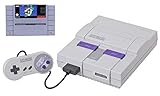
- Includes everything needed to play
- For a modified console: document revision, oscillator characteristics, reset procedure and temperature range.
- For an emulator: publish the timing profile, region, version and audio synchronization settings.
- For an FPGA: document the core version, clock model, enhancement-chip implementation and any turbo options.
- For TAS verification: use the same platform, capture method and startup conditions for every replay.
Bottom line
The SNES was designed to be close enough for consumers, not necessarily identical enough for modern frame-perfect verification. Its audio subsystem commonly runs above the nominal 32,000 Hz rate, varies between consoles and responds to temperature. That rarely matters during normal play, but it can change timing-sensitive APU/CPU interactions and break a TAS replay. The evidence does not yet prove that every SNES speeds up with age, and a quartz replacement alone does not guarantee deterministic behavior.
Frequently Asked Questions
Is the entire SNES overclocked?
No. The documented issue primarily concerns the S-SMP/S-DSP audio subsystem. It does not show that the main CPU and video hardware run proportionally faster.
Will I hear the difference on my console?
Usually not without direct comparison or measurement. The expected pitch and playback difference is very small.
Should I replace my SNES resonator?
Only for a specific measurement, preservation or repeatability project. A precision oscillator may reduce frequency variation, but reported testing shows it does not guarantee TAS-perfect replay and the modification carries hardware risk.
Quick Recap
Product prices and availability are accurate as of the date/time indicated and are subject to change. Any price and availability information displayed on Amazon at the time of purchase will apply.




