Recommended Free Tools
The U.S. Air Force retired the SR-71 because its exceptional reconnaissance performance came at a cost that grew harder to defend as budgets tightened and other options improved. Better space-based surveillance and the lower-cost U-2R changed the value calculation, but neither is established as a complete, one-for-one replacement for the Blackbird.
Why the Air Force retired the SR-71
The decision reflected a trade-off between capability and expense. The SR-71 was a costly aircraft to operate, and reduced defense budgets made that expense harder to justify. At the same time, improvements in space-based surveillance and the availability of the upgraded U-2R gave the Air Force less expensive ways to gather intelligence. The National Museum of the U.S. Air Force cites high operating costs and reduced defense budgets; the Air Force’s Airman Magazine also identifies satellites and the lower-cost U-2R as factors.
As an Amazon Associate I earn from qualifying purchases.
Cost and budget pressure
Operating and supporting the SR-71 required substantial resources. Official accounts describe that burden alongside defense-budget reductions, rather than pointing to one isolated technical problem or a single incident as the reason for retirement. The sources do not establish a verified dollar figure for the aircraft’s operating cost, so a precise per-flight or annual amount would be misleading.
Quick wins for a faster PC:
Fix the driver behind crashes, sound loss and screen glitchesFind Drivers →Clear out junk files and repair common Windows errorsFree Scan →Improving satellite surveillance
As space-based surveillance improved, the Air Force’s need to rely on an expensive, piloted aircraft for some intelligence missions changed. The CIA describes growing space-based capabilities as part of the context for the SR-71’s deactivation. That does not mean satellites duplicated every Blackbird capability: the available institutional explanations describe a changing mix of options, not a complete one-for-one replacement.
#1 Best Overall

- Revell Model Kit #85-5810, Skill Level 4, Contains 66-Parts, Recommended for ages 12 and up
- Accurate surface details
- Includes GTD-21 surveillance drone with cart
- Decals with authentic U.S. Air Force markings
- Molded in black and clear. Paint and glue required(not included).
The lower-cost U-2R
The upgraded U-2R offered a lower-cost reconnaissance alternative, according to Airman Magazine. Its continued usefulness helps explain why the Air Force could judge the SR-71’s expense less worthwhile without concluding that the two aircraft were identical in performance or mission. The sources identify the U-2R as an alternative, not as a full substitute for everything the SR-71 could do.
When did the SR-71 retire?
The dates refer to different steps in the shutdown. Air Force reporting says the program was terminated on November 22, 1989; the CIA describes deactivation in November 1989. The National Museum of the U.S. Air Force identifies January 26, 1990, as the fleet’s retirement or decommissioning date. These dates are not contradictory: the program decision and deactivation came first, followed by the fleet’s formal decommissioning.
Rank #2

- This plastic model requires assembly and painting. Adhesives, tools, paints, etc., sold separately.
- 1/72 scale unpainted plastic assembly kit
- Finished size: 18.9 inches (454 mm), total width 9.3 inches (235 mm),
- Decals are set of 12 including the 9th Strategy Reconceary Aviation Aviation Aviation Aviation Ichiban
Did the SR-71 return after retirement?
Yes. Congress revived the program in 1995, and two aircraft returned to operational service. That revival was temporary: it did not undo the fleet’s 1990 retirement, and the program ultimately ended in 1998. NASA’s research use was a separate chapter, continuing through October 1999; the end of Air Force reconnaissance service and the end of research flights were distinct milestones.
What the retirement does—and does not—mean
The retirement was a cost-versus-capability decision made in a changing reconnaissance environment. Better satellite surveillance and the lower-cost U-2R reduced the case for keeping the SR-71 in Air Force service at its operating expense. The historical record supports those as contributing factors; it does not show that either alternative reproduced every feature of the Blackbird or that the aircraft became technically useless.
Quick Recap
Rank #4

- ICONIC SR-71 BLACKBIRD MODEL: Build a detailed 1775-piece SR-71 Blackbird building set inspired by the legendary reconnaissance aircraft. This military aircraft model kit captures the long nose, swept wings, twin-engine profile, and sleek black silhouette for an impressive aviation display.
- LARGE AIRPLANE DISPLAY MODEL: The completed aircraft measures 32.68 x 16.06 x 5.79 in, creating a striking centerpiece for a desk, shelf, office, or display cabinet. Its large-scale profile makes this airplane building set a standout collectible for adult builders and aviation enthusiasts.
- RETRACTABLE LANDING GEAR & REALISTIC DETAILS: Explore a detailed cockpit, engine air intakes, streamlined fuselage, sweeping wings, and retractable spring-loaded landing gear. This military jet model combines interactive aircraft features with the clean look of a display-focused building block set.
- REWARDING BUILD FOR ADULTS & TEENS 14+: With 1775 PCS, numbered bags, and a step-by-step instruction manual, this advanced aircraft building kit offers a focused hands-on challenge. Designed for model builders who enjoy military airplane building blocks, construction sets, and detailed hobby projects.
- AVIATION GIFT & COLLECTIBLE DECOR: A distinctive SR71 model for aviation fans, military aircraft collectors, hobbyists, men, and teens 14+. This Blackbird airplane model combines building fun, aviation history, and home or office display value for birthdays, holidays, and special occasions.
Rank #3
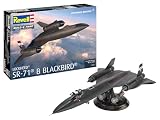
- HIGHLY DETAILED: Finely engineered plastic model kit with detailed parts and fully illustrated instruction manual
- Model kit of the legendary SR-71 Blackbird spy plane which was famous for reaching Mach 3. The Blackbird’s design was derived from the Lockheed A12, a CIA project which aimed to create an aircraft that could safely overfly the Soviet Union.
- The blackbird holds numerous records to this day including the absolute speed and altitude record. The SR-71B was a trainer variant of the Blackbird featuring a distinctive ‘humpback’ look.
- This impressive model can be used in many ways, be it as a exhibit, for exciting game scenarios or as a valuable collector's item.
Product prices and availability are accurate as of the date/time indicated and are subject to change. Any price and availability information displayed on Amazon at the time of purchase will apply.




