What’s actually slowing this PC down?
Pick the symptom - the matching free tool is one click away.
Neither a reflector nor a refractor is better for everyone. Choose a refractor if you want a generally low-maintenance telescope and value crisp planetary views; choose a reflector if getting more light-gathering aperture for your budget matters most, especially for faint deep-sky objects. Your targets, the telescope’s aperture and mount, portability, and tolerance for occasional adjustment matter more than the design name alone.
How reflectors and refractors work
The names describe the telescope’s main optical element. A refractor uses a lens: NASA defines it as “A telescope using a lens for its main optical element is called a refracting telescope.” A reflector uses a mirror as its main light-gathering element.
As an Amazon Associate I earn from qualifying purchases.
That difference affects cost, maintenance, and the kinds of compromises you may encounter. It does not, on its own, determine which telescope will give you the better experience.
Recommended Free Tools
Reflector vs. refractor: the practical differences
| What to compare | Refractor tendency | Reflector tendency |
|---|---|---|
| Main optical element | Lens | Mirror |
| Aperture for the budget | Larger apertures become expensive. | Often offers more aperture for the money. |
| Maintenance | Generally low maintenance. | Some mirror designs, especially Newtonians, may need occasional collimation (optical alignment). |
| Planetary viewing | Often valued for crisp planetary views. | No universal winner is established; results depend on the particular telescope and setup. |
| Color fringing | Basic achromatic refractors can show chromatic aberration: colored fringes around high-contrast objects. | A mirror does not refract different colors through the main optical element. |
These are design-level tendencies, not guarantees for every model. Optical quality, aperture, mount, and intended use all affect what you see. The cited guides do not establish a controlled comparison of equally priced models.
#1 Best Overall

- 【Excellent Optics】Astronomical telescope features 80mm aperture 600mm(f/6.7) focal length-The big aperture can capture more light; high transmission multi-fully coated optical lens can improve light transmittance, reduce the reflection of light. It will bring you more bright and clear images.
- 【Portable & Stable】Our refractor telescope has a backbag, an adjustable aluminum tripod and an upgraded phone adapter. All accessories can be packed into the bag, which is convenient for you to carry and storage for traveling. The tripod is stable and the height can adjust from 17.7" to 52", which is suitable for adults and kids. With the phone adapter, you can take amazing photos through your phone.
- 【Easy to Operate】 This telescope is easy to assemble even for astronomy beginners and kids. You can set up easily with the detail installation manual and video. No tools are required. It’s a great astronomy gift telescope for adults, astronomy enthusiasts, beginners and kids 8-12.
- 【Optimum Magnification】Our telescope for kids and adults is equipped with two replaceable excellent-quality eyepiecesa (20mm and 9mm) for 30X and 66X magnification. A moon filter transmits only 13 percent of the incoming light and improving contrast. Also with 5x24 finderscope, you can locate objects easily. A great option for astronomy lovers to explore the moon, Saturn and Jupiter.
- 【Satisfaction Service】We provide 3 years satisfaction service. If you have any questions about the product and service, please feel free to contact us to get 24-hour technical support from our expert team. Whether observing moon or viewing planets, our telescope can meet your all needs. It’s a great telescope for adults & 8-12 kids & astronomy beginners.
Why aperture and your targets matter
Aperture is the diameter of the main lens or mirror. It determines how much light the telescope can collect, making it central when comparing telescopes for observing faint objects. Sky & Telescope identifies aperture as a telescope’s most important characteristic and notes that refractors become expensive as aperture increases.
If you mainly want to observe planets
A refractor is a sensible starting point if you prioritize straightforward upkeep and crisp views of the Moon and planets. That is a general strength, not a promise that every refractor will outperform every reflector. Compare the specific telescope’s optics, aperture, and mount before deciding.
Rank #2
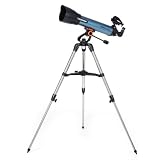
- Easiest setup of any entry level scope. With the folding accessory tray you just pop the tripod legs open, turn the lock knob and you’re ready to go.
- Bold new design - The main telescope lens cap comes with a fully integrated smartphone adapter built-in, perfect for the budding astrophotography.
- Red LED flashlight - Stowed in the center of the mount head, the flashlight can be used to gently illuminate the accessory tray or can be removed for use as a spotlight when needed.
- Focus micrometer - Allows quick return to a specific focus point for specific targets (bird nests, infinity focus, etc.)
- The asymmetrical mount design offers light weight and incredible stability. Erect image optics enables a fully correct image for easy viewing day or night, terrestrial or astronomical.
If you want to explore faint deep-sky objects
A reflector can be appealing because it often makes more aperture available for a given budget. The added light-gathering capacity can help with faint targets, but the telescope still needs a suitable mount and may require occasional collimation. Consider whether its size and setup suit where you will observe.
Which design makes more sense for a beginner?
Either can work for a beginner. Celestron uses a 102 mm refractor and a 130 mm reflector as examples of first-telescope sizes. These are examples, not a head-to-head performance test or universal recommendations; the different apertures mean they should not be treated as equivalent options.
Rank #3
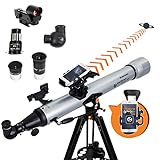
- SMARTPHONE-POWERED SKY TOUR: No experience needed! Just dock your phone, launch the StarSense Explorer app, and follow the on-screen arrows to locate stars, planets, nebulae, and more.
- PATENTED STARSENSE TECHNOLOGY: Unlike other astronomy apps, StarSense Explorer uses sky recognition technology to turn your phone into a celestial navigation system, analyzing star patterns overhead to pinpoint your telescope’s position.
- TONIGHT’S BEST TARGETS, INSTANTLY: The app generates a curated list of the top objects to see based on your time and location. See planets, bright nebulae, galaxies, and star clusters from the city—and even more from dark skies.
- SIMPLE SETUP, SMOOTH TRACKING: Features a manual altazimuth mount with altitude slow motion adjustment with a sliding rod. Follow the on-screen arrows to your target; when the bullseye turns green, you can view it clearly through the eyepiece.
- 80MM REFRACTOR WITH IMPRESSIVE VIEWS: The 3" Refractor with high-reflectivity coatings delivers sharp, vivid views of the Moon, planets like Jupiter and Saturn, and deep-sky favorites like the Orion Nebula and Andromeda Galaxy.
Before choosing, check the whole setup rather than buying on optical design alone:
- Targets: Decide whether planets and the Moon or faint deep-sky objects are your priority.
- Aperture: Compare the actual lens or mirror diameter, not just the telescope type.
- Portability and setup: Make sure you can store, transport, and set up the complete telescope where you plan to observe.
- Maintenance: Consider whether occasional mirror alignment is acceptable, or whether you prefer a lower-maintenance option.
- Mount: Evaluate the mount as part of the complete telescope. The cited guides do not establish a universal mount advantage for either design.
Make the choice by matching trade-offs to your use
- Set your observing priority. Start with the targets you are most excited to see; the design choice should follow your goals.
- Compare aperture within your budget. Refractors tend to become costly as aperture grows, while reflectors often offer more aperture for the money.
- Factor in ongoing effort. Favor a refractor if low maintenance is important. If you choose a reflector, be prepared for possible periodic collimation, depending on its design and use.
- Judge the complete setup. Compare the particular telescope’s optics, mount, size, and portability. A design label cannot tell you whether a specific model suits your observing location.
For product examples, Celestron’s beginner guide discusses a 102 mm refractor and a 130 mm reflector; treat these as starting points to compare, not a claim that one is best for every beginner. Celestron’s first-telescope guide also frames the decision around observing goals. For background on aperture and telescope types, see Sky & Telescope’s guide to choosing a first telescope.
Quick Recap
Best Value

- SMARTPHONE-POWERED SKY TOUR: No experience needed! Just dock your phone, launch the StarSense Explorer app, and follow the on-screen arrows to locate stars, planets, nebulae, and more.
- PATENTED STARSENSE TECHNOLOGY: Unlike other astronomy apps, StarSense Explorer uses sky recognition technology to turn your phone into a celestial navigation system, analyzing star patterns overhead to pinpoint your telescope’s position.
- TONIGHT’S BEST TARGETS, INSTANTLY: The app generates a curated list of the top objects to see based on your time and location. See planets, bright nebulae, galaxies, and star clusters from the city—and even more from dark skies.
- SIMPLE SETUP, SMOOTH TRACKING: Features a manual altazimuth mount with dual-axis slow-motion controls. Follow the on-screen arrows to your target; when the bullseye turns green, you can view it clearly through the eyepiece.
- 102MM REFRACTOR WITH IMPRESSIVE VIEWS: The 4" Refractor with high-reflectivity coatings delivers sharp, vivid views of the Moon, planets like Jupiter and Saturn, and deep-sky favorites like the Orion Nebula and Andromeda Galaxy.
Rank #4

- High Quality Optics: 600mm(f/6.7) focal length and 90mm aperture, fully coated optics glass lens with high transmission coatings creates stunning images and protect your eyes
- High Magnification: Come with three replaceable eyepieces(24X, 60X,120X) and one 3x Barlow lens. 3x Barlow lens trebles the magnifying power of each eyepiece
- Adjustable Tripod: This telescope allows for many different viewing positions with a adjustable aluminum tripod. The height of aluminum tripod can be adjusted from about 31.5-inch to 49-inch
- Easy to Operate: No tools are required for reflecting telescope even for the novice, quick and easy to focus
- Complete Package Included: AZ90600 telescope with 3 eyepieces, 3x Barlow lens, 6x30 finderscope, 48-degree erecting BAK7 prism, adjustable aluminum tripod, and astronomy software for enhanced stargazing experience
Product prices and availability are accurate as of the date/time indicated and are subject to change. Any price and availability information displayed on Amazon at the time of purchase will apply.




