There is no credible date for consumer technology that can reproduce any touch, pressure, temperature or texture between people. Today’s systems can transmit selected cues—especially vibration and pressure-like movement—in VR and research prototypes. The likely next step is practical, limited sensation-sharing for uses such as teleoperation, training, rehabilitation and social VR, not a complete copy of physical experience.
What “sharing a sensation” means today
Most current haptic systems translate an event into a limited set of outputs from wearable or handheld devices. A sensor may detect contact or movement, then a device signals it with vibration or deformation. That can communicate that something happened, where it happened or when it happened; it does not recreate every physical quality of the original event.

As an Amazon Associate I earn from qualifying purchases.
A 2025 Nature Reviews Bioengineering review describes haptics as a way to communicate through touch, supplement visual and auditory displays, or provide another channel when sight or hearing is unavailable. Vibration is the most mature rendering method in many commercial devices. Force, thermal and multimodal systems are harder to miniaturize and control.
What’s actually slowing this PC down?
Pick the symptom - the matching free tool is one click away.
What different haptic cues can convey
| Cue type | What it can signal | What it does not establish |
|---|---|---|
| Vibration | Contact, alerts, rhythm or timing through a localized buzz. | A faithful reproduction of pressure, texture or the feel of an object. |
| Pressure-like deformation | A changing physical signal, such as a pulse or heartbeat. | That the original touch or bodily sensation has been copied in full. |
| Force or kinaesthetic feedback | Resistance or movement cues that can help with remote interaction. | That a wearable can reproduce arbitrary forces safely or accurately. |
| Thermal or multimodal feedback | Temperature cues or combinations of sensory signals. | That these methods are as mature or easy to deploy as vibration. |
The comparison reflects the capabilities and challenges described in the 2025 Nature Reviews Bioengineering review; it is not a ranking of specific products.
#1 Best Overall

- [ Vibration Effect] Using top-notch 1027 mobile phone vibration motor for a noticeable vibration effect.
- [Versatile Applications] for creating vibration-sensitive interactive products, wearable smart device reminders, etc.
- [Compatibility] Compatible with ideal for diy projects with a on vibration technology.
- [ Control] Mos amplification drive allows direct digital port control and adjustment of vibration strength through pwm.
- [Effortless Conversion] Easily transforms electrical into mechanical vibration for seamless integration.
What research systems have demonstrated
Shared touch in virtual reality
A Stanford-affiliated IEEE ISMAR study by Yujie Tao, Jordan Egelman and Jeremy N. Bailenson, published on 21 October 2024, tested shared touch in VR with 32 participants. Participants reported a stronger body illusion and greater empathy toward the virtual agent whose touch they shared, and they stood closer to that agent. These findings show that a designed tactile cue can affect a social VR experience; they do not show that users received a full physical touch from another person.
A remote heartbeat as a physical signal
SoftHeart, a handheld interface introduced in a study published online on 3 July 2026, mirrors a remote partner’s heartbeat through continuous physical deformation in VR. In a mixed-design study with 24 participants, Simin Yang, Jiaying Chen, Xian Wang, Yang Li, Lik-Hang Lee and Pan Hui reported higher social connection, social presence, spatial presence and empathy than in visual-only or no-sharing conditions. The result concerns one deliberately chosen signal—a heartbeat—not general touch transmission.
Rank #2
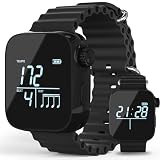
- 【Powerful & Clear Pulse Vibration】 Feel every beat with precision. Unlike traditional audible metronomes, the advanced vibrating motor delivers a strong, crystal-clear pulse directly to your wrist. Perfect for loud band rehearsals, outdoor running, or silent practice sessions without disturbing others.
- 【Music & Sport & Time】 A 3-in-1 wearable device smart metronome. Easily switch between instrument practice (40-240 BPM, 0-9 beats, 6 rhythm types) and fitness running (steady rhythm cadence mode). An all-in-one tempo master for guitar, drums, or jogging.
- 【Smart APP Control & Multi-Device Sync】 Take control via APP connection. Adjust tempo or set beat patterns directly from your smartphone. Multi-device sync allows multiple players to lock into the same beat wirelessly—for bands and orchestra practice.
- 【Lightweight Wearable Design】 Designed for all-day comfort, this wearable metronome features an adjustable strap that fits snugly on your wrist. Black metronome features an upgraded scratch-resistant screen for enhanced durability. Features portable USB magnetic charging.
- 【Beat Loop Function】The metronome now features a single-beat loop function. Performers can repeatedly practice specific sections to build muscle memory and enhance rhythmic precision.
Synchronized vibration between remote users
A 2025 Nature Communications system demonstrated bidirectional exchange of synchronized vibrotactile feedback. Its authors explicitly cautioned that the feedback “does not directly reproduce the sensation of physical pressure on contact.” It uses vibration cues to improve mutual awareness and timing, a useful capability that remains distinct from copying the pressure of a real touch.
Why richer sensation sharing is hard
The system must sense and encode touch
To transmit a physical interaction, a system needs to detect relevant contact or movement, represent that information in a form another device can use, and produce a corresponding sensation. The 2025 Nature Electronics review identifies sensing contact, encoding tactile and kinaesthetic data, synchronizing feedback, tracking motion and integrating AI-enabled wearables as parts of this engineering agenda. Capturing more detail is not enough by itself: the receiving device also needs actuators capable of rendering it in a useful and controlled way.
Timing matters as much as the signal
When touch arrives noticeably after the associated motion or video, an interaction can feel unnatural. TU Delft researchers describe the Tactile Internet’s “1 ms challenge.” A 2017 IEEE Access paper by Daniël van den Berg and colleagues states: “If the response time of a system is below 1 ms, the end-user will not be able to tell the difference between controlling a system locally or from another location.” That figure is a demanding research target for remote control, not a proven threshold every consumer haptic application must meet. Latency, jitter, packet loss and synchronization all affect how remote touch feels.
Wearables must be practical as well as expressive
More capable feedback can mean more actuators, sensors, power and weight. Coverage also matters: a single vibration point is easier to build into a controller than a comfortable system that can deliver distinct sensations across the body. The 2025 bioengineering review identifies miniaturization and control as challenges for force, thermal and multimodal devices. The reviewed evidence does not establish a consumer standard for full-body coverage, comfort or battery life.
Rank #4

- STRONG VIBRATION: These mini vibration motors deliver a powerful vibration effect despite their small size, making them ideal for mobile phones, pagers, and other devices that require clear haptic feedback. The flat button design ensures efficient performance in compact spaces.
- WIDE APPLICATIONS: for a variety of uses including toys, health products, handicrafts, tablets, wearable devices, and smart watches. The 20-piece package provides ample quantity for multiple projects or replacements.
- LOW NOISE & POWER EFFICIENT: Designed to operate quietly with minimal power consumption, these motors are for battery-powered devices. The radial and circumferential rotation ensures smooth and consistent performance.
- DURABLE CONSTRUCTION: Made from electroplated iron, these vibration motors are built to last. The simple yet robust structure enhances reliability, ensuring long-term use without frequent replacements.
- FAST RESPONSE TIME: With a rated speed of 120003000 rpm and a quick response time, these motors provide immediate feedback, making them suitable for applications where timing and precision are critical.
Devices and networks need to work together
The EU-funded TOAST project describes the Tactile Internet as a research direction for bilateral teleoperation, immersive VR and remote skill transfer. Its work includes haptic and kinaesthetic codecs, edge intelligence, an open testbed and low-power wearable hardware. The project’s reporting covered 1 March 2023 through 28 February 2025, and its report was updated on 28 July 2025. These efforts address compatibility and network infrastructure; they do not amount to a widely available consumer platform.
When the technology may arrive
The evidence points to a gradual rollout by use case, rather than a single launch of “Black Mirror” sensation-sharing.
Best Value

- 1030 COIN VIBRATION MOTOR: Compact 10mm diameter 3mm thick disc vibration motor delivers strong vibration feedback in a miniature flat form factor ideal for haptic notification and alert applications
- WIDE VOLTAGE RANGE: Operates at 2V to 5V compatible with Arduino Uno ESP32 ESP8266 Raspberry Pi and other 3.3V and 5V microcontroller platforms for easy motor control integration
- ARDUINO ESP32 COMPATIBLE: Easily driven via GPIO with a transistor or motor driver module compatible with Arduino IDE MicroPython and ESP-IDF for haptic feedback and vibration alert projects
- COMPACT FLAT DESIGN: Ultra-compact 10 x 3mm pancake form factor with flexible lead wires for easy installation in tight enclosures wearables smartwatches bracelets and portable devices
- 5 PACK VALUE SET: Includes 5 pieces of 1030 coin vibration motors ideal for haptic notifications wearable electronics game controllers IoT alarms and DIY vibration project applications
- Available now in limited forms: vibration and other selected cues are used in controllers, wearables, VR demonstrations and research systems. They communicate particular signals rather than recreate arbitrary touch.
- Near-term opportunities: specialist settings such as teleoperation, medical and rehabilitation tools, remote training, social VR and immersive entertainment can benefit from a restricted set of cues, even without perfect fidelity.
- Later, with uncertain timing: consumer systems that combine convincing texture, force, temperature and body-state signals would require broader sensing, richer output, reliable synchronization and comfortable hardware. The reviewed sources provide no defensible year for their arrival.
For now, “haptic feedback vest” is a useful product-category phrase for wearable devices that communicate selected sensations. It should not be taken to mean that a vest can reproduce a complete physical event.
How to judge claims about sensation-sharing devices
When a product or demonstration says it lets people “feel” something remotely, ask what is actually being sensed and rendered. These checks separate a functional haptic cue from a claim of full sensory reproduction.
- Cue: Is the output vibration, deformation, force, temperature or a combination?
- Fidelity: Does it signal contact, direction and timing, or does it demonstrate texture and force reproduction?
- Synchronization: Are motion, video, audio and haptics coordinated, and what latency conditions are reported?
- Coverage and comfort: Does feedback come from one contact point or a larger wearable, and are weight, heat, battery and skin safety addressed?
- Interoperability: Can the device work with other hardware and network systems, or does it depend on a specific setup? TOAST’s codec and testbed work reflects the importance of this challenge.
- Consent and control: Can the recipient choose which sensations to receive, mute them quickly and prevent unwanted or intrusive touch?
A demonstration that produces a convincing heartbeat, buzz or pressure-like cue may be meaningful on its own. It is not evidence that arbitrary physical sensations can already be copied between people.
The Tool Desk
Outbyte Driver Updater FREEFix the driver behind crashes, sound loss and screen glitchesFind Drivers →Outbyte PC Repair FREEClear out junk files and repair common Windows errorsFree Scan →Quick Recap
Product prices and availability are accurate as of the date/time indicated and are subject to change. Any price and availability information displayed on Amazon at the time of purchase will apply.




