Quick wins for a faster PC:
Clear out junk files and repair common Windows errorsFree Scan →Fix the driver behind crashes, sound loss and screen glitchesFind Drivers →Repair Windows errors before they cause bigger problemsFix Now →“Super strong hydrogel” is not one standardized material or a verified consumer product. It describes a range of water-rich polymer networks engineered for particular kinds of strength, toughness, low friction or resistance to swelling. Research studies report impressive results, but their formulations and test methods differ, so their numbers are not a reliable cross-study leaderboard—and they do not establish that a material is ready to buy or use clinically.
What makes a hydrogel “super strong”?
A hydrogel is a network of polymer chains that holds water. Researchers can reinforce that network or control its structure to improve a specific property. “Strength” may mean tensile stress before failure, stiffness (modulus), resistance to fracture (toughness), compression performance or another measure. Those properties are related but not interchangeable: a high tensile modulus, for example, does not mean the material has the highest fracture toughness.
As an Amazon Associate I earn from qualifying purchases.
The designs below illustrate different approaches. Each result belongs to the formulation and test reported by its authors; measurements from different studies should not be ranked as if they used the same protocol.
Examples of strong hydrogel research
| Design | How it is made or reinforced | Reported result and context | Research direction |
|---|---|---|---|
| PVA-PBO composite | Polyvinyl alcohol (PVA) reinforced with poly(p-phenylene-2,6-benzobisoxazole) (PBO) nanofibers | Oliveira et al., 2023, report 59–76% water content, tensile modulus up to 20.3 MPa, compressive modulus up to 4.5 MPa, and friction coefficient below 0.08 for the studied composite. The authors also report chondrocyte viability for one week. | Cartilage replacement research; the reported cell and material findings are in vitro, not evidence of an approved implant. Study |
| Tendon-inspired PVA-TA hydrogel | PVA is freeze-thawed, prestretched and air-dried under confinement, then soaked in tannic acid and dialyzed. | Luo et al., 2022, report 19.3 MPa tensile stress and 32.1 MJ/m³ toughness. The article reports little expansion after seven days in deionized water, PBS and simulated body fluid. | A tendon-inspired material design. Study |
| Aligned cellulose hydrogel | Regenerated cellulose gels are prestretched and dried while their length is constrained, creating hierarchical fibril alignment. | The study reports tendon-like fracture stress and Young’s modulus in the swollen state; the published account does not give numerical values for these measures. | Proposed directions include tissue engineering and soft electronics. Study |
| Paper-supported microfiber network | Acrylic acid and acrylamide are copolymerized on paper with an interconnected hollow cellulose microfiber network. | Zhou et al., 2025, report 27.8 MPa strength and describe it as a 253-fold increase over the study’s comparison gel. The comparison applies within that study, not across hydrogel research generally. | A reinforced network design; the authors also report improvements in work of fracture and fracture energy. Study |
| 3D-printed meniscus research ink | An ink combines cellulose nanocrystals, phenyl acrylate and acrylamide. | The 2019 study reports different strength and toughness tradeoffs as ingredient ratios change; no single result is supplied here for direct comparison. | A research demonstration of printing toward an artificial meniscus, not an available implant. Study |
Why do the designs behave differently?
Reinforcement adds load-bearing structure
In the PVA-PBO composite, nanofibers reinforce the polymer network. The paper-supported material instead uses a connected cellulose microfiber framework. Both approaches add structure, but they are different architectures and were assessed in separate studies.
#1 Best Overall

- MOISTURE-ENRICHED GEL FOR QUICKER HEALING: This hydrogel wound gel uses hydroxyethyl cellulose and glycerin to keep wounds hydrated while absorbing excess fluids. It creates the perfect environment for healing wounds like diabetic ulcers, venous ulcers, and surgical incisions.
- PROTECT AGAINST DRYNESS AND BACTERIA: The hydrogel forms a protective layer to shield wounds from dehydration and bacterial exposure, helping reduce infection risk. This wound gel is ideal for first and second-degree burns, cuts, or abrasions.
- SOOTHING RELIEF FOR SENSITIVE SKIN: Oil-free hydrogel for cooling and soothing relief from pain. This wound gel is great for delicate wounds, like post-surgical sites. Ensure comfort and prevent irritation during recovery.
- VERSATILE WOUND CARE FOR MULTIPLE INJURIES: Enhanced with allantoin and schizophyllan to promote cell growth, this hydrogel aids in removing necrotic tissue and speeds healing of partial and full-thickness wounds, from minor cuts to chronic skin ulcers.
- VIVE GUARANTEE: 30-day guarantee so you can purchase with confidence.
Alignment can direct mechanical performance
Prestretching and constrained drying arrange cellulose fibrils in the aligned-cellulose design. The tendon-inspired PVA-TA hydrogel likewise uses prestretching and drying under confinement before tannic-acid treatment. These fabrication steps are part of the material design, not incidental details: a network’s organization helps determine how it responds to force.
One recipe can trade one property for another
The 3D-printing study reports that changing ingredient ratios changes the balance of strength and toughness. That is why “strongest” needs a defined test and use case. A material intended to resist friction or compression may be optimized differently from one intended to stretch without tearing.
Rank #2
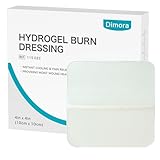
- Instant cooling to relieve minor burns - When the hydrogel wound dressing comes into contact with the burned skin, it quickly absorbs and disperses the heat released from the burn area, helping to reduce pain in the burn wound.
- Keep the wound moist to promote healing - The moist environment of burn bandages promote cell regeneration, keep the wound surface moist and relieves pain, which accelerates wound healing.
- Sterile & hypoallergenic - The burn dressing is sterile and latex-free, which effectively reduces the risk of wound infection. It is suitable for people with sensitive skin and provides safe care for wounds.
- Essential for home first aid kit - 4X4 inch hydrogel burn pads are suitable for minor burns, scald blisters, cuts, abrasions and other superficial wounds. Especially for burns caused by daily cooking, steam burns, and hot water burns, hydrogel burn dressings can provide effective help.
- Application steps - Gently apply the moist side and cover the burn or wound. Burn bandage can be covered again with a transparent dressing to strengthen the fixation. The wound dressing is for single use only.
Do these results mean a hydrogel is ready for medical or consumer use?
No. These studies describe laboratory formulations and experimental demonstrations. The PVA-PBO work reports one week of chondrocyte viability, but that finding alone does not establish long-term safety, performance in a person, regulatory approval or clinical availability. Printing toward an artificial meniscus is also a research demonstration, not proof that an implant can be obtained.
For a wet, moving-tissue adhesive, the Wyss Institute lists a slug-inspired tough gel as a “Current Opportunity – Startup” and invites inquiries about commercialization. That is an opportunity to pursue commercialization, not evidence of a retail product or clinical approval. Wyss Institute opportunity
Rank #3

- Hydrate Dry Skin and Slough - Dimora Hydrogel can hydrate the dry wound to improve healing by the active ingredients in wound exudate to soften the necrotic tissue in a longlasterd moist environment created by its oil-free hydrogel, it is gentle for the wounds without any pain
- Useful for Burns and Painful Wounds - Hydrogels can be cooling and soothing effect on the skin, which is effective in slight burns, Essentials for a seaside vacation sunburn and some painful wounds
- Professional Care for Elderly - Perfect for elderly care of chronic diseases and daily care of the pressure ulcers, venous stasis ulcers with slight exudation
- More Flexible for Any Positions - Dimora Hydrogel dressings conforms to the irregular contours of a wound bed and the tiny position, such as cracked fingers and nails gap, tightly fit the joints to support substantial exercise and your little one have fun
- Must Read - Infected wounds should be inquired by doctor before use. It is normal for the dressing to bulge and turn white after absorption, It should be changed after it happened. It is not suitable for wounds with a large amount exudate
No current official US retail listing was published for an Amazon product matching the engineered research materials described here. Generic hydrogel beads, PVA, tannic acid, cellulose, or wound dressings should not be treated as equivalent to these specific formulations.
Quick Recap
Rank #4

- McKesson
- McKesson
- Health & Household
Product prices and availability are accurate as of the date/time indicated and are subject to change. Any price and availability information displayed on Amazon at the time of purchase will apply.




