A contactless smart card is a card with an integrated circuit that exchanges data with a compatible reader over a wireless, short-range interface. It does not have to be inserted into a slot or make electrical contact with the reader. The term describes the card and how it communicates—not which payment, transit, identity, or building-access services it can use.
What “contactless smart card” means
A smart card contains an integrated circuit. In a contactless version, that circuit communicates with a reader through a contactless interface rather than through exposed electrical contacts. A card and reader must use compatible technology, and the service also depends on the card’s implementation and the system accepting it.
As an Amazon Associate I earn from qualifying purchases.
ISO/IEC 14443 is a key standard for proximity contactless cards. In its terminology, the reader is a proximity coupling device (PCD), while the card or other contactless object is a proximity integrated circuit card (PICC). These names identify the roles in the communication; they do not specify the card’s purpose.
PC Slower Than It Used to Be?
A free scan shows the junk files, broken settings and background clutter dragging Windows down - then fixes them in one click.Free scan · Windows 10 & 11Outdated Drivers Are Slowing You Down
One free scan finds every outdated or missing driver and matches the right update for your exact hardware.Free scan · exact hardware matchHow a contactless card communicates
Communication begins with the reader checking for nearby cards and exchanging initial frames. The devices initialize communication and, if several cards respond, use anticollision and selection procedures to identify one for communication. This initial stage is distinct from the higher-layer protocols and application commands that govern what the card does afterward. The IEC’s summary of ISO/IEC 14443-3:2016 describes these initial procedures and distinguishes them from higher-layer and application protocols covered by ISO/IEC 14443-4.
#1 Best Overall

- It not only supports Mifare cards and Class A and B cards conforming to the ISO 14443 standard, but also supports NFC and FeliCa contactless technology.
- This is a USB hot-pluggable device that complies with the CCID standard and is ideal for applications such as personal identity security authentication and online micropayments.
- This is a USB full-speed device (12 Mbps), which reads NFC tags at 106 kbps、212 Kbps and 242 Kbps, allowing faster read and write speeds and higher efficiency
- To increase the safety factor, you can choose to configure an ISO7816-3 compliant SAM card slot in the ACR122.
- Widely used in areas such as access control, electronic payment, bus e-ticketing, highway toll collection systems, network verification, logistics, and supply chain management.
The standard defines communication procedures, not a universal service. For example, public-transport fare media can interface with ISO/IEC 14443 readers; ISO describes this use in its ISO/IEC TS 24192-1:2021 overview, which identifies readers as PCDs and contactless fare media as PICCs. Whether a particular card works for a fare, payment, identity, or access application depends on that card and the system using it.
Contactless smart card versus NFC
“Contactless smart card” refers to a card and its contactless communication interface. NFC is a broader family of technologies and device roles. An NFC device may communicate with ISO/IEC 14443 cards and readers, but it can also act as a reader/writer or emulate a card. The NFC Forum describes these modes in its NFC technology overview and explains that NFC specifications harmonize and extend existing contactless standards.
Rank #2
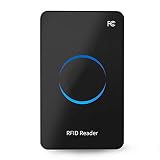
- Non‑contact card reader which response speed does not exceed 0.2 seconds, and the maximum reading distance is 50cm, very sensitive.
- Fashionable and compact, suitable for indoor desktop placement and use.
- Multi‑protocol compatibility, suitable for ISO18000‑6C and for ISO18000‑6B standards.
- Equipped with a circular LED display, full of sense of technology.
- It adopts the USB interface, whose wire stretches out about 1.4m, and it is plug and play to connect to the computer without installing a driver.
| Term or mode | What it describes |
|---|---|
| Contactless smart card | A card with an integrated circuit that communicates with a compatible reader without a physical electrical connection. |
| ISO/IEC 14443 | A proximity-card communication standard that includes initial communication and selection procedures; it does not define every application a card can support. |
| NFC | A wider technology family that includes communication with contactless cards and additional roles such as reader/writer and card emulation. |
What the definition does—and does not—tell you
The label tells you that a card communicates contactlessly, but it does not guarantee universal compatibility. A card’s standard, chip, implementation, reader, and application all matter. The definition alone also does not establish a particular card’s range, security properties, data capacity, or support for a specific payment or transit service.
- PCD: The proximity coupling device, or reader, in ISO/IEC 14443 terminology.
- PICC: The proximity integrated circuit card or contactless object communicating with the reader.
- Anticollision: Procedures for resolving responses when multiple cards or objects are detected.
- Card emulation: An NFC device operates like a contactless card to communicate with a reader; the NFC Forum lists payment and public-transport ticket emulation as typical uses.
- Reader/writer: An NFC device communicates with tags or other devices to read or write data, subject to the technology and application involved.
Is every NFC tag a contactless smart card?
No. NFC covers more than cards, including reader/writer interactions and card emulation. A tag or other NFC-compatible object should not automatically be treated as a smart card, and a contactless smart card should not automatically be assumed to be an NFC device in every role. Compatibility and function depend on the specific object and system.
Quick Recap
Rank #4

- [CAC & NFC Smart Card Reader 2-IN-1] This USB 2-in-1 nfc reader writer supports both traditional contact-based CAC cards and new contactless NFC cards. Simply tap to read compatible NFC IDs, access cards, debit, credit, driver license, in addition to standard inserted military and government smart cards. Connects to your computer/laptop via a USB cable. Plug-and-play.
- [Dual Technology] NFC reader and CAC reader, designed for secure authentication in high-risk environments. CAC contact smart card reader interface supports: Supports PC/SC standards, ISO7816 Class A (5V) and Class B (3.3V), T=0, T=1. NFC contactless smart card reader interface supports: ISO14443A&B type, ISO14443-4 compatible card T=CL, and MIFARE
- [Broad Application] FCC/CE/VCCI/CCID/ Micro soft WHQL certified for secure transactions. Perfect for government, banking, enterprise, and personal use. Smart id card reader Ideal for contactless verification with NFC-enabled ID cards, as well as for identity verification applications such as tax returns, pension insurance, vehicle registration, and criminal records.NOTE: 1.Applications for tax returns, credit card payments, etc., are not included; 2.Does not include third-party card editing software. 3.Not compatible with health insurance cards. Health insurance cards cannot be used with health apps.
- [Universal Compatibility] Plug and Play, no drivers needed for most systems; supports Windows XP+, MacOS 11.1+, Linux Fedora FC8+, Android. CCID-certified for seamless performance on laptops, PCs, and USB-A devices.
- [Compact and Portable] CAC & NFC reader has 3ft cable length for more space at your workspace. Thanks to its compact size and lightweight design, our USB ID card reader is ideal for professionals who need to access secure systems at work or on the go. This gives you access to your data anytime, anywhere. The integrated, reinforced cable and rugged housing ensure ultimate durability, making it a reliable companion for your needs. (Use one at a time)
Rank #3

- Streamlined for the End-User: Transaction-time efficiency, security, flexibility, full NFC capability, and in-field firmware upgrades ― this reader has convenience at heart every step of the way.
- Form Factor and NFC Flexibility: uTrust 3700 F works with ID-1 cards, tokens, and even NFC-enabled mobile devices. With NFC capability, network log-on, secure web-based transactions, and customer loyalty programs are a snap.
- Keyboard Emulation: No problem, we’ve got you covered. Through an optional tray app in Windows OS, it can read the unique identifier (UID) and chip serial number (CSN) of any passive RFID tag and insert it as a string in any host app. This keyboard emulation supports ISO 14443, MIFARE Classic 1K/4K, Ultralight, Ultralight C, DESFire, DESFire EV1, NTAG 203, and Broadcom Topaz tags.
- Plug and Play: uTrust 3700 F supports ISO/IEC 14443 and combines contactless and NFC smart card reader technology.
Product prices and availability are accurate as of the date/time indicated and are subject to change. Any price and availability information displayed on Amazon at the time of purchase will apply.




