United States customary units are the non-SI measurement units used in the United States, including the inch, foot, pound, gallon, and degree Fahrenheit. They are a collection with roots in several older measurement traditions, not one perfectly unified system. Their names overlap with British Imperial units, but some values differ, so the two systems should not be treated as interchangeable.
What are United States customary units?
The term U.S. customary units describes the non-metric units used in the United States. The National Institute of Standards and Technology (NIST) recommends this terminology because the collection draws on multiple historical systems, including avoirdupois, troy, and apothecary measures. Common examples include:
As an Amazon Associate I earn from qualifying purchases.
- Length: inch, foot, and yard
- Mass: ounce and pound
- Capacity: fluid ounce and gallon
- Temperature: degree Fahrenheit
These units are now defined in terms of the International System of Units (SI), even though customary measures remain in everyday use across many U.S. applications. See NIST’s U.S. Metrication FAQs and U.S. Survey Foot: Frequently Asked Questions.
Recommended Free Tools
Is the U.S. customary system the same as British Imperial?
No. The systems share many unit names and some relationships, but particular measures differ. For example, 12 inches make a foot and 3 feet make a yard in both systems, while capacity units and some mass denominations are not equivalent. NIST’s 2026 Handbook 44, Appendix B cautions against using “Imperial” or “British” to describe U.S. customary units.
#1 Best Overall

- CONVERT MORE THAN 70 UNITS: Convert U.S. Imperial, metric and other units of measure for reliable data input and conversion; enter measurements just like you say them; you can enter data in various formats and change solutions to preferred read out; you can enter feet, inch, fraction or decimal inch, other units are entered in whole or decimal numbers
- GIVES YOU OVER 500 CONVERSION COMBINATIONS: No need for complex scientific calculators or memorizing conversion formulas.
- EASILY WORK IN AND CONVERT BETWEEN MEASUREMENT FORMATS: Press the conversion key and then the desired unit key for easy and accurate results; you can add, subtract, multiply and divide your results to get to the solution you need
- TIME-SAVING BUILT-IN CONVERSIONS: All the most common units you need to complete your job in an accurate fashion; whether it's a linear, area or volume dimensional item, weight, temperatures, velocity, flow rate, pressure, torque, energy, power or another calculation you can convert it so it matches your workflow and project requirements
- VALUABLE TOOL FOR DAILY USE: Reduces headaches, saves time, improves conversion accuracy and prevents expensive errors on all your calculations from large to nano units; comes with a protective slide cover, easy-to-follow quick reference guide and handy pocket reference guide, long-life battery and a full one-year limited warranty
| Measure | U.S. customary value | British value | Why the distinction matters |
|---|---|---|---|
| Short ton / British ton | 2,000 pounds | 2,240 pounds | The same general name can denote different masses. (NIST, 2026 Handbook 44, Appendix B) |
| Gallon | The U.S. gallon descends from the 231-cubic-inch English wine gallon used by colonists. | The British Imperial gallon, defined in 1824, is approximately 277.42 cubic inches. | A volume stated simply as “gallons” may be ambiguous across jurisdictions. (NIST, 2026 Handbook 44, Appendix B) |
Not every similarly named unit differs. When precision matters, identify the jurisdiction and the specific unit—especially for gallons, fluid ounces, bushels, and tons.
Why does the U.S. use feet and pounds?
U.S. customary measures descend from English measures used before U.S. independence. The United States did not replace them wholesale when metric standards became part of modern measurement. Instead, the customary units acquired precise definitions tied to metric standards, while continuing to be used in many fields.
Rank #2

- INCLUDES MORE THAN 60 UNITS: Features both U.S. Imperial and metric units for easy and reliable data input and conversion; enter measurements just like you say them; you can also enter data in various formats and convert solutions to preferred read out; you can enter feet, inch, fraction or decimal inch, other units are entered in whole or decimal numbers
- GIVES YOU OVER 400 CONVERSION COMBINATIONS: No need for complex scientific calculators or memorizing conversion formulas; the most common 43 measuring units are set as primary function keys; the percent key also works for add-ons, discount or division percentage calculations; Paperless Tape lets you recall your last 20 entries
- SEAMLESSLY WORKS IN AND CONVERTS BETWEEN MEASUREMENT FORMATS: Press the conversion key and the desired unit key for easy and accurate conversions; then you can add, subtract, multiply and divide your results to get to the solution you need
- TIME-SAVING BUILT-IN CONVERSIONS: Provides all the most common physical units you need to complete your job in an accurate fashion; whether it's a linear, area or volume dimensional item, weight, linear velocity, flow rate, pressure, bending moments, temperatures or another calculation you can convert it so it matches your workflow and project requirements
- COMPREHENSIVE PACKAGE AND WARRANTY: Reduces headaches, saves time, improves conversion accuracy and prevents expensive errors on your calculations from large to small units; comes with a protective slide cover, easy-to-follow quick reference guide and handy pocket reference guide, long-life battery and a full one-year limited warranty
The Metric Act of 1866 legalized metric measurement in the United States. A 1988 amendment made SI the preferred system for U.S. trade and commerce, while leaving customary use permitted. Federal policy encourages voluntary metrication; the pace of adoption is left to companies, organizations, and individuals. NIST explains the legal position on its Metrication in Law page.
Are U.S. customary units defined in metric?
Yes. NIST states that U.S. customary units are defined in terms of SI. For example, the international foot is exactly 0.3048 meter. A 1977 National Bureau of Standards history of U.S. weights and measures records that the yard and pound had been defined in terms of the meter and kilogram since 1893; see Weights and Measures Standards of the United States: A Brief History.
Rank #3

- Construction Calculator with Writing Tablet:Equipped with a flip-page writing pad for quick note-taking, it requires no paper or pen, making it both eco-friendly and convenient. The thick, phone-like material provides strong, phone-level protection, keeping your calculator safe from drops and harsh construction environments
- 200+ Engineer Functions: For Mixed Dimension Calculations and Conversions,Area & Volume,Brick and Block,Concrete, Boards, Flooring, and Wall Stud,Drywall Sheet Count,Circle Area, Circumference, and Arc Properties,Compound Miter,Polygon Tiling,Roofing Material,Foundation Correction,Right Angle and Rafter,Roof Pitch and Angle Conversions,Common Rafter Length,Common/Hip/Jack Rafter and Spacing,Stair Layout,Rake Wall Calculations
- Precision for Every Construction Mind: More than 200 functions, designed specifically for engineering professionals, has 45 fast rebound hard PC buttons are reasonably distributed, more than other engineering calculator.It supports custom parameters.and has 3 storage registers for more convenient and smooth use
- Big Screen & Energy-Saving:With a 3" 12 digits large screen,Higher clarity and lager than other calculators.Clearer reading, fewer errors,8-12 minutes of no operation automatically shut down without worrying about energy consumption
- All-in-One Fit: Suitable for most people including builders, carpenters, concrete workers, contractors and DIY home renovators, roofers, architects, interior decorators, construction estimators, engineering students, etc
Which foot applies to new measurements?
Use the international foot for new applications. NIST says the U.S. survey foot should be avoided for new use after December 31, 2022, while historical and legacy applications may retain it. Older survey records can therefore encode a different foot definition; check the dataset’s stated units before converting or combining it with newer measurements. Details are in NIST’s survey-foot FAQs.
Quick Recap
Best Value
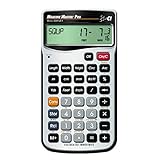
- EASILY CONVERT between dimensional formats including U.S. Imperial and metric to help you work with material and plans from Global suppliers regardless of the measuring units used; with a push of a button The calculator can change them into the measurement types you prefer to work in
- HELPS YOU CALCULATE jobsite solutions in Metric and Imperial units using linear, Area and volume measurements; Measure Master Pro makes these calculations even easier because you enter the numbers just as you say them; simply Factor in your waste allowances and you’ll have just what you need to build
- BUILT-IN CIRCULAR MATH gives you formula-free circles, areas, circumference, radius and arcs to layout a circular driveway, get requirements for a curved deck or determine measurements for a gazebo arch; with this information you can build according to plan
- SOLVE UNIT COST AND PRICING by finding total material requirements then solve for total cost by entering unit cost; great for estimating. And the built-in paperless tape lets you double-check Your entries for accuracy – without having to re-enter values
- YOUR DAILY PROBLEM-SOLVER TOOL lets you handle anything that comes your way, dimensional Math, unit conversions, board feet material estimating and more. And it comes with a protective hard slide cover, easy-to-follow pocket reference guides in English and Spanish, long-life batteries and a 1-year warranty
Rank #4

- Metric conversions.
- Sized and powered for calculations anywhere.
- Protective wallet case for carry-with convenience.
- Metric converter
- 10-Digits with punctuation
How should you convert U.S. customary measurements?
- Identify the exact unit and variant. For example, distinguish a U.S. gallon from an Imperial gallon, or a short ton from a British ton.
- Check for legacy definitions in historical data, particularly whether a foot is the international foot or the U.S. survey foot.
- Use an authoritative conversion table or calculator, and retain the units in the result so the conversion is auditable. NIST’s conversion resources provide a starting point.
Product prices and availability are accurate as of the date/time indicated and are subject to change. Any price and availability information displayed on Amazon at the time of purchase will apply.




