Quick wins for a faster PC:
Fix the driver behind crashes, sound loss and screen glitchesFind Drivers →Clear out junk files and repair common Windows errorsFree Scan →Scan for outdated or missing drivers - takes under a minuteDriver Scan →JSON-RPC has no built-in file or binary value. To upload a file, agree on an application-level convention: encode small, bounded files as Base64 in a JSON string, send bytes separately using multipart or an upload endpoint, then pass a file identifier and metadata to the JSON-RPC method. The right choice depends on payload size, middleware, and whether a separate request is acceptable.
How to upload a file over JSON-RPC, when JSON has no type for a file
JSON-RPC 2.0 defines a request format and uses JSON values for parameters; it does not define a file field, binary type, or standard upload binding. It is also transport agnostic, so the RPC message and the way file bytes reach the service are separate design concerns. See the JSON-RPC 2.0 specification.
As an Amazon Associate I earn from qualifying purchases.
That means an implementation can support file workflows, but client and server must share a contract describing how the bytes and RPC call relate. Three practical patterns cover most needs.
The Tool Desk
Outbyte Driver Updater FREEFix the driver behind crashes, sound loss and screen glitchesFind Drivers →Outbyte PC Repair FREERepair Windows errors before they cause bigger problemsFix Now →Choose an upload pattern
| Pattern | Best fit | Trade-off |
|---|---|---|
| Base64 in a JSON parameter | Small, bounded files when a single JSON request is convenient | Simple request shape, but the service must decode and validate the text; payload limits and memory use matter. |
| Multipart HTTP request with an RPC binding | One HTTP request must carry file bytes and related fields | Multipart standardizes file parts, but JSON-RPC does not define how those parts map to method parameters. |
| Separate upload, then JSON-RPC reference | Larger files, streaming needs, or middleware that expects application/json | Separates file transfer from the RPC call, but requires identifier, authorization, expiry, and failure-handling rules. |
Option 1: Put Base64 in a JSON parameter
Base64 represents bytes as text, making it possible to place encoded content in an ordinary JSON string. The encoding is specified by RFC 4648; using it as a JSON-RPC file convention is an application choice, not a feature of JSON-RPC itself.
#1 Best Overall

- BUILT FOR SERVERS & LEGACY SYSTEMS: Ideal for servers and industrial PCs with native VGA video; USB Crash cart adapter connects your laptop to a legacy headless system, turning your laptop into a portable console for servers, PCs, ATMs, kiosks, etc
- EFFICIENT TROUBLESHOOTING: Transfer files, take screenshots & log activity using downloadable software (pen drive not incl); Ensure you download & install the latest drivers & software for specific NOTECONS02 model (see additional content for more info)
- BIOS-LEVEL CONTROL: Connect a laptop to the USB/VGA ports on a server (cables incl) for instant BIOS/UEFI control; SUPPORT VARIES: keyboard/video/mouse support depend on system firmware; Some systems limit functions (see additional content for more info)
- SELF-POWERED: The KVM adapter is powered by the server-side USB connection, reducing strain on the laptop's battery and eliminating the need for an AC outlet, allowing you to connect to any PC or device with a VGA output port and USB connection
- COMPACT DESIGN: This TAA Compliant pocket-sized data center crash cart adapter requires no additional accessories, eliminating the need to carry around a traditional crash cart/trolley when troubleshooting and servicing your systems
A service might define a parameter like this:
{
  "jsonrpc": "2.0",
  "method": "document.import",
  "params": {
    "file": {
      "name": "report.pdf",
      "mediaType": "application/pdf",
      "encoding": "base64",
      "data": "<base64-encoded bytes>"
    }
  },
  "id": 1
}
This is an illustrative service schema, not a standardized JSON-RPC file object. Document the parameter names, the exact Base64 convention, accepted media types, and maximum sizes. The server should decode the content and validate it; a filename or declared media type alone does not establish what the bytes contain. There is no universal size threshold for this design: the practical limit depends on application constraints, intermediaries, memory behavior, and client and server implementations.
Option 2: Send a multipart request with an explicit binding
RFC 7578 defines multipart/form-data, including file parts, and permits its use beyond ordinary HTML form submissions. When known, a file part should be labeled with its appropriate media type; otherwise, RFC 7578 §4.4 specifies application/octet-stream.
Rank #2
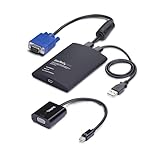
- LAPTOP TO SERVER: TAA-compliant USB crash cart adapter connects a laptop to a headless system, rack server, PC, ATM, or kiosk, turning it into a portable console; Included Mini DisplayPort adapter adds flexibility for connecting to servers with VGA or mDP
- EFFICIENT TROUBLESHOOTING: Easily transfer files, capture screenshots, and log activity using the crash cart adapter software; For optimal performance, install the latest drivers making sure to download the drivers specifically for the NOTECONS02-VGA-MDP
- BIOS-LEVEL CONTROL: Connect the crash cart adapter to your laptop using the included USB cable, then connect the integrated USB & VGA cables to your server for instant BIOS-level control; Note: Mouse function may be limited in some BIOS/UEFI environments
- SELF-POWERED: KVM adapter is powered by the server-side USB connection, reducing strain on the laptop's battery and eliminating the need for an AC outlet; Ideal for on-site work or tight server rooms where outlets aren't always accessible
- COMPACT DESIGN: Lightweight, pocket-sized adapter provides direct system access without relying on a traditional crash cart setup, helping IT technicians perform maintenance without wheeling around a separate monitor, keyboard, and mouse
The standard does not specify how a JSON-RPC method receives a multipart file part. If a service sends an RPC envelope and file in one multipart request, its API contract must define the envelope’s representation, part names, mapping to method parameters, size limits, and error behavior. Confirm that the server middleware, proxies, and clients can parse and forward that request; software expecting a plain application/json body may not accept it.
Option 3: Upload first, then call JSON-RPC with an identifier
A dedicated upload operation can accept the bytes and return an opaque identifier. A later JSON-RPC call then supplies that identifier and any metadata needed by the method. This is an architectural pattern, not a flow prescribed by either JSON-RPC or RFC 7578. It is often a better fit when files are large, streaming matters, or existing RPC infrastructure expects JSON request bodies.
Rank #3
![JSAUX USB C to USB 3.0 Adapter [2 Pack], USB C Male to USB Female OTG Cable Adapter Compatible with MacBook Pro/Air, iPhone 18 Pro Max/iPhone Duo/Air/17/16/15 Series, Samsung Galaxy S26/S25/S24/S23](https://m.media-amazon.com/images/I/41Q9tgu65+L._SL160_.jpg)
- USB OTG(On The Go): Plug in and use computer peripherals, such as flash drive, keyboard, hub, mouse and more, makes your USB C devices compatible with USB drives and any other USB devices that support OTG. Not compatible with video output.
- USB 3.0 Super Speed Transfer: Full USB 3.0 super speed data transfer up to 5Gbps, 10x faster than USB 2.0; Transfer files, HD movies and songs to your USB C devices in seconds
- Nylon Tangle-free Design: Tangle-free nylon braided design, premium nylon braided cable adds additional durability and tangle free
- Aluminum Body: Made out of sturdy aluminum alloy, innovative engineering ensures durability and a long life span
- What you get: We provide this 2 USB C adapters. If you have any questions,we will resolve your issue within 24 hours; Compatible with all USB C devices, Compatible with iPhone 18 Pro, iPhone 18 Pro Max, iPhone Duo, Samsung Galaxy S26/S25/S24/S23, MacBook Pro/Air, LG G6 G5 V20 and more.
Define the lifecycle as part of the service contract: when the uploaded object expires, whether it can be reused, which user or session can access it, and what happens to it if the subsequent RPC call fails. Authorization must cover both the upload and later use of its identifier.
Independent reader supportYour contribution helps us test, update, and keep practical guides available for everyone.Set limits and handle files as untrusted input
- Set request-body and per-file limits at the API and any intermediaries; reject oversized input predictably.
- Validate actual file content rather than trusting a filename or declared media type. Treat both as metadata.
- Generate server-side storage names. RFC 7578 warns receivers not to use a supplied filename blindly or preserve its path as a local filesystem path.
- Enforce authorization when bytes are uploaded and when an identifier is later used.
- Avoid logging file contents or secrets, and define cleanup or expiry for temporary uploads.
These safeguards need to fit the service’s threat model and platform. The standards do not decide the maximum size, storage policy, parser behavior, or authorization model for a particular API.
Rank #4

- Materials and Design: The adapter is made with anti-interference zinc alloy metallic housing and minimalist design with anti-slippery embossments
- Connectors: Engineered for enhanced durability, the male USB C and female USB3 connectors are designed to be plugged and unplugged up to 10000 times
- Compatibility: This USB C to USB 3.0 adapter is compatible with iPhone 17/17e/17 Air/17 Pro/17 Pro Max and MacBook Pro after 2016 and MacBook Air after 2018 and most of the laptops, tablets and smartphones with a USB Type C port
- USB 3.0 Speed in Two: Came in two fast speed adapters in data transfer and charging with premium materials. A foam container is also included for storage and travel
- Compact and Easy to Use: Plug and play, no driver required; Simple structure, lightweight and portability; Also, you can sync or charge your phone with this USB C to USB adapter
What the API contract must specify
Whichever pattern is chosen, document enough detail for independent clients and servers to interoperate:
- How bytes are represented or transferred, including part names or the JSON parameter structure.
- Filename and media-type handling, encoding if applicable, and request and file size limits.
- Whether an upload produces an identifier, how that identifier is authorized, and how long the object remains available.
- Validation rules, error responses, cleanup behavior, and what happens when upload succeeds but the RPC operation does not.
For small files, a documented Base64 JSON parameter is usually the simplest single-request convention. For larger files or systems constrained by JSON request handling, use a separate upload route and pass its identifier to JSON-RPC. Use multipart in one request only when the service explicitly defines and supports the binding between its RPC envelope and file part.
Quick Recap
Product prices and availability are accurate as of the date/time indicated and are subject to change. Any price and availability information displayed on Amazon at the time of purchase will apply.




