Do these 3 things before closing this tab:
1Scan for outdated or missing drivers - takes under a minute2Clear out junk files and repair common Windows errors3Fix the driver behind crashes, sound loss and screen glitchesTransformers are neural-network architectures that use attention to build context-aware representations of sequence elements. The original 2017 Transformer paired an encoder with a decoder; many language models instead use decoder-only designs to generate text one token at a time. ChatGPT, Claude and Gemini are product families, not architecture labels, and public information does not establish that they share one design.
What is a Transformer?
Introduced by Ashish Vaswani and coauthors in 2017, the Transformer was a sequence-processing architecture that replaced recurrence and convolution in its proposed translation system with attention mechanisms. The paper described it as a network “based solely on attention mechanisms, dispensing with recurrence and convolutions entirely.” Google Research’s paper page gives the original proposal and its results.


As an Amazon Associate I earn from qualifying purchases.
Attention is a computation: it lets a model relate a sequence position to other positions and use those relationships to form contextual representations. It is not human attention, understanding, or a guarantee that an answer is true. The Transformer also relies on positional information, feed-forward layers and other components; attention alone is not the whole network.
How does a Transformer process text?
- Convert text into tokens and vectors. Text is split into units called tokens, which the model represents numerically.
- Represent order. Positional information helps the model distinguish sequence order; without it, token relationships would not by themselves tell the model which item came first.
- Relate token positions with attention. Self-attention computes how representations at different positions relate. Multi-head attention applies multiple learned attention transformations, allowing the network to form different kinds of relationships.
- Transform the representations. Stacked feed-forward layers and components such as residual connections and normalization further process the representations. Exact implementation varies by model.
- For generation, score what can come next. A language model assigns scores to candidate next tokens, selects one according to its decoding procedure, and uses the growing sequence as context for the next step.
These steps describe the general idea, not one fixed implementation. The sources do not establish a universal layer count or parameterization for ChatGPT, Claude and Gemini.
What do the encoder and decoder do?
The original Transformer is an encoder-decoder model. Its encoder processes the input sequence into representations; its decoder produces an output sequence while consulting those encoded representations. In translation, for example, the encoder represents the source sentence and the decoder generates the translated sentence. Google Research’s accessible explanation puts it this way: “A decoder then generates the output sentence word by word while consulting the representation generated by the encoder.” Google Research explains the original flow.
The decoder uses a mask so a position cannot use future target tokens when generating an output. During training, many target positions can be processed in parallel while respecting that mask. At inference time, generation is autoregressive: each new token depends on the preceding context.
Why do many language models use decoder-only Transformers?
A decoder-only model uses the causal, masked prediction pattern to predict the next token from preceding context. It is related to the Transformer, but it is not the complete encoder-decoder architecture shown in the original paper’s famous diagram. OpenAI’s general explanation says models learn patterns from large volumes of text and become better at “recognizing patterns and predicting the most likely next word.” That describes a broad prediction objective, not the full architecture of every current model. OpenAI Help Center explains the general idea.
Quick wins for a faster PC:
Scan for outdated or missing drivers - takes under a minuteDriver Scan →Repair Windows errors before they cause bigger problemsFix Now →Architecture discussions often distinguish encoder-decoder, encoder-only and decoder-only models. They also distinguish whether a position can use context from both directions or only preceding context, and whether a model processes training examples in parallel or generates outputs sequentially at inference. These are useful architectural distinctions; product names such as ChatGPT, Claude and Gemini are not.
What is publicly known about ChatGPT, Claude and Gemini?
Public architecture disclosures are specific to particular models and dates. They should not be generalized to every model available through a product.
| Public document | What it establishes | What it does not establish |
|---|---|---|
| Google DeepMind, Gemini 1.0 technical report | The report describes the Gemini 1.0 family as decoder-only Transformers and documents choices including multi-query attention, a 32K context in that report, and multimodal training. Read the Gemini 1.0 report. | Those details should not be carried forward to later Gemini versions without version-specific documentation. |
| OpenAI, gpt-oss announcement (2025) | OpenAI describes its open-weight gpt-oss models as Transformers, with mixture-of-experts, alternating dense and locally banded sparse attention, grouped multi-query attention and RoPE; it also states context lengths. Read the gpt-oss announcement. | gpt-oss is a specific open-weight model family, not evidence that proprietary ChatGPT models use the same design. |
| Anthropic Claude system-card index | Anthropic publishes system cards covering capabilities, safety evaluations and deployment decisions. Browse Anthropic’s system cards. | The cited material does not confirm the architecture of current Claude models. |
Google DeepMind maintains a Gemini model page with model-specific documentation. A claim about a current release should be tied to that release’s own documentation rather than inferred from Gemini 1.0.
What did the original Transformer demonstrate?
Vaswani et al. reported 28.4 BLEU on WMT 2014 English-to-German and 41.0 BLEU on WMT 2014 English-to-French in 2017. They reported that the English-to-French result followed 3.5 days of training on eight GPUs. These are historical machine-translation results from the original paper, not scores for ChatGPT, Claude or Gemini and not proof that Transformers outperform every approach on every task. Google Research describes the proposed model as more parallelizable and faster to train than the recurrent and convolutional approaches compared in that work. The paper page reports the experiments.
What attention does—and does not—tell you
Attention gives a model a way to combine information across sequence positions. It does not work like a database lookup, and an attention mechanism cannot guarantee factual output. A model that predicts plausible next tokens may still produce incorrect information; the prediction objective is not proof of truth or human-like reasoning.
Quick Recap
Best Value
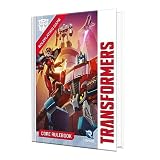
- Complete rulebook system: Includes all rules, character creation tools, weapons, equipment, and vehicles needed to start your transformers roleplaying campaign immediately with friends
- Epic combat and adventure: Features detailed combat mechanics, exploration guidelines, secret base construction, and special equipment to fuel endless storytelling possibilities
- Ready-to-play introductory adventure: Comes with a complete first-level adventure scenario designed for new players, requiring only dice and imagination to begin your first mission
- Officially licensed transformers content: Delivers authentic Autobot and Decepticon gameplay with detailed villain dossiers and lore-rich worldbuilding that honors the franchise legacy
- Premium hardcover production: Offers high-quality binding, stunning cover artwork, and professional layout designed for frequent reference during gameplay sessions
Product prices and availability are accurate as of the date/time indicated and are subject to change. Any price and availability information displayed on Amazon at the time of purchase will apply.




