Do these 3 things before closing this tab:
1Repair Windows errors before they cause bigger problems2Scan for outdated or missing drivers - takes under a minute3Clear out junk files and repair common Windows errorsGoogle Sheets can track time in three practical ways. You can store start and end times in cells, subtract them to get a duration, and format the totals as elapsed hours. If your work already appears on Google Calendar, Google’s Apps Script sample can import those events into a sheet and group them by customer, project, and task. If you would rather not build anything, you can adapt a prebuilt timesheet template. The right choice depends mostly on whether your hours are already recorded somewhere else.
Choose the method that fits how your time is recorded
Before you build anything, decide where the record of your work will come from. If you type in your hours at the end of each day, a manual log is the simplest option. If your meetings and work blocks already sit on a calendar, automation can save entry time, but only for the work that is actually represented there. If you need a ready structure for a pay period or shift schedule, start from a template.
As an Amazon Associate I earn from qualifying purchases.
| Approach | Best for | Setup effort | Main risk | Source for the capability |
|---|---|---|---|---|
| Manual time log with formulas | Freelancers and small teams who record hours daily and want full control of columns | Low: a sheet, a few formulas, one number format | Missed entries and text values that look like times but do not calculate | Google’s documentation on date, time, and number formats |
| Calendar-to-Sheets automation (Apps Script sample) | People whose billable work is already scheduled on Google Calendar | Moderate: script setup, authorization, and configuration | Calendar entries that do not match actual time worked | Google’s published Apps Script sample for Calendar-to-Sheets timesheets |
| Prebuilt timesheet template | Readers who want a starting layout for shifts or pay periods | Low to moderate: copy and adjust columns | Layout that does not match your pay period, categories, or reporting rules | Smartsheet’s list of Google Sheets timesheet and time-card templates |
Method 1: A manual time log
A manual log gives you the most control and needs no permissions. It works because Google Sheets stores dates and times as numbers, so subtraction returns a duration you can add up.
Recommended Free Tools
Build the log step by step
- Create a header row with the columns Date, Client, Project, Task, Start, End, and Duration. Add a Notes column if you need one.
- Enter the start and end times as real times, such as
9:00 AMand5:30 PM. Confirm each one is recognized as a time. Values that stay left-aligned are usually stored as text, and text will not calculate. - In the first Duration cell (for example, G2 when your times are in E and F), enter
=F2-E2. Fill the formula down the column. - Select the Duration column and apply an elapsed-hours format through Format > Number > Custom number format. Google’s format guide documents
[h+]as the elapsed-hours pattern, which keeps counting past 24 hours instead of wrapping back to zero. - Place a total at the top of the sheet with
=SUM(G2:G500), formatted the same way. Multiply that total by 24 only if you need a decimal figure such as 37.5 hours for an invoice.
Handle overnight shifts
A shift that starts at 10:00 PM and ends at 6:00 AM produces a negative result with a plain subtraction. A common workaround is =MOD(F2-E2,1), which adds a full day when the end time falls earlier than the start time. Test this with one overnight entry before relying on it for totals.
#1 Best Overall
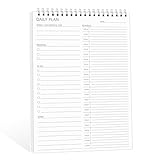
- ✔This daily plan pad features detailed hourly schedule timelines from 12 AM to 11 PM, perfectly segment your morning, afternoon and evening hours. Track meetings, appointments and fixed tasks hour by hour to eliminate procrastination and boost your daily time management efficiency.
- ✔ 1.Put an end to the time black hole: Every hour of activity is recorded, so you always know where your time goes and bid farewell to "being busy yet achieving nothing". 2.Cure procrastination: Visual time grids have an inherent sense of supervision; blank time slots serve as a direct reminder, with more binding power than phone alerts. 3.Gain instant a sense of accomplishment: Check off completed tasks with a simple tick. A filled time axis page by page delivers physical feedback that digital tools cannot match, making it easier to keep going the more you use it.
- ✔ 1.Students & Exam Takers: Plan class, review and practice time; allocate study hours for each subject precisely for targeted exam preparation. 2.Professionals: Schedule meetings, work projects and commute time; prioritize tasks clearly and bid farewell to chaotic overtime. 3.Freelancers & Stay-at-Home Parents: Clearly divide work/childcare/personal time to avoid blurring the boundaries between life and work. 4.Self-Discipline Enthusiasts: Check in on fitness, reading and learning; develop regular routines with hourly scales to build good habits effortlessly.
Check the locale setting
Google’s documentation notes that the display of date and time formats can depend on the spreadsheet’s locale. A time typed as 3:15 may be read differently in a sheet set to another region, and a sheet shared with a colleague in a different locale can display the same stored value differently. Check the locale under File > Settings before you start, and keep it consistent across any shared log.
Method 2: Calendar-to-Sheets automation
Google publishes an Apps Script sample that imports selected Calendar events into a Google Sheet, lets you categorize each event by customer, project, and task, and presents totals on a dashboard. It can also be configured to update Calendar event titles and descriptions from values in the sheet. Treat it as a small automation project rather than a switch you flip. It depends on script configuration and permissions, and it does not record billable time on its own.
Rank #2

- TASK PLANNER NOTEPAD FOR WORK – Structured task planner and productivity planner designed as a task organizer and workflow planner with expanded layout
- REDUCE OVERWHELM & IMPROVE EXECUTION – Use this task planner, productivity planner, and task tracker to organize workflow and improve execution
- TASK PLANNING + ACTIVITY TRACKING IN ONE FORMAT – Use as a productivity planner, task organizer, and workflow planner to manage tasks and execution
- ANALOG TASK & ACTIVITY SYSTEM THAT WORKS – Writing tasks improves memory and reduces missed steps
- STRUCTURED CHECKLIST + LOG FORMAT – Combines task planning and activity tracking with expanded space for detailed workflow management
Set it up
- Open Google’s Calendar-to-Sheets timesheet sample from its Apps Script samples and create a copy of the project in your own Google account.
- Run the setup function and approve the authorization prompts for Google Calendar and Google Sheets. Review what each permission allows before you accept.
- Select the calendars to include and the time period to import. Start with a single calendar and a short date range so you can check the results.
- Import the events, then assign each one a customer, project, and task category.
- Review the totals on the dashboard and compare them with what you remember working. Only then widen the calendars or date range.
Know what automation cannot fix
- Unscheduled work is invisible. Email, research, or a task you started without a calendar block will not appear in the totals.
- Placeholder events inflate hours. A recurring block you never actually worked still counts unless you exclude or recategorize it.
- Categories depend on your discipline. The import saves entry time, but someone still has to label events correctly.
- Write-back changes your calendar. If you enable the option that updates Calendar titles and descriptions, edits in the sheet modify the events themselves. Test it on a copy of your calendar first.
Method 3: Start from a prebuilt template
Smartsheet lists Google Sheets timesheet and time-card templates, including a layout for daily shift start and finish times. A template is useful when you need a structure quickly, especially for hourly shifts. Copy the template into your own Drive, then check three things before using it:
- Whether its columns match the categories you bill or report on.
- Whether its pay-period logic matches your schedule. A template’s period and totals may be built for a weekly pattern you do not use.
- Whether its overtime or break handling fits your situation. A template establishes that a layout exists. It does not establish that the layout meets payroll rules or legal requirements where you work, so confirm those with your employer or accountant.
Going further: add-ons and Apps Script
If a log outgrows formulas, Google documents several extension options: custom menus, sidebars, custom functions, connections to external services, macros, and triggers. Add-ons are installed through Extensions > Add-ons > Get add-ons, and custom scripts are written in Extensions > Apps Script. Before you install a third-party add-on, read its listing, its permission requests, and its own documentation. Capabilities differ widely between add-ons, so do not assume one covers what another does.
Rank #3

- Made in USA. Veteran-Owned and Proudly Produced in Ohio.
- THIS IS ESSENTIAL FOR LAWYERS AND CONSULTANTS: BookFactory Time Tracking book is a necessary addition to any attorney’s office, small business or freelance assignment. It’s a fundamental part of any business like. A simple and easy way track your billable hours
- TRACK BILLABLE HOURS BY DAY OR BY CLIENT: For business or personal use, time tracking is shown across a 2-page spread, on the left side, you have days and each hour, where you can write quick details about who you worked for. On the right side of the page you can keep more detailed track of the specific tasks you worked on and what client it was for – what breaks you took, and when, as well as the specific amount of time you spent on each task
- EXCELLENT VISUAL TO SHOW HOW YOU’RE SPENDING YOUR TIME: You may wonder where your day is going, or how you still have so much to do when you’ve already been working for hours. You may just need to be able to give your client an itemized invoice of work provided… either way, this book will be a help to you
- BUS-100-69CW-PP-(Time-Tracker)
Keep a large tracker responsive
A small personal log recalculates instantly. A tracker with thousands of rows and many dependent formulas does not. Google recommends using volatile functions such as TODAY, NOW, and RAND sparingly, because they can prompt recalculation across related cells whenever the sheet updates. For a running clock, enter a timestamp manually or limit the volatile formula to a single cell instead of a whole column.
Quick Recap
Best Value

- Plan Smarter, Stress Less: Our undated planner has 50 daily planning sheets per planning pad to help you keep your notes organized all in one place. Track important projects, tasks, time blocking, and goals with our planner.
- Enhance Your Productivity: The simple solution for managing your daily schedule. Helps you focus, especially those with ADHD. With our daily planner you can track your appointments and meetings throughout the week, organize your tasks in order of priority, jot down thoughts or ideas, and record when projects are due.
- Upgrade Your Office Supplies: The minimal design makes this a stylish and practical addition to your work from home essentials for both women and men. This to-do list notepad looks professional and keeps you organized.
- Give The Gift Of Organization: The sleek design makes this a beautifully practical gift for moms and dads who need a little extra help keeping track of soccer games, field trips, and doctor’s appointments. Also makes a wonderful gift for college students, coworkers, your boss, or the entrepreneur in your life to help them stay on top of busy schedules.
- Cultivate Healthy Habits: Plan and track your meals and water intake each day and use the checkbox as a visual reminder. Take a minute each day to write down something good that happened. Practicing gratitude is proven to increase happiness!
Rank #4

- SIMPLE, ATTRACTIVE DESIGN - The notepad flaunts a design that's both stylish and fun, making it the perfect backdrop to track your daily tasks and other deliverables.
- 8.5" X 11": LETTER SIZE - With ample space for jotting down your activities/tasks, projects and deliverables, this notepad ensures you never miss a beat. The larger size offers room to log all your work.
- DOUBLE-WIRE SPIRAL BINDING - Tear off sheets as needed or keep them intact to be able to look back on your prior tasks. Whether you're at your desk, in a meeting, or on the go, your notepad is ready for you to use as you see fit.
- 50 SHEETS - Created so you can list all your tasks onto one sheet in order to keep track of time stamps as you note how you spend your time each day.
- VERSATILE FOR TRACKING ALL YOUR TASKS - Whether you're a professional who bills for your time, a student recording time spent on studies, or a volunteer tracking your hours, this notepad can help you record your time spent on any and all activities throughout your day.
Common problems and fixes
- The duration shows a strange number such as 0.5625 or a date. The cell is not using an elapsed or time format. Reapply the format from Method 1.
- Totals stop at 24 hours. The total is using a standard time format instead of an elapsed-hours format.
- Durations are blank or zero. One of the times is text. Retype it, or use Data validation to restrict the column to times.
- Times change after sharing the file. The locale differs between accounts. Align the setting and re-enter one row to confirm.
- Calendar import misses events. Check the selected calendars and the date range first, then confirm the events are not declined or hidden.
Product prices and availability are accurate as of the date/time indicated and are subject to change. Any price and availability information displayed on Amazon at the time of purchase will apply.




