The Tool Desk
Outbyte PC Repair FREEClear out junk files and repair common Windows errorsFree Scan →Outbyte Driver Updater FREEFix the driver behind crashes, sound loss and screen glitchesFind Drivers →Short answer: T-Motor’s AT2814 tables are useful for comparing specific motor-and-propeller combinations on a static bench and checking their electrical demand. They do not tell you the thrust, torque, or efficiency at cruise. To estimate a fixed-wing propulsion envelope, first calculate the aircraft’s drag across airspeed, then compare it with airspeed-dependent propeller data and the electrical and thermal limits of the exact motor winding.
What the AT2814 static test data can tell you
The manufacturer’s AT2814 long-shaft listing covers KV900, KV1050, and KV1200 windings. Its propeller rows report bench results for named motor and propeller configurations, including voltage, current, electrical power, RPM, torque, static thrust, and efficiency-related values. Those rows are useful for component-level screening: they show how a tested setup behaved at the listed bench condition.
As an Amazon Associate I earn from qualifying purchases.
For example, the KV900 with an APC 10×5.5 propeller is listed at 40% command with 15.19 V, 6.54 A, 99.39 W, 6,433 RPM, 0.105 N·m, 687 g static thrust, and 6.91 g/W. Its 85% row gives 14.90 V, 23.55 A, 350.72 W, 9,791 RPM, 0.272 N·m, 1,702 g, and 4.85 g/W. The KV900 APC 12×6 40% row is a different configuration: 11.42 V, 5.06 A, 57.77 W, 4,348 RPM, 0.087 N·m, 523 g, and 9.05 g/W. Keep each value attached to its winding, propeller, voltage, and test condition; it is not an in-flight result. T-Motor AT2814 manufacturer listing
For the KV1200, UNITED UAV’s examples report a 4S APC 9×6 full-command static result of 14.46 V, 49.57 A, 716.86 W, 12,788 RPM, 0.402 N·m, and 2,152 g thrust. Its 4S APC 10×5.5 full-command row reports 14.37 V, 54.64 A, 785.36 W, 12,029 RPM, and 2,616 g static thrust. The latter is close to T-Motor’s listed KV1200 limits, so it is a boundary comparison—not evidence of safe margin or continuous operation. UNITED UAV’s AT2814 analysis
#1 Best Overall

- Model number: D2826 2200KV/1400KV/1000KV/930KV Brushless Motor.
- Fit for Battery : 2-3 Li-Po
- Shaft size : 3.17mm
- Come with 3.5mm banana plug adapters.
- Suitable for RC Fixed-wing/MultiCopter/QuadCopter/Multi-axis aircraft.
Keep winding-specific electrical limits separate
T-Motor specifies a 3–4S LiPo range for these long-shaft variants, but their stated current and power figures differ. The maximum-power duration shown is 180 seconds; do not treat it as a continuous system rating or transfer one winding’s limits to another. These are manufacturer product claims, not independent validation of the ESC, battery, wiring, connectors, or installed aircraft.
| AT2814 winding | Manufacturer-listed peak current | Manufacturer-listed maximum power and duration |
|---|---|---|
| KV900 | 45 A | 650 W for 180 seconds |
| KV1050 | 50 A | 700 W for 180 seconds |
| KV1200 | 55 A | 800 W for 180 seconds |
The KV1200 listing also gives 108 g including cable, 26 mΩ internal resistance, 1.8 A idle current at 10 V, and 5 mm input and output shaft diameters. These values help check fit and component selection; they do not establish a thermal model or the installed system’s operating limits. T-Motor AT2814 specifications
Rank #2
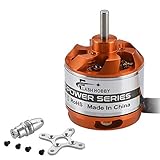
- Featuring 12N14P high torque design, strong thrust, more powerful than other ordinary brushless motors, high working efficiency
- Precisely balanced rotor is stable with high speed, ensure the motor high-speed running without shake and has the best reliability and the largest RPM
- High purity copper windings maximize efficiency, 42SH magnets and NMB bearing, good insulation and heat resistance
- Motor KV 1400KV, shaft size 3.17 x 41mm, motor mount 16 x 19mm (M3*4), which is compatible with 7~9 inch propeller
- The motor battery is 2S lipo, which is widely use in RC aircraft, drone, fixed wing, helicopter, plane, multicopter and so on
Estimate cruise thrust from aircraft drag, not aircraft weight
In steady, level flight, thrust balances drag. Aircraft weight is not the cruise-thrust requirement; it sets the lift requirement, which affects drag through the aircraft’s aerodynamic polar. For a preliminary estimate, declare the aircraft mass, wing reference area, air density, true airspeed, and drag polar rather than borrowing unqualified sample values.
Free tools Windows power users keep installed
One-click scans. No signup required.
One simple model is CD = CD0 + k·CL², where CD0 represents zero-lift drag and k captures the induced-drag term. With dynamic pressure q = 0.5·ρ·V² and lift approximately equal to weight W in level flight, the estimated drag is:
Rank #3

- SunnySky X2814 Brushless Motors(1250KV)
D = q·S·CD0 + k·W²/(q·S)
Here, S is wing reference area and V is true airspeed. For each candidate airspeed, the estimated level-flight thrust requirement is approximately D, and useful propulsive power is D·V. This is an aircraft-side estimate, not a claim about AT2814 output. A climb case also needs the potential-energy rate W·climb_rate; converting useful power into electrical demand requires accounting for propeller efficiency, motor and ESC losses, installation effects, and operating margin. Use measured or otherwise justified aerodynamic inputs when available, and identify the provenance and condition of every input. UNITED UAV’s discussion of the preliminary envelope
Why static thrust cannot be scaled into cruise thrust
A propeller’s advance ratio is J = V/(n·D), where V is forward airspeed, n is revolutions per second, and D is propeller diameter. On a static bench, V = 0 and therefore J = 0. In cruise, airspeed is nonzero, so the propeller operates at a different advance ratio. Its thrust and power behavior change with that operating point.
Rank #4

- C2826 1900KV/1350KV/1200KV/1000KV Brushless Motor 3mm shaft that suitable for RC Fixed wing/MultiCopter/QuadCopter/Multi-axis aircraft.
- RC electric motor mount is 16*19 mm (M2.5*4) and the motor size is 28 x 17 mm. fit for 2-3 Li-Po Battery and come with 3.5mm banana plug adapters.Package include 1 x C2826 fixed-wing motor and a set of accessorie
- C2826 Brushless outrunner motor is 14 pole 12 slot high torque motor design, 42SH magnets and purity copper windings maximize efficiency, which is compatible with 7~9 inch propeller
- FPV brushless motor provides the most incredible power and thrust in the lightest weight. Give you a more satisfied experience with your model Precision balanced rotor, smoothness for best reliability and maximum RPM.
- The brushless motor is durable,stable,and has high torque Each motor has been dynamically balanced,crush-resistant damping bearing,eliminate vibration effectively
A static table alone therefore cannot establish cruise thrust, torque, or propulsive efficiency. Do not manufacture those values by scaling static thrust with voltage, RPM squared, or throttle percentage. A cruise estimate needs thrust and power coefficient data across advance ratio, or validated dynamic measurements at relevant operating conditions. As UNITED UAV puts it, “It is not enough to predict cruise without an airspeed-dependent propeller map.” UNITED UAV’s AT2814 analysis
Do these 3 things before closing this tab:
1Repair Windows errors before they cause bigger problems2Scan for outdated or missing drivers - takes under a minute3Clear out junk files and repair common Windows errorsBuild a preliminary propulsion envelope step by step
- Define the aircraft and mission condition. Record mass, wing reference area, air density, true airspeed range, and any climb rate to be assessed. State whether the calculation is for steady level flight or another condition.
- Estimate drag at each airspeed. Choose a declared drag polar, such as
CD = CD0 + k·CL², and calculate drag at each candidate point. Treat the result as an estimate whose accuracy depends on the input data. - Set the thrust and useful-power targets. For steady level flight, compare propeller thrust with estimated drag and useful propulsive power with
D·V. Add the climb energy rate when assessing climb, then account for propulsion losses and margin rather than equating useful power with battery power. - Choose the exact motor and propeller configuration. Keep the AT2814 winding and propeller diameter and pitch explicit. Use the static bench row only to screen static behavior and electrical demand, not to fill in an unmeasured cruise point.
- Obtain airspeed-dependent propeller evidence. Use thrust and power coefficient maps over the relevant advance-ratio range, or validated dynamic measurements from an appropriate wind-tunnel, dynamometer, or flight-derived method. If these are unavailable, mark cruise thrust, torque, and propulsive efficiency as unknown.
- Check electrical, thermal, and installation constraints. Compare loaded voltage, current, and electrical power with the duration-qualified limits for the exact winding. Assess motor temperature under a stated test duration and cooling condition, as well as mass, installation, and propeller clearance.
- Validate before relying on the estimate. A static record is not a substitute for the dynamic evidence the cruise calculation needs. Tyto Robotics’ AT2814 test record says it focuses on static testing, omits dynamic performance and airspeed, and recommends internal testing before design reliance. Tyto Robotics AT2814 static test record
Compare configurations without overstating the data
When comparing candidate propulsion setups, hold the aircraft and mission condition constant. The meaningful comparison is not simply which static row has the largest gram reading; it is whether the complete configuration can meet the aircraft’s demand across its operating envelope and remain within the relevant limits.
Best Value

- Model number: D2830 750KV/850KV/1000KV/1300KV Brushless Motor.
- Fit for Battery : 2-4 Li-Po
- Shaft size : 3.17mm
- Come with 3.5mm banana plug adapters.
- Suitable for RC Fixed-wing/MultiCopter/QuadCopter/Multi-axis aircraft.
- Aircraft demand: compare estimated required drag or thrust across airspeed, not only at one cruise point.
- Propeller behavior: compare diameter and pitch along with advance-ratio thrust and power data.
- Electrical loading: compare loaded voltage, current, and power with the limits for the exact winding and their stated duration.
- Thermal behavior: state test duration and cooling conditions. Do not turn the manufacturer table’s operating-temperature field into a general thermal model; sensor placement, airflow, starting temperature, and ambient conditions are not fully specified in the cited analysis.
- Aircraft integration: include propulsion mass, installation effects, and physical clearance.
When reproducing derived measurements, preserve the source’s definitions and units. Tyto Robotics defines electrical power as voltage × current, mechanical power as torque × rotational speed, motor efficiency as mechanical/electrical power, propeller efficiency as thrust/mechanical power, and powertrain efficiency as thrust/electrical power. These quantities are not interchangeable; identify which definition a reported value uses. Tyto Robotics test record and definitions
Quick Recap
Product prices and availability are accurate as of the date/time indicated and are subject to change. Any price and availability information displayed on Amazon at the time of purchase will apply.




