EPFL researchers have demonstrated tiny robots that use sound to propel themselves, rather than relying on onboard batteries or motors. Their hollow resonators turn tuned sound into directional air jets: audible tones steer miniature boats, while ultrasound powers separate microflier designs. These are laboratory demonstrations, not consumer-ready robots.
How can sound make a tiny robot move?
The devices use hollow cavities designed to behave as Helmholtz resonators—the same basic acoustic effect that produces a tone when someone blows across a bottle opening. At a cavity’s resonant frequency, the air inside oscillates strongly. In the researchers’ design, that motion forms a concentrated jet of air leaving the cavity, while air entering it is more diffuse. The imbalance creates thrust.
As an Amazon Associate I earn from qualifying purchases.
This differs from using sound waves simply to push or levitate an object. Here, sound activates the resonator, and the resonator produces the device’s own propulsive force. As MICROBS Lab head Selman Sakar put it: “Instead of pushing devices around with sound waves, we have created acoustic resonators that are tuned to harness sound at specific frequencies to generate directional thrust and controlled motion.”
Free tools Windows power users keep installed
One-click scans. No signup required.
The resonators can be made from materials including common 3D-printing plastics, rubber-like polymers and glass. For the microfliers, the team used 3D nanoprinting to integrate microscopic cavities into polymer structures.
#1 Best Overall
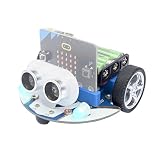
- CUTE & MINI The simple color combination makes the appearance look more charming, and the cutebot is very comfortable to hold.
- Structural Features - Elecfreaks Cutebot is a smart coding car with a dual speed motor that delivers strong power.
- CREATIVITY - Cutebot's rich graphic programming blocks allow micro:bit beginners to learn programming from the simplest to the most complex. They can achieve distance tracking, avoid obstacles, follow lines, etc.
- Extension port: (1) Sensor extension: we can do more experiments through the 3PIN port. (2) Building Block Extension: This microbit robot supports building block, we can create various cases. Better your interest in programming.
- Tips: (1) Not include micro: bit board and AAA battery. (2) The ultrasonic module must be connected to the front port, otherwise the cutebot will not work. (3) Tutorial Wiki Get: Please enter "wiki.elecfreaks.com/en/" to learn. (4) Strong technical support: please click Amazon store "elecfreaks" and click "Ask a question" to email us. Look for your query!
What did the researchers demonstrate?
The experiments covered boats and two distinct kinds of microflier. They did not combine every reported feature in one vehicle.
| Demonstration | Sound and actuation | Reported result |
|---|---|---|
| Miniature boats | Audible frequencies selectively activate cavities aimed in different directions. | Movement, steering around obstacles and programmed autonomous navigation; no boat speed or other measurement is specified in the cited announcement. |
| Direct-thrust microflier | Ultrasound activates resonators that generate upward thrust. | One design weighed 150 micrograms, according to EPFL’s 2026 announcement. |
| Blade-driven microflier | Ultrasound activates resonators coupled to tiny blades. | A separate design reached blade speeds of up to 13,000 revolutions per minute, with lift described as stable and helicopter-like. |
The 150-microgram figure belongs to the direct-upward-thrust design; the 13,000-rpm maximum belongs to the blade-driven one. They are separate demonstrations, not specifications for a single craft. EPFL says the boats used audible sound, while the microfliers operated at ultrasonic frequencies, which humans cannot hear.
Rank #2

- BUILD, CODE & DRIVE YOUR OWN ROBOT CAR: Turn coding, electronics and engineering into a working programmable robot car you can assemble, program and drive; ideal for weekend family projects, STEM classrooms, coding clubs, robotics lessons and maker challenges
- EXPLORE FPV, LINE TRACKING & OBSTACLE AVOIDANCE: Control the robot with the ELEGOO app or IR remote, view live FPV video through the onboard camera, follow black lines, avoid obstacles with the ultrasonic sensor and explore multiple interactive driving modes
- BEGINNER-FRIENDLY BUILD WITH GUIDED WIRING: Keyed XH2.54 connectors help reduce wiring mistakes, while the illustrated tutorial and example programs guide beginners step by step from chassis assembly and module connection to programming and the first successful run
- GO BEYOND ASSEMBLY WITH CREATIVE CODING: Program with Arduino IDE to explore movement, sensors and control logic, then modify example code to create custom routes, reactions and robotics experiments that develop coding, problem-solving and engineering skills
- COMPLETE RECHARGEABLE STEM ROBOTICS KIT: Includes an ELEGOO UNO R3 controller board, ESP32-WROVER-based camera and Wi-Fi module, line-tracking and ultrasonic sensors, motors, IR remote and a 2000 mAh rechargeable lithium-ion battery; recommended for ages 8+ with adult guidance for first-time builders
How were the boats steered?
The centimeter-scale boats had as many as three cavities. Each cavity was tuned to a different audible frequency and oriented to produce thrust in a particular direction. Changing the frequency played through a speaker selectively activated the corresponding cavity, letting the researchers change the boat’s motion and steer it around obstacles. EPFL also reports programmed autonomous navigation.
This is a way to control motion without putting a conventional motor and its power source aboard the miniature vehicle: the sound comes from outside, and the resonators convert it into directed thrust. The cited announcement does not state the sound intensity required or how the boats perform outside the reported experimental setting.
Rank #3

- Hands-On STEM Robot Learning. This STEM robot kit combines coding, electronics, and robotics into a fun hands-on learning experience. Powered by an Mirco:bitV2 controller and guided by 16 story-based tutorials, this robotics kit helps children ages 8–12 12-16 build real-world STEM skills while sparking creativity. A perfect introduction to robotics for kids ages 8–12 12-16, ideal for science fairs, classroom use, or at-home projects.(Note: AA Batteries not included)
- Build Your Own Robot – Parent-Child DIY Fun. This Makecode-compatible coding robot kit includes HD videos and illustrated step-by-step instructions, making it easy for kids and parents to assemble together. Great for family STEM bonding, the process boosts confidence and critical thinking skills. A wonderful option for building sets for boys and robot kits for kids age 8-12 12-16. Tutorial & code path: ACEBOTT Official Website → Resources → WIKI and Assembly Video.
- Expandable Robot Kit – Extension Port: (1)Sensors Extension: We can do more experiments through 3PIN port. (2)Building Block Extension: This microbit robot is compatible with LEGO building block, We can create various cases. It better improves their interest in programming, and making it one of the most engaging STEM toys for boys age 8-12 12-16
- App & remote control & wireless controller operation. This programmable robot car supports infrared remote control and smartphone apps (compatible with iOS and Android systems), plus wireless controller operation, allowing you to control it with ease and flexibility both indoors and outdoors. Whether kids are coding or just playing, it enhances confidence and excitement while exploring technology—an excellent robotics kit for independent learning.
- Learn by Exploring: Rich Makecode graphical programming blocks allow micro:bit beginners to learn programming from the simplest to more complex.They can achieve distance tracking, obstacle avoidance, line following, Light Following, etc.
What do the results establish—and what remains unknown?
The work establishes that tuned acoustic resonators can generate directional propulsion in small-scale prototypes, including audible-frequency control for boats and ultrasound-driven microflier demonstrations. It does not establish practical readiness for consumer or field use.
The cited EPFL announcement does not provide measured flight duration, travel range, payload capacity, manufacturing yield or cost. It also does not report a safety analysis or define operating-environment limits. Without those details, the prototypes should not be described as ready for medical, environmental or industrial missions.
Rank #4

- BUILD A METAL TRACKED ROBOT: Assemble the stainless-steel chassis, suspension, tracks, sensors and UNO R3 control system into a working robot; ideal for home STEM projects, homeschool lessons, coding clubs and classroom builds
- EXPLORE FIVE INTERACTIVE MODES: Switch between FPV driving, IR remote control, obstacle avoidance, line tracking and auto follow; create patrol routes, black-line courses, maze challenges and navigation experiments
- DRIVE FROM THE ROBOT’S VIEW: The camera and ESP32-WROVER Wi-Fi module stream live FPV video to a compatible phone, while the adjustable servo-mounted camera lets you change the viewing angle during driving and inspection
- START WITH BLOCK CODING, ADVANCE TO ARDUINO IDE: Use the ElegooKit app for visual programming, then modify motor speed, sensor thresholds, servo movement and navigation logic in Arduino IDE as coding skills grow
- COMPLETE NO-SOLDER PROJECT KIT: Includes the UNO R3 controller, metal chassis, tracks, camera, ultrasonic and line-tracking modules, motors, servos, IR remote, 7.4 V battery, tools and illustrated instructions; recommended for ages 10+
The work is reported in Junsun Hwang, Q. Angéloz, A. S. Murugan, H. Lissek and M. S. Sakar, “Acoustic resonators as wireless actuators in air for small-scale robots,” Science Advances 12, issue 33 (2026), DOI 10.1126/sciadv.aef5620. EPFL’s announcement and the lab’s publication listing identify the paper. EPFL’s announcement was published August 14, 2026; the MICROBS Lab publications page lists the work.
What’s actually slowing this PC down?
Pick the symptom - the matching free tool is one click away.
Could this approach lead to smaller or more capable robots?
EPFL describes flexible devices with multiple independently sound-responsive structures as a possible future direction. First author and MICROBS Lab PhD student Junsun Hwang said: “Our concept is compatible with even further miniaturization, enabling advanced designs that push the boundaries of robotics and aeronautics.” That is the researchers’ outlook, not evidence that further miniaturization or a particular application has already been achieved.
Quick Recap
Best Value

- Micro:bit is the perfect controller for learning how to build and program a robot car! Develop your coding skills with our building kit for micro:bit. Note this car is only compatible with microbit v2.
- Learn about movement, how to utilize light and sound, obstacle detection and avoidance, follow a line, and control it by IR remote and app.
- The microbit kit is accompanied by a detailed set of instructions that will not only walk you through the assembly, but it also covers the coding in detail.
- Nearly everything you will need is supplied with the kit. Note this car kit does Not include a micro:bit v2 board and AAA batteries, but you can prepare it separately.
- The kit reserves some electronic interfaces and holes so that you can expand other sensors, actuators and general building blocks.
Product prices and availability are accurate as of the date/time indicated and are subject to change. Any price and availability information displayed on Amazon at the time of purchase will apply.




