Smartphones can weaken face-to-face relationships when they repeatedly pull attention away from people who are physically present. The issue is not owning a phone, or even every use of one. It is the pattern of making a companion wait, compete with notifications, or feel less important than whatever is happening on the screen. A quick emergency call, shared photo, translation tool or message to a distant relative can strengthen connection instead.
What “phubbing” actually means
Phubbing means ignoring, interrupting or sidelining someone who is present because of a phone. Related terms describe more specific situations:
- Technoference: technology-related interruptions during an interaction.
- Partner phubbing: a romantic partner’s phone behavior that makes the other partner feel ignored.
- Parental phubbing: a parent’s device use disrupting attention to a child.
- Co-present mobile use: any phone use while another person is present. This broader term is neutral; it does not imply harm.
These categories matter because a phone used to look up a fact everyone is discussing is different from repeatedly scrolling while someone tells you about a difficult day. The relevant questions are whether the phone captures attention, excludes the other person, breaks an understood norm and serves a shared or urgent purpose.
Why a small glance can feel like rejection
Attention is repeatedly captured
Notifications, variable rewards and open-ended feeds create frequent opportunities to switch tasks. A habitual check may happen before the user consciously decides to make it. Even a short interruption can break conversational flow, eye contact and emotional responsiveness.
What’s actually slowing this PC down?
Pick the symptom - the matching free tool is one click away.
#1 Best Overall

- 🔒 WHAT ITS FOR – Building better habits in today’s busy world. The Mindsight Timed Lockbox helps you disconnect from your phone and reconnect with friends & family. Use as a tool to build better screen habits, reduce consumption of snacks & cravings; build better willpower leading to a happier, healthier mind & body
- 🔒 HOW TO USE IT – Out of Sight ~ Out of Mind. Set countdown timer and select Commitment Level. 3 unique modes allow users to select ‘Commitment Level’ ranging from simple lockbox (no timed countdown), Standard Mode (Timed Countdown w/ unlock code) & Patent Pending Fortress Mode (Timed Countdown w/ NO unlock code). Timer can be set from 1 minute up to 30 days. (Fortress Mode Override Code can be provided in emergency by emailing customer support)
- 🔒 WHO ITS FOR – Those who spend too much time on their phones, screens, social media & other unhealthy habits and want to improve their mental and physical health by living in the moment and reducing consumption. Additionally, works for securely storing medication, ensuring it is taken as scheduled and in accordance with daily requirements
- 🔒 WHERE & WHEN TO USE IT – fits perfectly on kitchen counter, bedside table, home office or even in the classroom & workplace. Set limits on screen time and practice when kids get home from school, family dinner time, lazy Sunday morning’s or during night time wind down (no more doom scrolling)
- 🔒 FEATURES & SIZE – Exterior Size: "9 x 5 x 4" | Holds 3–4 phones (depending on thickness; no iPads) | Fits small items like controllers, snacks, cards & medication | Custom-designed safe-lock system prevents forced openings | Includes 2 AA batteries (6-month battery life) | Charging slot allows devices to stay plugged in while locked
The phone sends a social signal
Looking at a screen can unintentionally communicate that something else is more important. A companion often cannot tell whether the user is handling an emergency or merely browsing, so uncertainty magnifies the slight.
Checking spreads through the group
One person’s phone use can normalize checking for everyone else. The gathering becomes a set of parallel digital activities rather than a shared interaction.
Phones offer an easy exit
A device can provide socially acceptable escape from boredom, awkward silence, anxiety or disagreement. That may reduce discomfort in the moment while preventing the conversation or conflict from being resolved.
These are plausible mechanisms supported by the broader literature, but no single mechanism explains every relationship or setting.
Quick wins for a faster PC:
Fix the driver behind crashes, sound loss and screen glitchesFind Drivers →Repair Windows errors before they cause bigger problemsFix Now →Scan for outdated or missing drivers - takes under a minuteDriver Scan →What the evidence shows—and what it does not
A 2024 systematic meta-analysis covering 83 studies and 53,916 participants found that being phubbed was associated with adverse emotional, social, cognitive and behavioral outcomes, including lower relationship satisfaction and depression-related measures. Reported associations varied by outcome (approximately 0.23 to 0.75), and effects were larger among adolescents than adults in the review. Most studies were correlational, many used self-report and the average participant was young, so the findings do not prove that every phone check causes relationship damage. Read the meta-analysis.
A second 2024 review and meta-analysis of 27 studies, 20,415 participants and 15 countries (searches through December 10, 2023) found a significant relationship between phubbing and fear of missing out. FOMO may encourage checking and make exclusion by someone else’s phone more noticeable, but the evidence does not establish a one-way cause in every case. See the FOMO review.
Rank #2

- Take Back Control of Your Screen Time: Brick is a physical device that temporarily removes distracting apps and their notifications from your phone by creating real world friction. When you're ready to reconnect, return to your brick and tap to unblock your apps. Includes 1 grey Brick.
- Effortless Control: Brick is subscription-free and includes lifetime access to the Brick app at no additional cost. No complex setups, just more time for what matters.
- How to Use: Open the Brick app and choose which apps or websites you want to block. Tap your phone to the Brick to activate it and turn your phone back into a tool that supports your goals. When you're ready to reconnect, simply tap again to regain access.
- Custom Modes: Create custom modes for different parts of your day — each with its own set of blocked apps. Boost productivity in Work mode, study without distractions in School mode, and be present at home in Family Time mode.
- Track Usage: Make digital health a daily habit. As soon as your phone is Bricked, a timer starts tracking how long you are staying focused for. You can monitor your Brick activity such as hours spent Bricked or daily average Bricked time in the app.
| Question | What current evidence supports | Important qualification |
|---|---|---|
| Relationship satisfaction | Being phubbed is associated with lower satisfaction and other negative relationship outcomes. | Association is not proof that phone use alone caused dissatisfaction. |
| Emotional well-being | Being phubbed is associated with adverse emotional outcomes. | Findings commonly rely on self-report and cross-sectional designs. |
| Fear of missing out | Phubbing and FOMO are significantly related across 27 studies. | Either may reinforce the other; the direction is not settled. |
| Family life | A 2025 scoping review of 68 studies identified time-, content-, activity- and context-based digital disconnection. | Research focuses heavily on parents and children, with less on siblings and wider family systems. Review details |
Digital contact is not inherently isolating. A 2024 review of digital interaction among older adults considered contact with friends and family a potential contributor to well-being, while noting that better measures and more diverse study designs are needed. Phones can maintain long-distance relationships, support caregiving, translation, navigation, accessibility, health monitoring and emergency communication. Read the older-adult review.
When phone use helps a relationship
A 2025 study of co-present phone use argues that use around a partner is not automatically harmful. It may be neutral or supportive when it is shared, relevant or openly explained. Showing a photo, researching a question together, coordinating a child’s care or answering an urgent call has a different meaning from silent, repeated scrolling. See the partner-phubbing study.
- Shared use: everyone is watching, playing or researching the same thing.
- Purposeful use: the phone solves a task connected to the group’s needs.
- Transparent interruption: the user explains the urgent call or message and returns attention promptly.
- Agreed downtime: people have explicitly chosen to relax separately rather than expecting conversation.
Visibility alone is not a reliable measure of harm. A phone on the table may create an expectation of interruption, but actual effects depend on whether it is checked, how often, and whether the behavior violates the group’s expectations. Turning it face down is not a solution if the user remains mentally on standby.
Who is most likely to feel the cost?
Couples
Repeated checking during emotionally important conversations can make a partner feel ranked below the device. Existing insecurity or conflict may also increase phone use, so the phone can be a cause, consequence or both.
Parents and children
Children competing with work messages or social feeds may receive less responsive attention. Adults also model the behavior they criticize in teenagers; rules that apply only to children are unlikely to feel fair.
Friends and siblings
Groups may remain physically together while each person scrolls separately. Whether anyone experiences this as exclusion depends on the group’s norm and the quality of the interaction they expected.
The Tool Desk
Outbyte Driver Updater FREEFix the driver behind crashes, sound loss and screen glitchesFind Drivers →Outbyte PC Repair FREERepair Windows errors before they cause bigger problemsFix Now →Rank #3

- 【Fit for Most smartphones with Cased】:The internal size of phone lock box is about 18.3 * 8.7 * 1.5cm (7.2 * 3.4 * 0.59inch), Compatible with i-Phone 17 Series/16 /16Pro/16Plus/16Pro Max/15 /15Pro/15Plus/15Pro Max/14/14Pro/13Pro/13 /12 Pro Max /12/11/X/XR/XS/8 Serials, Sum-Sung, Hua-wei etc.(Cautions: some folding phones or with thick phone case not support.)
- 【Two Locking Ways Optional 】: 1.Phone's Screen Face to You when locked,You can Use Phones except Games by the small holes on the lid .2.Phone's back Cover Face to You,Only Emergency Calling can use by Earphone Siri or Small Holes on the Transparent lid to answer/hang up the calling.(Please Note: for kids using ,better put phone's screen down so that they can not touch the screen,otherwise they still can use the phone by the small holes on the lid of the phone jail locker box )
- 【TAKE CONTROL OF SCREEN TIME & BUILD BETTER HABITS】:ySky Phone Access Blocker Device for Cell Phones Easy-Carrying ,Lightweight Phone lock box , Make good Habit for Kids,Students,Adults. More respect and Love from ySky timed phone lock box ,Make their Focus Back.Lock your phone away to reduce distractions, improve focus, and take back your time. Perfect for office use, studying at school, or use to engage with friends & family while setting healthy boundaries with your screen usage.
- 【30 days long working Time with Auto-Timer】: Max working time reach up 30days once full charge. Max setting Time is 99hrs and 59mins ,Super standby time over 90 days.ySky Phone jail lock box with timer can make you reduce screen time, focus on work, study and life, effectively multiply your time.Compact and secure, it's easy to bring anywhere—whether to work, home, car (prevents distracted driving) or on the go—offering peace of mind and total focus.
- 【Emergency Calling Support when locked】:You can Use Earphone , Siri or Small Holes on the Transparent Cover Once important Calling Coming.There is reserved power on the motherboard of phone lock box, so It will unlock when time is up even battery runs out.
Older relatives and long-distance families
Digital contact can be the bridge that keeps relationships active across distance. The problem arises when a local conversation is repeatedly displaced by unrelated online activity.
People with particular pressures
Adolescents, people with anxiety, loneliness, ADHD or compulsive-use patterns, couples in conflict, caregivers and people with limited opportunities for high-quality interaction may be especially affected. That is not a judgment about character; it reflects how valuable or difficult the interaction is.
Is this “smartphone addiction”?
“Addiction” is common public language but is not a precise diagnosis for ordinary heavy use. Researchers use overlapping terms including problematic smartphone use, dependence, nomophobia and behavioral-addiction scales. A 2025 review of 22 longitudinal studies linked later problematic-use outcomes with mental-health and emotional factors, academic stress, social rejection, peer victimization, family dysfunction and parental phubbing, while noting inconsistent measurement across studies. Review the findings.
For everyday decisions, “compulsive checking,” “habitual use” and “phone-related distraction” are usually more accurate. A high screen-time total does not reveal whether minutes were spent calling a relative, using an accessibility feature, working, reading or ignoring a partner.
Recommended Free Tools
A practical plan for protecting attention
1. Define protected moments together
Choose a small number of contexts where full attention matters, such as the first 20 minutes of a meal or an emotionally important conversation. Agree on what counts as urgent and make the rule mutual for adults and children.
2. Explain exceptions
A parent awaiting a school or medical call, someone working on call, a caregiver or a person using a phone as an accessibility aid may need availability. Saying, “I’m waiting for an urgent call; otherwise I’ll keep this away,” prevents uncertainty from becoming resentment.
Rank #4
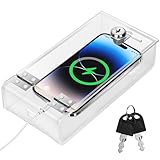
- Personal Item Lock Box: This phone storage box comes with 2 keys, keeping your mobile device secure and safe inside.
- Phone Storage Box: Put your phone in this lock box to help refocus your attention. Let your phone be a tool, not your master.
- Transparent Phone Box: The clear design lets you easily see what’s inside, confirming your items are there.
- Phone Lock Box: Use this box to make your phone a tool again, not the center of your life.
- Locking Phone Case: Lock your phone up to step away from it, freeing up your focus for real life.
3. Remove interruptions at the source
- Disable nonessential notifications and vibration.
- Remove tempting social apps from the home screen.
- Use Focus or Do Not Disturb with carefully configured emergency exceptions.
- Keep the device physically out of reach during high-value conversations.
- Charge phones outside the bedroom or eating area when practical.
4. Add friction instead of relying on willpower
A 2023 JMIR evaluation of 13 phone-reduction apps found self-tracking and goal setting were common, while shared focus and accountability features were less common. Tools such as Forest, Offtime, Flipd and Space use timers, blocking or gamification; they are aids, not relationship treatments. Read the app evaluation.
5. Replace the habit
Use a walk, cooking, a game, a hobby, conversation cards or a “best part of the day” question. A replacement makes a rule easier to repeat than a prohibition alone.
Outdated Drivers Are Slowing You Down
One free scan finds every outdated or missing driver and matches the right update for your exact hardware.Free scan · exact hardware matchPC Slower Than It Used to Be?
A free scan shows the junk files, broken settings and background clutter dragging Windows down - then fixes them in one click.Free scan · Windows 10 & 116. Repair quickly
- Notice the interruption.
- Put the phone down.
- Say, “Sorry—I stopped listening.”
- Ask the person to repeat the last point.
- Handle the phone issue or explain why it can wait.
- Return full attention.
Fast, sincere repair often matters more than achieving perfect abstinence.
Built-in controls and optional apps
| Option | Useful for | Limits and cautions |
|---|---|---|
| Apple Screen Time | App limits, downtime, reports and family controls without another installation. | Limits can be overridden and it manages devices rather than relationship norms. Apple previewed redesigned Screen Time features for iOS 27 and related systems in fall 2026; availability and details may vary. Apple’s announcement |
| Google Digital Wellbeing | Usage reports, app timers, notification controls, wind-down and focus settings on supported Android devices. | Labels and features vary by manufacturer, Android version and model. |
| one sec | A pause before opening selected apps for people who check automatically. | Vendor reports a 57% average reduction in app use in its own research; this is not an independent universal result. The company lists regional pricing that differs by platform and says intervention logic runs locally. Verify price, privacy and emergency behavior before purchase. Research · FAQ · U.S. App Store |
| Forest | Visual timers, gamified focus sessions and shared sessions. | Free download with in-app purchases; current price varies by storefront. It may not suit nuanced emergency exceptions or people who dislike gamification. U.S. App Store |
No paid app has been shown here to outperform built-in controls. Choose a tool only if it fits the person’s device, privacy needs, accessibility requirements and agreed household rule.
Common mistakes to avoid
- Using total screen time as a direct measure of relationship harm.
- Calling correlational findings proof that phones cause breakups or depression.
- Blaming children while excusing adults.
- Making rules without defining urgent exceptions.
- Assuming face-down phones eliminate divided attention.
- Installing blockers that interfere with navigation, accessibility, work or emergency contacts.
- Ignoring loneliness, boredom, conflict or poor communication that may drive checking.
- Treating a weekend “detox” as a lasting solution without a maintenance plan.
The useful bottom line
Smartphones disconnect people when they repeatedly convert shared attention into divided attention—especially when the person in front of us is left feeling unimportant. The goal is not maximum abstinence. Set a few shared, protected moments; reduce avoidable interruptions; preserve legitimate access; and repair quickly when attention slips. Let the importance of the relationship and the moment determine whether the phone belongs in the conversation.
Quick Recap
Product prices and availability are accurate as of the date/time indicated and are subject to change. Any price and availability information displayed on Amazon at the time of purchase will apply.



