Recommended Free Tools
The QNAP TS-233 is a compact 2-bay NAS aimed at home users who want shared storage, automatic backups, private cloud access, and light media features without stepping into business-class pricing. It sits in an accessible part of QNAP’s lineup, but still runs the full QTS operating system, which gives it far more flexibility than a simple external drive or basic network backup box.
This review looks at how the TS-233 feels in daily use, from its physical design and setup process to file sharing, RAID options, apps, media handling, noise, and power consumption. The main question is whether this affordable ARM-based NAS offers enough performance and features for a modern home, or whether buyers should spend more on a stronger 2-bay model.
As an Amazon Associate I earn from qualifying purchases.
Design, Build Quality, and Hardware Specifications
The QNAP TS-233 is clearly designed for a shelf, desk corner, or home office rather than a rack or utility closet. Its white plastic chassis has a clean, rounded look that feels more consumer-friendly than businesslike, and it is compact enough to sit beside a router without dominating the space. The front panel keeps things simple with status LEDs, a power button, and a USB port for quick external-drive access, while the rear houses the fan, Gigabit Ethernet port, additional USB connectivity, and power input.
What’s actually slowing this PC down?
Pick the symptom - the matching free tool is one click away.
Build quality is good for an entry-level 2-bay NAS, though it is not a tool-less metal enclosure. The outer shell feels sturdy enough for normal home use, but the drive installation process reminds you this is a budget-focused model. Instead of hot-swap trays, the TS-233 uses internal drive bays accessed by removing the cover. You mount 3.5-inch drives with the included hardware, and 2.5-inch SATA SSDs or hard drives are also supported with screws. For a home NAS that will likely be configured once and left alone, this is acceptable, but users who swap drives frequently may prefer a model with front-access trays.
#1 Best Overall
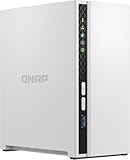
- ARM Cortex-A55 quad-core 2.0GHz processor with 2 GB DDR4 RAM
- Budget-friendly Home NAS for file storage and multimedia streaming
- Centrally store and organize personal or family photos, music, and videos
- Mitigate the threat of ransomware with QNAP's storage snapshot technology
- Effortlessly backup your Windows Computers with QNAP’s NetBak Replicator software and Mac computers with Time Machine
Core hardware specifications
| Component | QNAP TS-233 Specification |
|---|---|
| Drive bays | 2 x SATA 3.5-inch or 2.5-inch drives |
| Processor | ARM Cortex-A55 quad-core 2.0 GHz |
| Memory | 2 GB DDR4, non-upgradeable |
| Networking | 1 x 1GbE LAN port |
| USB | USB ports for external drives, UPS, and accessories |
| Cooling | Rear system fan |
The hardware platform is modest but well matched to the TS-233’s intended role. The ARM-based quad-core processor is suited to file sharing, backups, photo indexing, lightweight media serving, and running a handful of QNAP apps. The included 2 GB of DDR4 memory is enough for basic QTS use, but it cannot be upgraded, so this is not the right NAS for heavier multitasking, mulle containerized services, or demanding surveillance workloads. The single Gigabit Ethernet port also defines the performance ceiling: this NAS is built for typical home network speeds, not multi-gig transfers.
Connectivity is practical rather than expansive. The front USB port is useful for copying files from an external drive, while the rear USB ports can be used for backup drives or supported peripherals. There is no HDMI output, no M.2 slot for SSD caching, and no PCIe expansion, which keeps the TS-233 firmly in the entry-level category. That said, the simplicity works in its favor for first-time NAS buyers. There are fewer decisions to make, fewer upgrade paths to worry about, and less temptation to overspend on features that many households will not use.
Overall, the TS-233’s design and hardware reflect a clear focus: quiet, low-power network storage for homes and small personal workspaces. It is not built like QNAP’s higher-end Intel or multi-gig models, but it does not need to be. As a two-drive appliance for centralizing files, protecting family photos, and replacing a patchwork of USB drives and cloud folders, the physical design and component choices are sensible for the price class.
Setup Experience and QTS Software Overview
Setting up the QNAP TS-233 is approachable, even if you have not owned a NAS before. After installing one or two 3.5-inch or 2.5-inch drives in the bays, the process is mostly handled through QNAP’s browser-based setup wizard. On a home network, the NAS can be found using Qfinder Pro on a desktop computer or by visiting QNAP’s cloud setup page with the Cloud Key printed on the unit. In testing, discovery was straightforward, and the initial wizard guided through naming the NAS, creating an administrator account, setting the time zone, configuring networking, and initializing the installed disks.
The first-time setup takes longer than simply plugging in an external drive, but the steps are clearly structured. QNAP prompts you to install the latest QTS firmware early in the process, which is worth doing before loading the NAS with data. Once the system is initialized, you land in the QTS web interface, which behaves much like a lightweight desktop operating system inside the browser. There are icons, windows, menus, notifications, and a control panel, so users familiar with Windows or macOS should understand the basic layout quickly.
QTS on the TS-233 is powerful for an entry-level 2-bay NAS, but it can feel busy at first. The Control Panel houses core settings such as users, shared folders, network services, permissions, security, firmware updates, and external device options. Storage & Snapshots is where disks, storage pools, volumes, RAID mode, and snapshot settings are managed. File Station provides browser-based file access, while App Center is used to add QNAP and third-party apps for backup, media, photos, cloud sync, surveillance, and productivity.
Initial setup steps
- Install drives: Fit one or two compatible SATA drives, then connect Ethernet and power.
- Find the NAS: Use Qfinder Pro or QNAP’s web setup page to detect the TS-233 on the network.
- Create the admin account: Choose a strong password and avoid using obvious usernames.
- Update QTS: Apply the latest firmware before creating shares and copying important files.
- Configure storage: Select single disk, JBOD, or RAID 1 depending on the number of drives and protection needs.
- Create shared folders: Set up folders for documents, photos, media, backups, or family users.
For home users, the most valuable part of QTS is how much can be done from one interface. You can create individual accounts for family members, assign folder permissions, enable SMB file sharing for Windows and macOS, set up Time Machine support, install photo management tools, and configure remote access. QNAP’s myQNAPcloud service can make the NAS accessible from outside the home, although remote access should be configured carefully with strong passwords, two-factor authentication where available, and only the services you actually need exposed.
The TS-233 uses an ARM-based processor and modest memory, so the QTS experience is best when kept focused. Basic administration, file sharing, backup tasks, and lightweight media apps run well, but this is not the model to buy if you plan to run many apps at once, host mulle containers, or perform heavy database and virtualization workloads. App Center contains a large catalog, but restraint helps the system remain responsive. For a first NAS, QTS offers more depth than many users will need on day one, yet it leaves room to grow as backup, photo, and private cloud needs become more advanced.
Storage Configuration, RAID Options, and Expansion Limits
The QNAP TS-233 is a straightforward 2-bay NAS, so its storage configuration choices are easy to understand but also inherently limited. It accepts two 3.5-inch SATA hard drives, and it can also use 2.5-inch SATA SSDs with suitable mounting hardware. For most home users, the most sensible setup is a pair of NAS-rated hard drives from the same capacity class, such as 4TB, 6TB, or 8TB models, depending on budget and how much photo, video, document, and backup storage is needed.
During setup, QTS guides you through creating a storage pool and volume. The interface is clear enough for first-time NAS owners, with options for checking disk health, setting up alerts, and choosing how the two drives should be used. The TS-233 supports the expected configurations for a 2-bay system: single disk, JBOD, RAID 0, and RAID 1. Single disk mode is useful only if you are starting with one drive and plan to add another later. JBOD combines drives without redundancy, while RAID 0 stripes data across both disks for maximum capacity and better sequential throughput, but neither option protects you if a drive fails.
For this model, RAID 1 is the best default choice. It mirrors the same data to both drives, so if one disk fails, the NAS can keep running while you replace the bad drive and rebuild the array. The trade-off is capacity: two 8TB drives in RAID 1 give you around 8TB of usable raw capacity before formatting and system overhead, not 16TB. That may feel inefficient, but it is the right compromise for a home NAS storing family photos, personal files, and PC backups. RAID is not a backup, however, since accidental deletion, ransomware, file corruption, or theft can still affect the data on the NAS.
Quick wins for a faster PC:
Fix the driver behind crashes, sound loss and screen glitchesFind Drivers →Clear out junk files and repair common Windows errorsFree Scan →Scan for outdated or missing drivers - takes under a minuteDriver Scan →| Configuration | Usable Capacity | Drive Failure Protection | Best Use |
|---|---|---|---|
| Single Disk | One drive only | No | Basic starter setup |
| JBOD | Combined drive capacity | No | Maximum simple storage |
| RAID 0 | Combined drive capacity | No | Speed-focused temporary storage |
| RAID 1 | Capacity of one drive | Yes | Home file storage and backups |
The biggest limitation is expansion. The TS-233 has only two internal bays, no PCIe slot, and no dedicated high-speed expansion path for adding a large disk shelf. USB ports can be used for external drives, which is useful for backup rotation or occasional extra storage, but USB storage is not a substitute for expanding the internal RAID volume in the same way a larger multi-bay NAS can. There are also no M.2 slots for SSD caching, and with a 1GbE network port, the system is not designed for high-end storage performance or multi-user creative workflows.
In practical terms, buyers should choose drive sizes carefully from the beginning. If you expect your media library, phone photo backups, and computer images to grow quickly, buying larger drives upfront is usually better than starting small and replacing both disks a year later. The TS-233 is at its best as a compact mirrored storage box for a household, not as a platform for major future expansion. As long as that expectation is clear, its storage options are simple, reliable, and well matched to the entry-level role of the device.
Rank #2

- Minimalist design
- 64-bit Cortex-A55 quad-core 2.0 GHz CPU
- 64-bit Cortex-A55 quad-core 2.0 GHz CPU
- Protect your data from ransomware threats with Snapshots
- QNAP TS-233, 2GB Memory, 1x Gb LAN
File Sharing, Backup, and Sync Features
The TS-233 covers the core file-sharing jobs most home users expect from a 2-bay NAS. Shared folders can be created from QTS with user accounts, groups, and permissions, so it is easy to separate personal folders, family media, work documents, and device backups. SMB is the main protocol for Windows and macOS file access, while AFP, NFS, FTP, and WebDAV are also available for users who need broader compatibility. In day-to-day use, mapping a network drive from a Windows PC or connecting through Finder on a Mac feels straightforward once the shared folders and credentials are set up.
QNAP’s File Station is useful when you want browser-based access without opening a desktop file manager. It allows uploads, downloads, folder creation, file previews, compression, extraction, and link sharing. Share links can be password-protected and set to expire, which is handy for sending a photo album or document folder to someone outside the home. Remote access can be configured through myQNAPcloud, although users who care about security should be selective with exposed services, use strong passwords, enable two-factor authentication, and keep QTS updated.
Do these 3 things before closing this tab:
1Fix the driver behind crashes, sound loss and screen glitches2Repair Windows errors before they cause bigger problems3Scan for outdated or missing drivers - takes under a minuteBackup options
For a home NAS, the TS-233 is stronger as a centralized backup target than as a heavy-duty business backup server. Windows users can back up to shared folders using File History or third-party imaging tools, while Mac users can configure Time Machine support through QTS. External USB drives are also supported, making it possible to copy data to or from a portable drive without relying on a PC. The front USB port is convenient for quick transfers, although QTS configuration determines exactly how those jobs behave.
- PC and Mac backups: Use SMB shares for Windows backup tools and Time Machine-compatible folders for macOS.
- External drive backup: Copy folders between the NAS and USB storage for an offline layer of protection.
- Cloud backup: Use QNAP apps to connect supported cloud services and create scheduled backup or sync jobs.
- NAS-to-NAS jobs: Back up to another QNAP or compatible rsync target if you have a second device.
Hybrid Backup Sync is the main app for backup, restore, and synchronization tasks. It supports scheduled jobs, one-way backup, two-way sync, versioning on supported targets, filtering by file type, and bandwidth controls. This is one of the TS-233’s more practical strengths: once configured, it can quietly copy folders to cloud storage or another storage device on a schedule. The ARM-based processor is not built for large enterprise workloads, but for family documents, phone photos, scanned paperwork, and small media libraries, the backup tools are more than sufficient.
Sync and private cloud use
Qsync turns the TS-233 into a Dropbox-like private sync device. Folders can be synchronized between laptops, desktops, and the NAS, with mobile access available through QNAP’s apps. This works well for keeping a household document folder consistent across mulle computers or making sure a laptop has a local copy of active files. It is not as seamless as the biggest commercial cloud services, and remote performance depends heavily on upload speed, router configuration, and QNAP’s remote access settings, but it adds real value if you want local ownership of your data.
The main limitation is that backup strategy still matters. RAID 1 protects against a single drive failure, but it does not protect against accidental deletion, ransomware, theft, fire, or a bad sync job propagating corrupted files. The TS-233 is best used as one layer in a broader plan: local NAS storage for convenience, an external USB copy for offline recovery, and a cloud or off-site backup for irreplaceable data. For an entry-level 2-bay system, that combination makes the TS-233 a capable and approachable hub for file sharing, backup, and home synchronization.
Free tools Windows power users keep installed
One-click scans. No signup required.
Media Streaming, Photos, and Home Cloud Use
The QNAP TS-233 works well as a simple home media hub, especially if your expectations match its entry-level hardware. With two drive bays, quiet operation, and QTS apps for video, music, and photo management, it can replace a USB hard drive attached to a router or a stack of external drives shared around the house. For families that mainly want one place for phone photos, downloaded videos, music libraries, and documents, the TS-233 is easy to live with once the folders and user permissions are set up.
For video playback, the TS-233 is best suited to direct streaming rather than heavy transcoding. If your smart TV, Apple TV, Nvidia Shield, Fire TV, tablet, or media player can play the file format directly, the NAS simply serves the file over the network and does not have to work very hard. In that scenario, 1080p playback is smooth, and even high-bitrate local files can work well over a stable wired Gigabit connection. Problems are more likely if you expect the NAS to convert unsupported video formats on the fly, reduce 4K files for remote viewing, or handle several demanding streams at once. Its ARM-based processor is efficient, but it is not designed to behave like a powerful Plex transcoding server.
QNAP’s own media apps cover the basics. Video Station, Music Station, and DLNA media server features make it possible to browse and play content on compatible devices around the home. Plex can also be installed, but it should be treated as a direct-play library server on this model. If your collection is mostly H.264 MP4 files and your playback devices support them natively, the experience is straightforward. If your library contains mixed codecs, subtitles that require burning in, large 4K remuxes, or older formats that need conversion, a more powerful NAS or a separate media player will be a better fit.
Photos are one of the stronger everyday uses for the TS-233. QuMagie provides a central photo library with timeline browsing, albums, sharing options, and AI-assisted organization features. The built-in NPU helps with image recognition tasks, which is useful on a low-power NAS because it avoids relying entirely on the main CPU. Automatic uploads from phones can turn the NAS into a private alternative to cloud photo storage, keeping full-resolution images at home while still making them accessible from QNAP mobile apps. Initial indexing can take time with a large library, but day-to-day browsing is generally responsive once processing has settled.
Outdated Drivers Are Slowing You Down
One free scan finds every outdated or missing driver and matches the right update for your exact hardware.Free scan · exact hardware matchWindows Errors? Fix Them Before They Spread
Repair common Windows errors and clear accumulated junk for a smoother, more stable PC - no reinstall needed.Free scan · no reinstall- Best fit: phone photo backups, family albums, music libraries, 1080p video, and direct-play media streaming.
- Less ideal: real-time 4K transcoding, multiple Plex users with mixed formats, and large creative media workflows.
- Useful apps: QuMagie for photos, Qfile for mobile file access, Qmusic for audio, and DLNA services for TVs and players.
As a home cloud device, the TS-233 is practical but should be configured carefully. QNAP’s remote access options make it possible to reach files, photos, and shared folders away from home, but exposing any NAS to the internet requires regular firmware updates, strong passwords, two-factor authentication, and selective service access. For many users, VPN-based access or carefully managed QNAP remote services will be safer than opening ports broadly on the router. Used this way, the TS-233 becomes a convenient private cloud for a household: it can collect phone uploads, serve media to the living room, share folders with family members, and keep personal files under your control without monthly storage fees.
Independent reader supportYour contribution helps us test, update, and keep practical guides available for everyone.Performance, Noise, Power Consumption, and Real-World Use
The QNAP TS-233 performs like a capable entry-level NAS rather than a miniature server, which is exactly how it should be judged. Its ARM-based quad-core processor and 2GB of non-upgradable memory are well matched to basic home storage, file sharing, backups, photo management, and light media serving. Over a standard 1GbE network, sequential file transfers are usually limited more by the network connection than by the NAS itself. With decent hard drives installed, large file copies can approach the practical ceiling of Gigabit Ethernet, making it fast enough for moving photos, documents, music libraries, phone backups, and occasional video files around a home network.
Real-world responsiveness depends heavily on what the TS-233 is doing in the background. During simple SMB file transfers, Time Machine-style backups, or DLNA media access, the system feels smooth and predictable. QTS remains usable through the web interface, although apps can take a few seconds to open. Heavier tasks such as photo indexing, thumbnail generation, antivirus scans, or cloud sync jobs can make the interface feel slower, especially if they are running while large files are being copied. This is not a NAS built for virtual machines, heavy Docker use, multi-user editing workflows, or Plex hardware transcoding.
Rank #3

- ARM Cortex-A55 quad-core 2.0GHz processor with 4 GB DDR4 RAM
- Built-in NPU for AI Acceleration to boost performance for high-speed face and object recognition.
- 2.5GbE (2.5G/1G/100M) ports accelerates file sharing across teams and devices or streamline large file transfers
- Budget-friendly Home NAS for file storage and multimedia streaming
- Centrally store and organize personal or family photos, music, and videos
Everyday performance observations
- File copies: well suited to saturating a 1GbE connection with large sequential transfers, depending on drive choice and RAID configuration.
- Small files: acceptable for documents and photo folders, though not as snappy as higher-end Intel or AMD-based NAS models.
- Backups: reliable for scheduled PC, Mac, and mobile backups, especially when tasks are staggered outside peak usage times.
- Media access: good for direct playback to smart TVs, tablets, and streaming boxes when the client supports the original file format.
- Background indexing: can temporarily reduce responsiveness after importing large photo or video libraries.
Noise levels are one of the TS-233’s strengths in a home setting. The enclosure uses a single rear cooling fan, and with quiet NAS-grade hard drives it is unobtrusive enough for an office, bedroom corner, or living room cabinet with ventilation. Most audible noise comes from the drives rather than the fan, especially during random access or backup jobs. Using 5400 RPM or quieter 7200 RPM drives helps keep the system pleasant. As with any two-bay NAS, placing it on a solid surface away from resonant furniture can reduce vibration and low-frequency hum.
Power consumption is modest, which suits a device intended to stay on around the clock. Exact figures vary by hard drive model, RAID mode, connected USB devices, and workload, but the TS-233 typically sits in the low-power range expected from an ARM-based 2-bay NAS. Drive standby can reduce usage when the unit is idle, though frequent sync tasks, media indexing, and client access may prevent the disks from sleeping consistently. For most homes, the running cost should be far lower than leaving an old desktop PC powered on as a file server.
In day-to-day use, the TS-233 is best treated as a dependable household storage hub. It handles shared folders for family members, centralizes phone photos, keeps backups organized, and serves media files without demanding much attention. Its limits appear when mulle demanding services run at once or when users expect workstation-class application performance. For a first NAS, those compromises are reasonable: the TS-233 prioritizes simplicity, low noise, low power draw, and steady network storage performance over expandability and raw processing power.
Price, Competition, and Buying Verdict
The QNAP TS-233 sits in the budget end of the 2-bay NAS market, but it is not a bare-minimum box. Its value depends heavily on the price of the enclosure at the time you buy it, because hard drives are not included and can quickly become the larger part of the total cost. With two 4TB or 8TB NAS-rated drives, the real-world spend moves from “cheap home server” territory into a more deliberate home data investment. For buyers who want central file storage, phone photo backup, basic media serving, and a private cloud without jumping to a more expensive Intel-based model, the TS-233 is priced sensibly.
The main competition comes from Synology’s entry-level 2-bay models, especially the DiskStation DS223j and similar Realtek ARM-based units, along with older discounted QNAP models and low-cost DIY mini-PC setups. Synology has the more polished software ecosystem for beginners, particularly if you want a very guided interface and excellent first-party mobile apps. QNAP, however, gives the TS-233 a strong feature set through QTS, including flexible backup tools, container-related possibilities within its hardware limits, media apps, snapshots on supported volumes, and a broader feeling of control for users who like to tune settings.
Against cheaper single-bay NAS units, the TS-233 is the better long-term choice for most households because it supports RAID 1 mirroring. RAID 1 is not a substitute for backup, but it does protect against one drive failing and taking the NAS offline immediately. Against more powerful 2-bay models such as the QNAP TS-262 or Synology DS224+, the TS-233 loses on processor performance, memory headroom, app responsiveness under heavier loads, Plex transcoding, virtual machines, and multi-user throughput. Those higher-end units are better if you expect to run lots of services, stream to several users, or keep the NAS for more demanding tasks over many years.
Who should buy the QNAP TS-233?
- Home users replacing USB drives: It is a major upgrade over scattered external drives for documents, family photos, videos, and shared folders.
- Phone photo backup users: It works well as a private alternative to paying for more cloud storage, especially for a household with several phones.
- Light media users: It is suitable for storing and serving videos to smart TVs, media boxes, and local devices when the files are already in a compatible format.
- Basic backup planners: It is a practical target for PC backups, Mac Time Machine jobs, external USB copies, and cloud sync workflows.
Who should skip it?
- Plex power users: If you need frequent transcoding, look at an Intel-based NAS instead.
- Small offices with many active users: The ARM processor and fixed memory are better suited to light concurrent access.
- Users expecting easy upgrades: There are only two drive bays, no memory upgrade path, and no high-speed networking expansion.
The buying verdict is straightforward: the QNAP TS-233 is a good entry-level 2-bay NAS when your expectations match its hardware. It is quiet, compact, affordable, and capable enough for file sharing, backups, photo management, and light home media use. It is not the model to buy for heavy apps, advanced virtualization, or serious Plex transcoding, but that is not its intended role. If the enclosure is priced below or close to its Synology rival and you are comfortable with QTS, it offers strong value for a first home NAS. If you want the smoothest beginner software experience, Synology may still appeal more; if you want more control and a broad feature set for the money, the TS-233 is easy to recommend.
Frequently Asked Questions
Is the QNAP TS-233 powerful enough for everyday home NAS use?
Yes, the TS-233 is well suited for file storage, PC and phone backups, photo organization, light media streaming, and basic private cloud use. Its ARM processor and 2GB of RAM are fine for typical home workloads, but it is not designed for heavy multitasking, large business databases, virtual machines, or demanding Plex transcoding.
Can the QNAP TS-233 run Plex or stream movies to a TV?
The TS-233 can store a Plex library and stream videos to devices that can play the file format directly. It is not a good choice if you need real-time 4K transcoding or frequent format conversion, because the hardware is entry-level and has limited media acceleration compared with more expensive NAS models.
The Tool Desk
Outbyte PC Repair FREERepair Windows errors before they cause bigger problemsFix Now →Outbyte Driver Updater FREEScan for outdated or missing drivers - takes under a minuteDriver Scan →What RAID setup should I use with two drives in the TS-233?
Most home users should choose RAID 1, which mirrors data across both drives so the NAS can keep running if one drive fails. RAID 0 gives more usable capacity but no drive-failure protection, while using the drives separately can be useful for simple storage pools or dedicated backup targets. RAID is not a replacement for backup, so files should still be copied to an external drive or cloud service.
Can I upgrade the RAM or add more drive bays later?
The TS-233 has 2GB of built-in memory and it is not designed for RAM upgrades. It also has only two internal drive bays, so capacity expansion mainly means replacing the installed drives with larger ones. If you expect to need more bays, faster networking, SSD caching, or heavier apps, a higher-end QNAP or Synology model may be a better long-term buy.
Is the QNAP TS-233 a good first NAS compared with Synology alternatives?
It is a strong first NAS if you want affordable 2-bay storage with QNAP’s QTS apps, backup tools, photo management, and broad file-sharing features. Synology models often feel simpler for beginners and have a very polished software ecosystem, while QNAP tends to offer flexible features for the price. The better choice depends on whether you value ease of use or app flexibility more.
Bottom Line
The QNAP TS-233 is a solid entry-level 2-bay NAS for home users who want centralized storage, simple backups, file syncing, and light media duties without spending too much. Its compact design, approachable setup, and capable QTS software make it a practical first NAS, especially for households moving beyond USB drives and scattered cloud accounts.
It is not the right choice for heavy Plex transcoding, demanding virtualization, or multi-user workloads, but it handles everyday storage and protection tasks well. If your priority is an affordable, easy-to-manage NAS for photos, documents, backups, and local media access, the TS-233 is a sensible place to start.
Quick Recap
Product prices and availability are accurate as of the date/time indicated and are subject to change. Any price and availability information displayed on Amazon at the time of purchase will apply.




