What’s actually slowing this PC down?
Pick the symptom - the matching free tool is one click away.
A networked media player plays digital media delivered from another device or service over a network. The source and player may communicate across a local home network; internet access is not what makes a device a networked media player.
What is a networked media player?
It is a device—or software-enabled device—that receives and plays digital media over a network rather than relying only on a disc or storage connected directly to it. The phrase is broad: it does not guarantee a particular connection method, file format, or media-sharing standard.
As an Amazon Associate I earn from qualifying purchases.
A typical setup has three parts: a media source or server that makes files available, a network connecting the devices, and a player or renderer that plays them. The source might be a computer or network-attached storage (NAS); the playback endpoint might be a TV or a separate streaming player. The devices can communicate over the same local network, so internet access is not inherently required for local playback.
How does a networked media player work?
In a common DLNA setup, the player discovers a media server on the network, browses the available content, and requests a stream. Microsoft describes streaming as transferring content from a sender to a receiver, and its DLNA documentation describes discovery, browsing a server’s content directory, and requesting playback: Microsoft’s DLNA protocol documentation.
#1 Best Overall

- 【Mini Portable Media player】-- Fits into the palm of your hand, It is a perfect travel partner for those short on space and sockets. Also compact and easy multifunction HD media player for office work and home entertainment;Aluminum alloy material, not easy to damage during carrying
- 【1080P MP4 Player】-- Full HD 1080p@60Hz supports most video decoding formats: RM, RMVB, AVI, DIVX, MKV, MOV, HD MOV, MP4, M4V, PMP, AVC, FLV, VOB, MPG, DAT, MPEG, TS, TP, M2TS, WMV, (H.264,H.263,WMV9/VC-1,MPEG1/2/4),Not support VPR files. Note: Please use our 4K player to play some videos taken with smart phones, ASIN: B07WPY8VKL
- 【HDMI or AV Output】-- Supports 1080p HDMI output, allowing you to transmit crisp, clear video and audio in a pure digital format to an HDTV; it also supports composite AV output for use with analog TVs. An analog AV cable is included. While using HDMI video output, you can also connect external speakers via the AV output. However, video cannot be output via both AV and HDMI at the same time.
- 【USB 2.0/3.0 Compability】-- Drive external USB 2.0/3.0 storage devices such as USB flash(up to 512G)/SD card(up to 128G) and hard drive(partition should be MBR, up to 8TB), you can also delete or copy files in the USB drive(FAT or FA32) directly, Also plays subtitle files as well as loop videos
- 【Support Multiple Formats of Files and Playback Modes&Multi-functional Remote Control】-- Supports most video, audio, and image formats on the market, supports random playback of video and image modes, and supports loop playback. Supports repeat, zoom, fast forward, fast rewind, rotation, breakpoint playback method, start from scratch playback method and time selection playback method. It is also equipped with a convenient remote control for easy navigation of menu screens (ASIN: B0C9PZPFL8)
DLNA uses distinct roles for the devices involved. These are protocol roles, not interchangeable names for every product marketed as a networked media player.
- Digital Media Server (DMS): Makes media available to other devices. In DLNA terms, it implements the UPnP MediaServer device type.
- Digital Media Player (DMP): Finds content on a server and provides playback. Microsoft’s glossary describes the DMP as a UPnP control point, rather than a UPnP device itself.
- Digital Media Renderer (DMR): Plays media when instructed by a controller. It implements the UPnP MediaRenderer device type.
- Digital Media Controller (DMC): Invokes actions to control playback—for example, asking a renderer to play a stream from a server.
Microsoft’s DLNA device-role glossary defines these terms. In everyday product descriptions, terminology can be less precise: a DLNA-compatible TV, for example, may be described as a media player because it plays content stored on another device.
Rank #2

- MAKE YOUR TV SMARTER - Enhance any TV with the ability to play videos, music, and photo slideshows from a USB drive or MicroSD Card! It’s so simple and intuitive - anyone can use it. The Micca 4K is amazingly compact and affordable, get one for each TV in the house!
- PLAYS 4K ULTRA-HD VIDEOS - Works with TVs old and new! Smoothly plays videos up to 4096x2304@30fps over UHD 4K/60Hz HDMI output. Sharp and clear video and audio in pure digital format, compatible with 4K and 1080p TVs, projectors, and monitor displays. Composite AV output for use with analog TVs or for sending sound to a stereo system.
- DUAL USB AND MICRO SD READER - Play media files from USB flash drives and USB hard drives up to 8TB, or microSD cards up to 1TB. Supports FAT/FAT32, exFAT and NTFS file systems. Compatible with wireless air mouse remotes for non-line-of-sight control so that the player can be hidden away!
- SIMPLE DIGITAL SIGNAGE - Automatic video playback with endless repeat and looping, and the ability to resume from the last stopping point. Configurable 90/180/270 degree video output rotation. Great for digital signage applications such as restaurant menu boards, lobby welcome videos, art and museum installations.
- MEDIA FORMAT SUPPORT - Videos: MKV, MP4/M4V, AVI, MOV, MPG, VOB, M2TS, TS files encoded with H.265/HEVC, H.264/AVC, MPEG1/2/4, VC1, up to 4096x2304, 30fps, 200mbps. Subtitles: SRT, PGS, IDX+SUB. Music: MP3, WAV, FLAC. Photos: JPG, GIF, BMP, PNG
Is a networked media player the same as a DLNA player?
No. “Networked media player” is a broad category; DLNA is one set of roles and standards that devices may support. A product’s category name alone does not establish that it works with DLNA, a particular server, or a particular media format. Check the exact model’s supported protocols, server sources, and file formats.
Compatibility can also depend on the specific use case. Roku, for instance, documents local DLNA-server playback through Roku Media Player on supported Roku devices. Roku says the server and player must be on the same network, and notes that support depends on the device and file format: Roku’s guidance for playing media from a local network. Its list of tested server software includes Windows Media Player/Center, Serviio, Plex, Twonky, MiniDLNA/ReadyDLNA/ReadyMedia, PlayOn, and Synology DSM 6.2.1. That is Roku-specific guidance, not a guarantee that every device using those servers will work with every player.
Rank #3
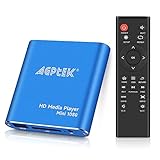
- 【Mini Portable Media player】-- Fits into the palm of your hand, It is a perfect travel partner for those short on space and sockets. Also compact and easy multifunction HD media player for office work and home entertainment;Made of aluminum alloy, it has better protection during carrying
- 【1080P MP4 Player】-- Full HD 1080p supports most video decoding formats: RM, RMVB, AVI, DIVX, MKV, MOV, HD MOV, MP4, M4V, PMP, AVC, FLV, VOB, MPG, DAT, MPEG, TS, TP, M2TS, WMV, (H.264,H.263,WMV9/VC-1,MPEG1/2/4),Not support VPR files. Note: Please use our 4K player to play some videos taken with smart phones, ASIN: B07WPY8VKL
- 【HDMI or AV Output】-- Supports 1080p HDMI output, allowing you to transmit crisp, clear video and audio in a pure digital format to an HDTV; it also supports composite AV output for use with analog TVs. An analog AV cable is included. While using HDMI video output, you can also connect external speakers via the AV output. However, video cannot be output via both AV and HDMI at the same time.
- 【USB 2.0/3.0 Compability】-- Drive external USB 2.0/3.0 storage devices such as SD card(up to 128G)/USB flash(up to 512G) and hard drive(partition should be MBR, up to 8TB), you can also delete or copy files in the USB drive(FAT or FA32) directly, Also plays subtitle files as well as loop videos
- 【Support Multiple Formats of Files and Playback Modes&Multi-functional Remote Control】-- Supports most video, audio, and image formats on the market, supports random playback of video and image modes, and supports loop playback. Supports repeat, zoom, fast forward, fast rewind, rotation, breakpoint playback method, start from scratch playback method and time selection playback method. It is also equipped with a convenient remote control for easy navigation of menu screens (ASIN: B0C9PZPFL8)
What equipment do you need to play media over a network?
You need a source that shares the media, a compatible player, and a network connection between them. A NAS is optional: it can store files and act as a media server, but a computer or another compatible device may serve that role instead.
| Equipment | Typical role | What to check |
|---|---|---|
| TV with built-in network playback | Player or renderer, depending on implementation | Supported protocols, file formats, server sources, and Wi-Fi or wired-network options. |
| Separate streaming player | Adds playback capability to a display | Whether the exact model supports local-network playback, the intended source, required formats, and available network connections. |
| Computer or NAS | Usually a media source or server | Whether it has compatible server software, sufficient storage for your files, and is available on the network when you want to play them. |
Some routers and NAS devices have a built-in DLNA server, according to Roku Support. A built-in server can remove the need to install separate server software, but it does not remove the need to check playback compatibility.
Rank #4
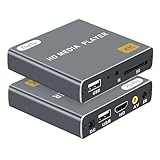
- 【UPGRADED 4K@30Hz H.265 HEVC Decoding】Equipped with advanced H.265/HEVC decoding technology, this 4K media player delivers sharper ultra-HD images and much smoother playback than conventional H.264 and 1080P players. It effectively reduces frame stuttering, blurriness and lagging visuals, bringing you fluent and immersive viewing experience for both commercial signage and home theater use.
- 【Versatile HDMI RCA Output & Multi-Media Playback】Featuring standard HDMI output, the player can be easily connected to TVs, monitors, projectors and more display devices. 4K media player supports direct playback of local videos, background music, photo slideshows and business presentations via USB drives or SD cards, meeting your daily entertainment and office demonstration needs.
- 【Large Storage Support & Broad System Compatibility】Digital media player supports USB hard drives up to 8TB and SD cards up to 1TB, and is fully compatible with mainstream file systems including FAT32, exFAT and NTFS. Supported formats include: H.265/HEVC (MKV, MOV, AVI), MPEG, FLV, RM, 3GP, MP4, WMV, RMVB, DAT, MPG, TS, M2TS, JPG, JPEG, BMP, GIF, PNG, MP3, OGG, FLAC, APE, AAC, WMA, etc.
- 【Smart Custom Playback Modes & Screen Orientation】Packed with practical playback functions: auto-play on power-up, resume playback from last stopped point, repeat/loop playback, sequential photo/video display and random music playback. It supports both horizontal and vertical screen display, perfectly fitting customized advertising broadcast and daily playback demands.
- 【Wide Application Scenarios】Built with high-quality zinc alloy shell, this compact and portable HDMI media player features outstanding heat dissipation, wear resistance and stable long-term operation. It is ideal for home theater, office presentations, restaurant digital signage, lobby welcome screens, art galleries and museum exhibition installations.
How do you check whether your devices will work together?
- Identify the exact playback device and model. Confirm that it supports network playback and, if needed, the relevant DLNA role or protocol. A general description such as “smart TV” is not enough to establish local-server support.
- Check the source or server. Verify that your computer, NAS, or other source can share media using a protocol the player accepts. For DLNA playback, the source needs DLNA server software or a built-in DLNA server.
- Check the media formats. Confirm that the player supports the video, audio, or photo formats in your library. Network discovery can work even when a particular file cannot be played.
- Confirm the network requirement for your use case. Some documented local-playback setups require the server and player to be on the same network. Do not assume that internet access is needed—or that every product has the same local-network requirements.
As one product-specific example, Philips says its listed TV models and a PC or Mac should be connected to the same home network for DLNA playback. That instruction applies to the models covered by its page, not to every networked player.
What the term does not tell you
- It does not guarantee DLNA, UPnP, or compatibility with any particular server.
- It does not guarantee that the player can decode every video, audio, or photo format on the network.
- It does not mean that media must come from the internet; a local computer or NAS can be the source.
- It does not reveal whether a product acts as a DMP, DMR, or both. That depends on its implementation.
Microsoft’s Digital Media Player protocol page was last updated on April 23, 2024: Microsoft DLNA protocol documentation. Its separate API enumeration page is marked legacy and says that API has been superseded by Media Casting; that notice concerns the API and should not be read as a statement that DLNA devices generally are unavailable: Microsoft’s legacy API reference.
Quick Recap
Product prices and availability are accurate as of the date/time indicated and are subject to change. Any price and availability information displayed on Amazon at the time of purchase will apply.




