The Tool Desk
Outbyte Driver Updater FREEFix the driver behind crashes, sound loss and screen glitchesFind Drivers →Outbyte PC Repair FREERepair Windows errors before they cause bigger problemsFix Now →A neural network transforms inputs into outputs by passing signals through connected mathematical units. Each unit combines inputs with learned weights, adds a bias, and applies an activation function; during training, an optimization process adjusts the weights and biases so the network can better perform its task. The design borrows a loose analogy from biological information processing, but artificial neurons are simplified mathematical abstractions—not miniature brain cells.
What a neural network is—and what the brain analogy means
A neural network is a computational model made of connected units arranged to process information. The brain provides some of its motivating language: biological neurons receive signals through dendrites, integrate them in the cell body, and pass signals onward through an axon. Connections between biological cells, called synapses, vary in strength and can change.


As an Amazon Associate I earn from qualifying purchases.
That resemblance is useful for understanding the idea of connected inputs and adjustable connection strengths, but it should not be taken literally. University of Toronto CSC311 course notes describe the artificial neuron as “far simpler than a real one” and explain that the aim is “not biological accuracy, but for a clean mathematical abstraction that keeps only these important ideas.” In an artificial network, weights, biases, and functions summarize a computation; they do not reproduce the physical dynamics of a cell.
Biological signaling also involves excitation and inhibition, synaptic plasticity, and recurrent circuits. These are part of a more complex account of learning and memory, not evidence that brains learn by the machine-learning procedure called backpropagation.
#1 Best Overall

- ✅Powered by 26 Tera-Operations Per Second (TOPS) Hailo-8 AI Processor. 2.5W typical power consumption
- ✅Scalable, enabling simultaneous processing of multi-streams & multi-models
- ✅Enabling real-time, low latency and high-efficiency AI inferencing on the edge devices
- ✅Supports TensorFlow, TensorFlow Lite, ONNX, Keras, Pytorch frameworks
- ✅Supports Linux and Windows. Supports the temperature range of -40°C to 85°C
How an artificial neuron computes
For an input vector x, associated weights w, a bias b, an activation function f, and output y, a common expression is:
y = f(wᵀx + b)
In expanded form, the same operation is y = f(Σwᵢxᵢ + b). A one-input version, y = f(wx + b), makes the roles easier to see: multiply the input by its weight, add the bias, then apply the activation function.
Rank #2

- 12.3 MP Sony IMX500 Intelligent Vision Sensor with a powerful neural network accelerator
- Integrated low-power inference engine
- Integrated RP2040 for neural network and firmware management
- Pre-loaded with MobileNet machine vision model
- Sensor modes: 4056×3040 at 10fps, 2028×1520 at 30fps
- Inputs are data features or outputs from earlier units.
- Weights scale each input’s contribution. A positive or negative weight can raise or lower that contribution in the mathematical model.
- Bias is an adjustable offset added to the weighted sum, shifting the unit’s response.
- Activation function transforms the combined value into the unit’s output.
- Output is passed to later units or interpreted as part of the network’s result.
The activation matters because it can introduce nonlinearity. If a model stacks only linear transformations, the result is still equivalent to a linear transformation. Nonlinear activations let layered networks represent more complex relationships and decision boundaries.
How layers turn units into a network
Neural networks commonly organize computation into input, hidden, and output layers. The input layer receives the original data; hidden layers perform intermediate transformations; and the output layer produces a result suited to the task, such as a prediction or class score.
- Input layer: presents the initial features to the computation.
- Hidden layer or layers: transform signals using connected units and their parameters. The architecture determines how many there are and how units connect.
- Output layer: provides the final values. In a classification design, separate output units may represent different classes, with their activations used to select a class.
A network does not have to contain a hidden layer: descriptions of neural-network architectures allow zero, one, or several hidden layers. “Deep learning” commonly refers to networks with multiple hidden layers, though conventions about whether the input layer counts toward depth can differ. Connectivity and layer count are architectural choices, not fixed properties of every neural network.
How training changes weights and biases
In a standard supervised-learning setup, training uses examples with target values. A typical backpropagation training loop works as follows:
- Forward pass: Send an input through the network using its current weights, biases, and activation functions to produce a prediction.
- Calculate loss: A loss function scores how different the prediction is from the target.
- Backward pass: Backpropagation propagates information about the loss backward through the network to calculate how the parameters affect it.
- Update parameters: An optimizer uses that information to adjust weights and biases in an effort to reduce the loss. Gradient descent is a common introductory example.
- Repeat: The process runs across training data until the model performs sufficiently for the task.
Backpropagation and optimization are related but distinct: backpropagation calculates parameter-related loss information; the optimizer uses it to update parameters. This supervised loop is one common training approach, not a description of how every neural network must be trained. Not all networks use labeled examples or this exact algorithm.
What the components do together
The components form a chain of computation. Inputs enter a layer, weights determine how strongly each input contributes to each unit, biases shift the combined values, and activations produce outputs for the next layer. The output layer turns the accumulated transformations into values relevant to the task. During supervised training, the loss measures prediction error, and the training procedure uses that error information to adjust parameters for later predictions.
Best Value
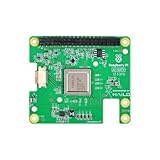
- 【Provide 13/26TOPS power】Two AI computing powers are available to provide Raspberry Pi 5 with better AI acceleration performance and unprecedented AI performance for edge devices.
- 【Build a model world】By supporting common frameworks such as TensorFlow and PyTorch, RaspberryPi AI HAT+ allows you to build a variety of AI-driven applications for process control, home automation, research, etc.
- 【Camera stacking】RaspberryPi AI HAT+ is fully integrated into the RPi's camera software stack, using the neural network accelerator to run post-processing tasks such as object detection, image segmentation, and pose estimation.
- 【Adaptability】Supports stacking installation with Pi 5, supports installation of active heat sinks, and supports installation of Yahboom's cool cooler pi. It is recommended to use with a heat sink to effectively avoid overheating problems caused by high-load computing. Ensure that the AI acceleration module is fully cooled to improve performance.
- 【Provide techn support】We provide a series of accessories for RaspberryPi 5 peripherals, and provide high-quality after-sales technical support services. If you encounter problems during use, please contact Yahboom or technical support for help.
For a particular application, architecture choices depend on the data and task, the desired output, layer organization and connectivity, interpretability needs, available computing resources, and training-data requirements. There is no universally best layer count or network design in the abstract.
Ways to explore the computation
OpenStax points learners to TensorFlow Playground, an interactive tool for changing choices such as hidden layers, neurons, learning rate, and activation functions and observing training behavior. For a fuller mathematical treatment, OpenStax names Michael Nielsen’s Neural Networks and Deep Learning (2019) as further reading; matrix operations, calculus, and numerical analysis underpin the detailed account.
Quick Recap
Product prices and availability are accurate as of the date/time indicated and are subject to change. Any price and availability information displayed on Amazon at the time of purchase will apply.
Recommended Free Tools




