In a 2011 research demonstration, a Cambridge-led team used inline infrared monitoring and software-controlled pumps to coordinate reagent additions during a multi-step segmented-flow process. The method was demonstrated in making pyrazoles, with the report describing yields as comparable to standard methods and methyl hydrazine use as lower—but giving no numerical comparison. Here, “natural products” refers to complex molecules as targets for chemical synthesis, not consumer products.
Why coordinating sequential reactions is difficult
A multi-step synthesis can require one reaction to produce an intermediate before another reagent is introduced. In a flow process, material moves through the system as streams, so the next addition must be coordinated with the intermediate’s arrival and concentration. The challenge highlighted in this work was how to combine several synthetic transformations efficiently in one process without treating reagent delivery as a fixed, disconnected step.


As an Amazon Associate I earn from qualifying purchases.
Segmented flow carries reaction material in distinct segments through the apparatus. When a later transformation depends on what the earlier step has produced, the process needs a way to detect that intermediate and adjust the next reagent addition accordingly.
How infrared monitoring and pump feedback work together
- Monitor the reaction stream: Inline infrared monitoring provides information about reaction intermediates as the process runs.
- Use the measurement to guide control: A LabVIEW software application uses intermediate-concentration information to control additional pumps in real time.
- Time and mix the next reagent: The pumps deliver reagent streams in response to the observed intermediate stream, coordinating the next transformation with material moving through the process.
The important feature is the feedback loop: reagent delivery responds to information measured during the process rather than relying only on a predetermined addition schedule. The Royal Society of Chemistry’s research record describes this approach as accurate reagent addition in multi-step segmented-flow processing.
#1 Best Overall
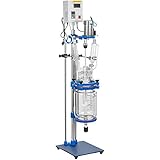
- Premium Material: Borosilicate glass (GG17 material) has excellent physical properties and chemical properties. The overall national standard stainless steel new frame structure, compact and sturdy.
- Precise Digital Screens: LCD makes temperature measurement easier and more convenient; temperature range: -60 °C-200 °C, resistant to strong acid and alkali, high-temperature resistance, high strength, high hardness。
- Variable Speed Motor: Lab reaction vessel adopts variable speed motor, which has long-running time, excellent stability, no noise, standard gear, no gap, wear-resistant
- PTFE Component Seal: The PTFE component seal is durable and air-tight, with an abrasive dust collection box. The PTFE discharge valve is designed with a large bottle of mouth, which is easy to clean and disassemble. Solid/liquid substances are easily released from the bottom.
- Widely Used: The 5 liter reaction vessel can be safely operated under a full vacuum. Jacketed glass reactor systems are ideal equipment for mixing, reaction, and distillation in the chemical and pharmaceutical industries.
What the pyrazole demonstration showed
A 2 March 2011 Chemistry World report says the method was used to make pyrazoles by coupling benzoyl chlorides and phenylacetylenes with methyl hydrazine. It describes the yields as comparable to those obtained with standard methods, while using less methyl hydrazine.
The report gives no numerical yield or reagent-use comparison. The result therefore supports a qualitative claim about that particular demonstration, not a percentage improvement or a general claim that flow synthesis always uses less reagent or gives equivalent yields.
What this result does—and does not—establish
- It establishes a control strategy: Inline measurements can inform software-controlled reagent delivery during sequential flow transformations.
- It provides a specific example: The reported application made pyrazoles and was described as using less methyl hydrazine with comparable yields to standard methods.
- It does not establish universal performance: The demonstration does not show that every complex natural product can be made this way, that flow processing is universally safer or cheaper than batch processing, or that commercial-scale performance has been demonstrated.
- It is a historical research report: The Chemical Science article was first published on 28 January 2011; the available evidence does not establish that the approach has since become standard practice.
Why the approach matters for complex-molecule synthesis
Complex targets can require several transformations, each dependent on the material produced by the previous one. The reported approach addresses a practical coordination problem: measuring an intermediate in the moving stream and using that information to trigger or regulate the next reagent feed. It is a step toward machine-assisted synthesis, but the cited demonstration should be read as a method-development result rather than proof of a general-purpose synthesis platform.
Quick wins for a faster PC:
Repair Windows errors before they cause bigger problemsFix Now →Scan for outdated or missing drivers - takes under a minuteDriver Scan →Clear out junk files and repair common Windows errorsFree Scan →In the 2011 news report, team leader Steven V. Ley described the work as a solution to a difficult problem that could help develop a machine-assisted approach to assembling complex functional molecules. That ambition explains the relevance of the control method; it is not evidence that all such molecules can already be assembled automatically.
Quick Recap
Best Value
Product prices and availability are accurate as of the date/time indicated and are subject to change. Any price and availability information displayed on Amazon at the time of purchase will apply.




