A smart traffic system, in the sense that matters to agencies, is adaptive signal control: a network of signals that measures current demand, compares candidate timing strategies, applies the one that performs best against a chosen measure, and repeats that cycle. Configuring one is an engineering project run by a public agency, not a plug-and-play device setup.
The work follows a fixed logic. Define the problem, set measurable objectives, document requirements, match the architecture to existing detection and communications, set optimization constraints, calibrate and maintain the system, then validate it against the original objectives. Skip the early steps and the final validation has nothing to measure against.
As an Amazon Associate I earn from qualifying purchases.
Why don’t traffic lights adjust to actual conditions?
Conventional signals often run pre-programmed, time-of-day schedules. Between timing reviews, those plans stay the same whatever the traffic does. FHWA’s EDC-1 Adaptive Signal Control Technology page (last modified 2017) describes the practical result: “In the absence of complaints, months or years might pass before inefficient traffic signal timing settings are updated.” Adaptive control is meant to close that gap by letting the controller respond to what its detectors observe, rather than to demand assumptions made when the plan was written.
What the system does, and what it does not
Adaptive signal control runs a repeating loop:
- Detect. Sensors report current traffic demand.
- Evaluate. A model or algorithm compares alternative timing strategies.
- Implement. The strategy judged best against the selected operational measure is applied.
- Repeat. The loop runs again, at the cadence the chosen system is built for.
Each pass is only as good as its inputs and its measure, which is why the measure is a configuration decision rather than a default to accept. This guide covers signals on signalized roadway networks operated by a public agency. It does not cover consumer devices, app-based tools, or personal navigation products.
#1 Best Overall

- Traffic Signal Light-Two Traffic Signal Lights can attract childrens attention and simplify the teaching of traffic rules. As children grow up, the signal lights can be compatible with all other railway toys, so their railway games can also be used
- Traffic Model Toys- When using a round base, you can place 2 traffic lights on the table top and other smooth surfaces. The accessory for your play area! The present for birthdays, holidays and other present - giving occasions
- Improve Skills- Traffic Stop Lights can automatically change lights and imitate sounds, so they are very close to real traffic lights. Playing with trains can help children understand and understand their environment in a fun way. The train function can help improve childrens spatial awareness and fine motor skills
- Best present - You can play the Traffic Light Toy with your children to enhance parent- child relationship. It can be given to children as a birthday present , Christmas or other holiday present , can teach them traffic rules, and can also make them have fun
- Materials- Traffic Light Lamps are Made of materials, suitable for children to play. This traffic signal model is suitable for teaching children road signs
How the main approaches differ
FHWA identifies several adaptive approaches, including SCOOT, SCATS, RHODES, OPAC, and ACS Lite, and its EDC-1 page names InSync as a system example. The table reports only what FHWA’s material says about each one.
| System | What FHWA’s material says |
|---|---|
| SCOOT | Uses advance and stop-line detection. |
| SCATS | Uses real-time traffic flow data and split-plan selection. |
| RHODES | Named as an adaptive approach. Detection and optimization features not stated in FHWA’s material. |
| OPAC | Named as an adaptive approach. Detection and optimization features not stated in FHWA’s material. |
| ACS Lite | Named as an adaptive approach. Detection and optimization features not stated in FHWA’s material. |
| InSync | Named as a system example on the EDC-1 page. Features not stated in FHWA’s material. |
Treat these as examples of architecture, not a current comparison, an endorsement, or a complete market list. The more consequential difference is how each approach optimizes. Some evaluate a network solution on a short, continuous cadence; others optimize individual signals on a cycle basis. Those choices change the detection, communications, processing, operations, and maintenance a city has to support, so the architecture should fit the agency’s capacity rather than be assumed best in general.
Choosing an architecture: six comparison axes
Use these axes to compare any candidate system, including ones not named above.
| Axis | Question for your network | Why it matters |
|---|---|---|
| Optimization scope | Does the system need network-wide coordination, or intersection-level optimization? | Determines how much detection, communications, and processing you must support. |
| Operational measure | Are you minimizing delay, balancing delay and stops, or favoring progression on a main street? | Decides which movements win when corridor and side-street demand conflict. |
| Calibration effort | How much expert time will the model need, and who will supply it? | Some systems adjust internal parameters automatically; others depend on human judgment. |
| Communications and processing | What connectivity and processing capacity do the controllers and central system have? | Limits which architectures are practical at your sites. |
| Integration | Which existing controllers and central traffic signal systems must it work with? | Affects migration effort and the number of interfaces that must be tested. |
| Agency capacity | Who will operate, maintain, procure, and verify the system? | A system the agency cannot maintain will not keep the accuracy its decisions depend on. |
How important are detection systems?
Very. FHWA’s Adaptive Signal Control FAQs answers the question directly: “Effective detection systems are essential components of all adaptive systems.” Detection is the input to every decision the controller makes. Poorly maintained or inaccurate detection undermines those decisions however well the algorithm is designed.
Rank #2

- Accurate HO Scale Proportions – Designed to true 1:87 scale, ensuring it blends seamlessly with vehicles, buildings, and road layouts.
- Realistic Traffic Signal Design – Faithfully replicates real-world traffic lights with detailes
- Working LED Light System – Equipped with red, yellow, and green LEDs to simulate real traffic signal operation and improve scene realism.
- Paintable Surface – Customizable to match layout themes.
- Versatile Use – Great for dioramas, railways, or architectural models.
Detection requirements follow from the architecture you select, so confirm them during step 4 rather than assuming them. Plan for:
- Detector type, count, and placement on each approach, including the advance and stop-line positions some architectures depend on.
- Accuracy checks against known counts at commissioning, repeated on a maintenance schedule.
- Communications from the field to the controller and central system, with a defined response when a link fails.
- Processing capacity for the data volume the detectors produce.
The seven-step configuration sequence
The order matters because each step produces an input the next one needs.
1. Define the problem and operational context
Start by naming what varies and why current timings no longer fit. Adaptive control is most relevant where variability makes existing timing unsuitable: daily demand swings, changing land use, recurring queues, incidents, construction, and special events. If a corridor carries steady, predictable volumes, that finding should shape the project as much as any other.
Document the surrounding land use, user needs, the agency’s technical capability, and its maintenance capacity. These are not background details; they determine which architectures are realistic.
Rank #3
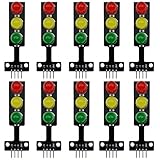
- 8mm * 3 LEDs Color: Red, Yellow, Green
- Voltage: DC 5V, Input: digital signal output
- Each color could be controlled individually, each LED lamp can only emit one color of light
- Easy to use, compatible with arduino: GND to GND, Red to the I/O interface Pin #2, Yellow to Pin #3, Green to Pin #4
- Suitable for the traffic light system model and school scientific research projects, compatible with Arduino, ESP32, ESP8266, Raspberry Pi, Micro:Bit
Illustrative example: an arterial that jams during school dismissal and stadium events but runs smoothly otherwise has variability that fixed plans cannot cover. School-day and event-day demand should be documented as separate conditions.
2. Set measurable objectives
Start from a goal, then write objectives that can be checked. FHWA names goals such as minimizing congestion, preventing or delaying oversaturation, accommodating long-term variability, and managing incidents and special events. Objectives that follow from those goals often address smooth flow, throughput, equitable access, and queue management.
FHWA’s Measures of Effectiveness and Validation Guidance for Adaptive Signal Control Technologies sets the standard: “To the greatest extent possible, objectives should be stated in a manner that is Specific, Measurable, Achievable, Realistic and Time-bound (SMART).”
| Weak objective | SMART rewrite (illustrative) |
|---|---|
| Improve traffic flow on the main street. | Reduce average eastbound travel time on the main street, weekdays 4:00 to 6:00 p.m., against a pre-project baseline, with the numeric target set from that baseline before go-live. |
| Reduce side-street queues. | Reduce the share of signal cycles in which side-street queues reach the upstream intersection during weekday peak periods, measured against the same baseline window. |
3. Document needs and requirements
Write a concept of operations (ConOps) describing how the system should work in your setting: who operates it, what it must do during incidents and events, and how staff intervene. Translate the ConOps into system requirements, then write a verification plan and a validation plan. FHWA’s Model Systems Engineering Documents for Central Traffic Signal Systems presents this sequence as part of procurement and implementation for central traffic signal systems (CTSS).
Rank #4

- Brand new and high quality.Perfect for Railway & Building Layout!Great accessories for diorama, buildings, train models.
- Prewired quality products.Lights include red and green leds.Each line corresponds to the color of the glowing colors, the green line is the green LED, the red line is the red LED.Black wire with positive, and the other two with negative.
- You must connect a resistor in series before you will use them on 12V or 16V, I will supply compatible resistors for free.
- Reference Scale: 1:150,Suitable for N scale.Operating Voltage: 12V, AC or DC Compatible.Operating Current: 20mA.Material: Plastic
- Package included: 3 complete lamps,including 3 Resistors for 9~18V operation.
The same guidance ties the project to the agency’s wider planning: “A CTSS implementation project will be part of an overall ITS implementation strategy to support the agency’s operations planning.” Treat the signal project as one part of the intelligent transportation systems (ITS) strategy, not as a standalone upgrade.
- Concept of operations: the agency’s description of intended behavior and roles.
- System requirements: each traceable to a ConOps statement.
- Verification plan: evidence that the system was built to its requirements.
- Validation plan: evidence that the system meets the agency’s objectives in operation.
4. Inventory what you have and choose the architecture
- List every controller, detector, communications link, and central software component in service, with make, model, and age.
- Mark which items can support each candidate architecture as-is, and which need replacement or upgrade.
- Decide the optimization scope, network-level or intersection-level, using the comparison axes above.
- Record the detection, communications, and processing gaps this creates, and carry them into step 5 and into procurement.
5. Configure optimization constraints and measures
Constraints define what the controller must never do; the measure defines what it works toward. Set them together, because a constraint that is too tight can make the chosen measure unreachable.
| Setting | What it controls | Configuration question |
|---|---|---|
| Performance measure | The quantity the system optimizes, such as delay, or a balance of delay and stops | Does it reflect the agency’s priority across the whole network? |
| Progression or green band | Coordinated movement along a corridor, where the architecture supports it | Which corridor carries priority, and at what times of day? |
| Minimum and maximum phase lengths | The shortest and longest green allowed for each phase | What is the shortest safe green for side streets and pedestrians, and the longest a main street may hold? |
| Permitted phase sequences | The orders in which phases may run | Which sequences does your signal operations and safety practice allow? |
| Rate-of-change limits | How quickly timing parameters may shift from one cycle to the next | How much change can drivers absorb without surprise, and how much responsiveness is lost by limiting it? |
The most consequential check is network fit. A measure that minimizes delay at one intersection can starve the rest of the network, so confirm that the measure reflects the agency’s priority across the whole system rather than only the busiest node.
Recommended Free Tools
6. Calibrate, operate, and maintain
Calibration tunes the system’s model and parameters to observed traffic. FHWA notes that calibration can be time-consuming and expert-driven. Some systems adjust internal parameters automatically; others require human judgment. Confirm which kind you are buying before you staff the project.
Best Value

- Variety of Miniature Signal Lights: Includes multiple types of traffic signals and railroad crossing signs designed to simulate diverse railroad environments, making it a versatile addition to your dollhouse lighting and city miniature accessories collection
- Durable Plastic Material and Compact Size: Crafted from lightweight plastic measuring approximately 4.13 by 1.37 by 0.59 inches, these mini train track decor pieces fit perfectly in sand table micro landscape scenes without overwhelming the layout
- Realistic Model Train Accessories: This 8-piece set of miniature railroad signs and traffic lights features detailed plastic construction with assorted colors and precise dimensions to create an authentic train station scene that enhances any model train decoration
- Educational DIY Railroad Light Kit: Encourages children to build and their own train station setups, improving hands-on skills and spatial imagination while learning about traffic safety through interactive play
- Ideal for Family Interaction and Creative Play: Designed to support shared activities between parents and children, this model train accessory set fosters bonding and creativity by allowing the whole family to collaboratively build and decorate miniature railroad scenes
- Calibrate the model against field observations, and repeat calibration after major network changes.
- Train operations staff to run the system and to interpret its performance output.
- Assign who may change constraints and who reviews those changes before they take effect.
7. Validate against the original objectives
Validation asks whether the deployment did what the agency set out to do. FHWA cautions that reported measures do not always validate whether a deployment met its objectives. The remedy is traceability: every objective maps to a measure of effectiveness, a data source, a baseline, and an evaluation period, all fixed before go-live.
The rows below show the structure of that traceability, not results.
| Objective | Measure of effectiveness | Baseline and evaluation period |
|---|---|---|
| Evening peak travel time on the main street | Average travel time through the corridor in the peak window | Pre-project baseline under comparable demand; evaluation covers the same peak window and day types. |
| Side-street queue control | Share of cycles with queue spillback at the upstream intersection | Pre-project baseline from the same approaches and windows; evaluation period set in advance. |
Performance claims and what they actually say
Published benefit figures are the most quoted and least portable part of adaptive control. The table gives each claim with its source, date, and limits.
Do these 3 things before closing this tab:
1Repair Windows errors before they cause bigger problems2Fix the driver behind crashes, sound loss and screen glitches3Clear out junk files and repair common Windows errors| Claim | Source and date | Qualification |
|---|---|---|
| “On average ASCT improves travel time by more than 10 percent. In areas with particularly outdated signal timing, improvements can be 50 percent or more.” (ASCT is FHWA’s abbreviation for adaptive signal control technology.) | FHWA, EDC-1 Adaptive Signal Control Technology page, last modified 2017 | FHWA’s general reported claim. It is not a promise for an individual corridor, and the page does not describe the study basis. |
| Many studies found average performance-metric improvements of 10 percent or more, and systems in particularly poor conditions saw 50 percent or more. | FHWA, EDC-1 Adaptive Signal Control FAQs, last modified 2016 | FHWA’s summary of existing studies, not a new study by the FAQ’s authors. The metric is a performance measure, not necessarily travel time. |
| More than 100 adaptive systems implemented in the United States since 2010. | FHWA, Model Systems Engineering Documents for Central Traffic Signal Systems, 2019 guidance (executive summary) | A count as of that 2019 document, not a current deployment total. |
Benefits depend on the starting point. FHWA’s FAQ states that improvement may be smaller where pre-timed systems already perform well and traffic fluctuations are rare. FHWA’s Traffic Signal Timing Manual adds that fixed-time and fixed-parameter operation may perform better under very low traffic volumes, where sound engineering practice may be adequate. A corridor with well-maintained timing and steady volumes may be a legitimate case for keeping current operation.
FHWA lists potential benefits, which any deployment has to demonstrate against its own baseline:
- Responding to incidents and special events.
- Improving travel time reliability.
- Reducing delay and congestion.
- Reducing fuel consumption and some emissions.
Deployment-share figures in older FHWA pages, drawn from 2016-era material, describe that period rather than today’s adoption. FHWA’s guidance does not provide a 2026 national count.
Where the published guidance stops
- Currency. The core FHWA pages date from 2016 to 2019. The engineering sequence still holds, but vendor rosters, product capabilities, regulations, and deployment counts change. Check current agency standards and current vendor documentation before committing.
- No product ranking. FHWA’s material names example systems without ranking or endorsing them. This guide does not recommend a vendor, controller, or detector. Hardware is deployment-specific and should come out of the procurement steps above.
- Vendor availability. Current availability and procurement partner programs are outside this guide’s scope.
Treat adaptive control as a measured change to a signal network, validated against a baseline the agency set in advance, not as a switch that improves traffic by default.
Free tools Windows power users keep installed
One-click scans. No signup required.
Quick Recap
Product prices and availability are accurate as of the date/time indicated and are subject to change. Any price and availability information displayed on Amazon at the time of purchase will apply.




