Short verdict: The Intel Core i7-13700F remains a powerful 16-core desktop processor, but it is no longer an automatic recommendation for a new PC. It makes the most sense when discounted, when you already own an LGA1700 motherboard and memory, or when you need strong mixed gaming and multi-threaded performance at a clearly lower total cost than a newer platform. Its major drawbacks are the lack of integrated graphics, potentially high sustained power, and the limited forward upgrade path of LGA1700.
Core specifications
Intel introduced the Core i7-13700F in the first quarter of 2023 as a 13th-generation Core desktop processor, formerly known as Raptor Lake. It uses the FCLGA1700 socket and Intel 7 process. The hybrid design combines eight Performance-cores (P-cores) with eight Efficient-cores (E-cores), for 16 cores and 24 threads total.
As an Amazon Associate I earn from qualifying purchases.
| Specification | Core i7-13700F |
|---|---|
| Generation and family | 13th Gen Core, Raptor Lake |
| Socket | FCLGA1700 |
| Core layout | 8 P-cores + 8 E-cores |
| Threads | 24 |
| Maximum turbo frequency | 5.20 GHz |
| P-core maximum turbo | 5.10 GHz |
| E-core maximum turbo | 4.10 GHz |
| L2 cache | 24 MB |
| Intel Smart Cache | 30 MB |
| Processor Base Power | 65 W |
| Maximum Turbo Power | 219 W |
| Maximum operating/junction temperature | 100°C |
| Official memory support | DDR5-5600 or DDR4-3200, two channels |
| Maximum memory | 192 GB |
| PCI Express | PCIe 5.0 and 4.0, up to 20 CPU lanes |
| Integrated graphics | None |
These are Intel’s specifications; actual clocks, power and temperatures depend on motherboard firmware, cooling, memory, workload and ambient conditions. See the Intel ARK specification page.
The Tool Desk
Outbyte PC Repair FREEClear out junk files and repair common Windows errorsFree Scan →Outbyte Driver Updater FREEScan for outdated or missing drivers - takes under a minuteDriver Scan →What the F suffix changes
The “F” means the processor has no usable integrated GPU. You must install a discrete graphics card for display output, including initial setup. Video connectors on the motherboard do not provide an image with this CPU.
#1 Best Overall

- 16 cores (8 P-cores + 8 E-cores) and 24 threads
- Performance hybrid architecture integrates two core microarchitectures, prioritizing and distributing workloads to optimize performance
- Up to 5.2 GHz. 30M Cache
- Compatible with Intel 600 series and 700 series chipset-based motherboards
- Turbo Boost Max Technology 3.0, and PCIe 5.0 & 4.0 support. Intel Optane Memory support. Intel Laminar RH1 Cooler included. Discrete graphics required
- A failed or removed graphics card leaves no integrated fallback for troubleshooting.
- Intel Quick Sync, which depends on the integrated GPU, is not available through the 13700F.
- Video-editing workflows that rely on Quick Sync may prefer the standard Core i7-13700, which includes UHD Graphics 770.
- A discrete GPU is still required even for a mostly office-focused system.
The standard-model comparison is documented by Intel’s product comparison tool.
Architecture and everyday behavior
Windows and Intel’s scheduling technology assign demanding foreground work to P-cores while E-cores handle background and parallel tasks. This gives the 13700F much more multi-thread capacity than a typical six-core or eight-core processor, but core count alone does not determine application or game speed. Software must scale across the available threads, and sustained results change with power limits and cooling.
The multiplier is locked, so the 13700F is not the normal choice for traditional CPU multiplier overclocking. Memory tuning and a motherboard’s power settings are separate matters; enabling a memory profile or higher vendor power limit does not turn it into a K-series processor.
What’s actually slowing this PC down?
Pick the symptom - the matching free tool is one click away.
Gaming performance: capable, but price-sensitive
The 13700F is not a weak gaming CPU. With a suitable graphics card it can support high-refresh gaming, while at 1440p and 4K the GPU commonly determines frame rate before the processor does. At 1080p with a very fast GPU, newer gaming-focused CPUs can produce higher averages or smoother 1% lows, particularly in games that are sensitive to latency and scheduling.
Rank #2
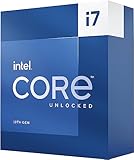
- 13th Gen Intel Core processors offer revolutionary design for beyond real-world performance. From extreme multitasking, immersive streaming, and faster creating, do what you do
- 16 cores (8 P-cores plus 8 E-cores) and 24 threads
- Up to 5.4 GHz unlocked. 30M Cache
- Integrated Intel UHD Graphics 770 included
- Compatible with Intel 600 series (might need BIOS update) and 700 series chipset-based motherboards
How to interpret results
- 1080p CPU-limited play: differences between processors are easiest to see, especially with high-end GPUs and high refresh-rate targets.
- 1440p: the gap usually narrows as the graphics workload grows; the 13700F remains suitable for mainstream and high-end cards.
- 4K: GPU limits dominate in many titles, so replacing a functioning 13700F may deliver less benefit than upgrading the graphics card.
- Frame-time consistency: average FPS alone is insufficient. Compare 1% lows using the same game build, memory, BIOS power behavior, GPU and Windows configuration.
There is no universal benchmark score for this processor. Intel’s performance-information guidance explains why workload, system configuration and test dates must accompany performance claims. E-core settings can affect individual games, but disabling them is not a general performance recommendation.
Productivity, creation and multitasking
The 8P+8E layout is well suited to workloads that scale across many threads: rendering, software compilation, compression, batch photo processing, virtual machines, streaming while gaming and heavy multitasking. It offers considerably more parallel capacity than mainstream six-core parts without requiring an i9-class processor.
Results are less predictable in lightly threaded applications, software with unusual scheduling behavior, or media workflows that specifically benefit from Quick Sync. Long all-core jobs also expose the limits of a small cooler or restrictive case. Use independent tests that identify the application version, memory, power limits and cooling rather than extrapolating from the specification sheet.
Power, temperature and cooling
“65 W” is the Processor Base Power, not a sustained consumption ceiling. Intel lists 219 W Maximum Turbo Power, and some boards apply enhanced limits that allow higher power for longer. That is why the same 13700F can be quiet in one system and hot or loud in another.
Rank #3

- Game Without Compromise. Play harder and work smarter with Intel Core 14th Gen processors
- 20 cores (8 P-cores plus 12 E-cores) and 28 threads. Integrated Intel UHD Graphics 770 included
- Up to 5.6 GHz with Turbo Boost Max Technology 3.0 gives you smooth game play, high frame rates, and rapid responsiveness
- Compatible with Intel 600-series (with potential BIOS update) or 700-series chipset-based motherboards
- DDR4 and DDR5 platform support cuts your load times and gives you the space to run the most demanding games
Practical cooler choices
- A substantial single-tower or dual-tower air cooler is the sensible baseline for sustained rendering, compiling and encoding.
- A 240 mm or larger liquid cooler can work when the case supports it and pump reliability is acceptable, but it is not automatically better than a high-end air cooler.
- Power-limited operation can make a smaller or quieter system practical, with some loss of sustained performance.
- Verify whether a particular boxed listing includes a cooler; do not assume every package does.
Temperature depends on ambient conditions, mounting pressure, thermal paste, airflow, fan curves, BIOS behavior, workload duration and silicon variation. The 100°C value is Intel’s operating/junction limit, not a recommended everyday target. A brief spike is not, by itself, proof of a defective processor.
Motherboard compatibility and selection
The CPU fits LGA1700 boards from the 600- and 700-series families, but socket fit alone does not guarantee a good build. Check the exact model’s BIOS support, memory type and power delivery. Intel’s compatibility guidance recommends checking the processor and motherboard support pages together.
What to check before buying
- BIOS revision with 13th-generation support, plus BIOS Flashback if possible.
- VRM heatsinks and documented power behavior for sustained loads.
- DDR4 or DDR5 support; these are different board versions and are not interchangeable.
- M.2 slots, PCIe layout, USB ports, networking and Wi-Fi features.
- Case format, CPU-cooler clearance and warranty support.
B660 and B760 boards are often the logical value choices for a locked processor when their VRMs and features are adequate. H670/H770 can make sense for additional expansion. Z690/Z790 is justified by connectivity, memory tuning or plans for an unlocked CPU—not simply because the chipset is premium. The cheapest entry-level board may be a false economy for sustained all-core work.
PC Slower Than It Used to Be?
A free scan shows the junk files, broken settings and background clutter dragging Windows down - then fixes them in one click.Free scan · Windows 10 & 11Outdated Drivers Are Slowing You Down
One free scan finds every outdated or missing driver and matches the right update for your exact hardware.Free scan · exact hardware matchDDR4 or DDR5?
Intel officially rates the processor for up to DDR4-3200 or DDR5-5600 in two channels. A board supports one memory type, so choose the memory and motherboard as a pair.
Rank #4

- 20 cores (8 P-cores + 12 E-cores) and 28 threads. Integrated Intel UHD Graphics 770 included.
- Performance hybrid architecture integrates two core microarchitectures, prioritizing and distributing workloads to optimize performance
- Up to 5.4 GHz unlocked. 33MB Cache
- Compatible with Intel 600-series (with potential BIOS update) and 700-series chipset-based motherboards
- Turbo Boost Max Technology 3.0 Frequency, and PCIe 5.0 & 4.0 support. DDR4 and DDR5 Memory support. RM1 thermal solution included.
- Choose DDR4 when you already own a good kit or the complete platform is materially cheaper.
- Choose DDR5 for a new build when the price premium is small and you want greater bandwidth or easier access to current kits.
- Use two matched modules for dual-channel operation. Real gains vary by game, timings, GPU and resolution; DDR5 is not automatically a major gaming upgrade.
Platform value in 2026
The processor launched with an Intel Recommended Customer Price of $359–$369, but that historical figure is not a current buying recommendation. In 2026, compare the complete system: CPU, motherboard, memory, cooler, graphics card, power supply, storage and case. Also account for whether parts are new, used, refurbished, boxed or tray, and record the retailer, region, date, shipping, tax, return policy and warranty.
LGA1700 is an older platform. A discounted 13700F can still be rational if you already own a compatible board and memory, or if a complete DDR4 build is substantially cheaper. A new platform may be preferable when upgradeability, efficiency, newer I/O or a current gaming-focused CPU matters more than the initial processor discount.
13700F versus the main alternatives
| Alternative | Choose it when | Main trade-off |
|---|---|---|
| Core i7-13700 | You need integrated graphics, Quick Sync or fallback display output | Usually costs more; exact market gap varies |
| Core i7-13700K/KF | You specifically want an unlocked multiplier and have stronger cooling and power delivery | Higher heat, power and platform cost; not automatically faster at stock limits |
| Lower-cost Core i5 | Gaming is the priority and your GPU or budget is more limited | Less multi-thread capacity |
| Newer Intel platform | You value current connectivity, efficiency or a longer upgrade path | May cost more as a complete platform |
| Current AMD gaming-oriented Ryzen | High-refresh gaming and frame-time performance are the priority | Gaming advantage and value depend on current CPU and platform prices |
| Higher-core-count productivity CPU | Your workload is dominated by long rendering, simulation or compilation jobs | Higher purchase price and often greater cooling requirements |
Buying checks and troubleshooting
No image after assembly
- Install a discrete GPU; the 13700F cannot produce display output by itself.
- Connect the monitor to the graphics card, not the motherboard.
- Check GPU seating and all required GPU power cables.
- Update the motherboard BIOS and consult its CPU-support list.
Unexpectedly high temperatures
- Check cooler mounting, protective film, thermal paste and fan or pump operation.
- Improve case intake and exhaust and verify the ambient temperature.
- Inspect BIOS-enhanced power limits and vendor multicore settings.
- Judge temperatures alongside workload duration, noise and throttling rather than one brief spike.
Crashes or instability
Use a current motherboard BIOS and Intel-default power behavior where available, especially with used or older-stock hardware. Claims about a specific microcode fix, affected batch, failure rate or warranty treatment must come from Intel or the motherboard manufacturer; user reports alone do not establish that every 13700F is affected.
Quick wins for a faster PC:
Clear out junk files and repair common Windows errorsFree Scan →Scan for outdated or missing drivers - takes under a minuteDriver Scan →Performance below expectations
- Confirm dual-channel memory and correct memory settings.
- Check for thermal throttling and restrictive power limits.
- Separate a GPU bottleneck from a CPU bottleneck.
- Close background tasks and compare only with tests using the same configuration.
Boxed versus tray listings
Intel lists both boxed and tray ordering variants. Packaging, included accessories, warranty handling and return rights can differ, so read the exact listing before paying a small discount for an uncertain source. See the Intel ordering information.
Who should buy the Core i7-13700F?
- Existing LGA1700 owners who need more multi-thread performance and can reuse their board and memory.
- New-build buyers who find the CPU and complete platform substantially cheaper than current alternatives.
- Users combining gaming with streaming, editing, compiling, rendering or virtual machines.
- Anyone already budgeting for a discrete GPU and a capable cooler.
Who should choose something else?
- Buyers who need display output without a graphics card or rely on Quick Sync.
- Small, quiet systems where the required cooling and power headroom are inconvenient.
- New-build shoppers paying near-current-platform prices while receiving an older socket and limited upgrade path.
- Gaming-only buyers whose budget would be better spent on a faster GPU or a newer gaming-focused CPU.
The Bottom Line
Bottom line: Buy the Core i7-13700F when its actual total-system price is compelling, especially as an LGA1700 upgrade. For a fresh 2026 build, compare the full cost and warranty of newer platforms, and pay extra for the standard i7-13700 if integrated graphics or Quick Sync matters.
Quick Recap
Product prices and availability are accurate as of the date/time indicated and are subject to change. Any price and availability information displayed on Amazon at the time of purchase will apply.




